

Open Instagram, YouTube or Amazon, everything loads instantly — even with millions of users.
Behind this speed lies one key system design concept: Caching.
For backend developers in India and across the global tech industry, understanding caching is essential for building scalable, high-performance applications.
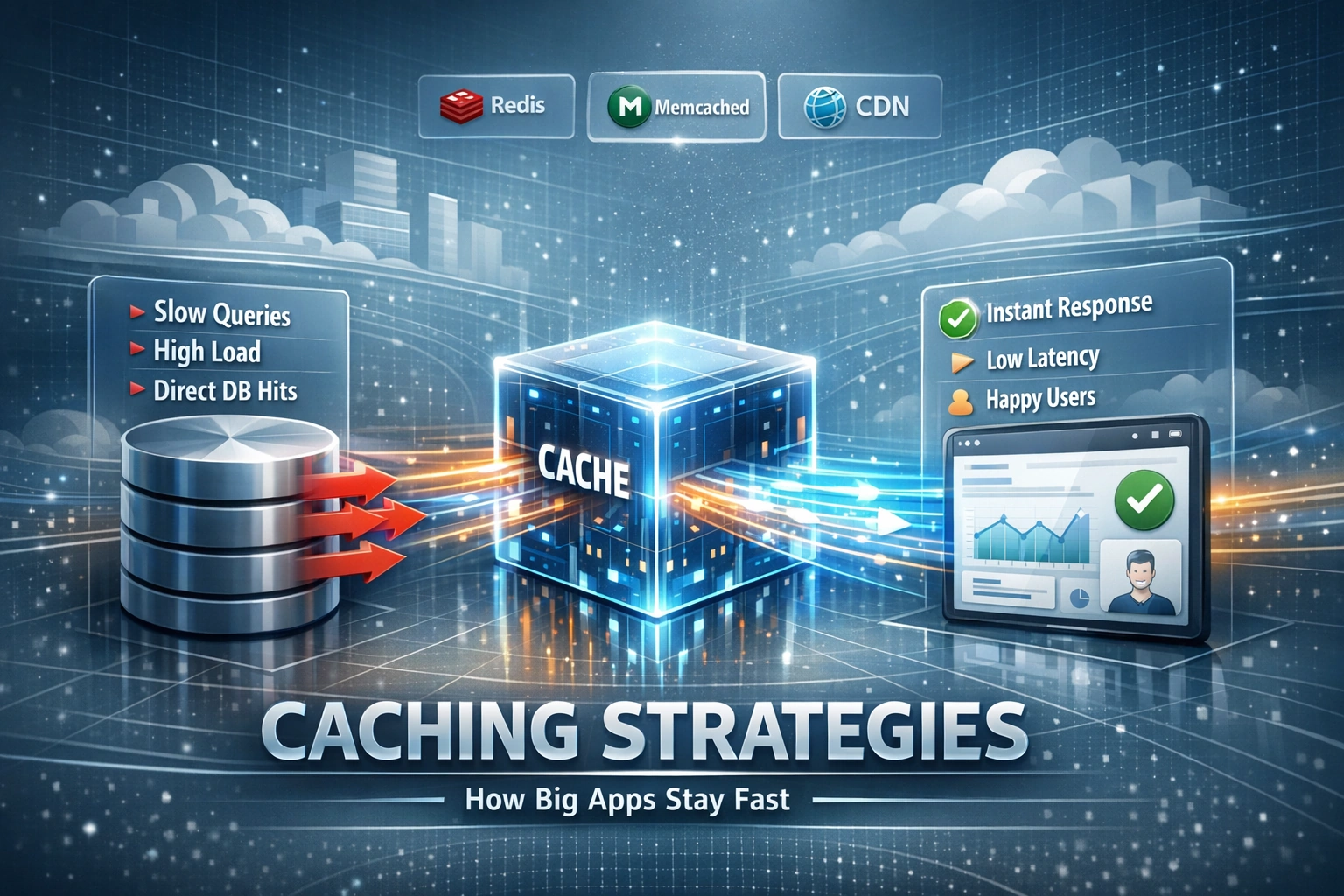
The Problem: Direct Database Access
When an app is small:
Every request hits the database
Performance remains manageable
But as users grow:
Queries become slower
Server load increases
Response time rises
Databases become bottlenecks
At internet scale, direct database access alone is not sustainable.
What is Caching?
Caching means:
Storing frequently used data in fast temporary storage.
This allows:
Faster response times
Fewer database queries
Better user experience
Simple idea: Don’t compute or fetch the same data again and again.
Why Big Apps Need Caching
High-traffic platforms face:
Millions of requests per second
Heavy database workloads
Global user distribution
Caching helps them achieve:
Instant content loading
Low latency
Reduced infrastructure cost
Scalable system performance
Types of Caching Used in Real Applications
1. Client-Side Caching
Browser stores images, CSS, JavaScript
Faster page reloads
Reduced server requests
2. Server-Side Caching
Backend stores pre-generated responses
Avoids repeated processing
Improves API response time
3. Database Caching
Frequently used queries stored in memory
Ultra-fast data retrieval
Reduces database pressure
Popular Caching Tools
Large-scale apps commonly use:
Redis – In-memory data store for fast caching
Memcached – Distributed memory caching
CDN (Content Delivery Network) – Serves content from nearest global servers
These tools form multiple caching layers in modern architectures.
Benefits of Caching
Caching delivers:
Faster application performance
Reduced database load
Better scalability
Lower operational cost
Improved user satisfaction
This is why companies like Netflix, Google, Meta, and Amazon rely heavily on caching.
Caching in System Design Interviews
A frequent interview question:
“How will you make your application faster?”
Expected answer:
“Implement an efficient caching strategy.”
Knowing caching concepts signals strong backend and system design understanding.
India and Global Demand for Backend Performance Skills
In India:
SaaS startups
Fintech platforms
EdTech applications
Enterprise systems
All require high-performance backend architectures.
Globally:
Cloud-native platforms
AI-driven services
Streaming and e-commerce giants
Depend on caching to handle massive scale.
Backend engineers who master caching gain strong career advantages.
Final Thoughts
Databases alone cannot handle internet-scale demand.
Caching bridges the gap between speed and scalability.
For developers in India and worldwide, mastering caching strategies is a crucial step toward becoming a high-level backend or system design engineer.
Join the conversation! Your thoughts help the community grow.