

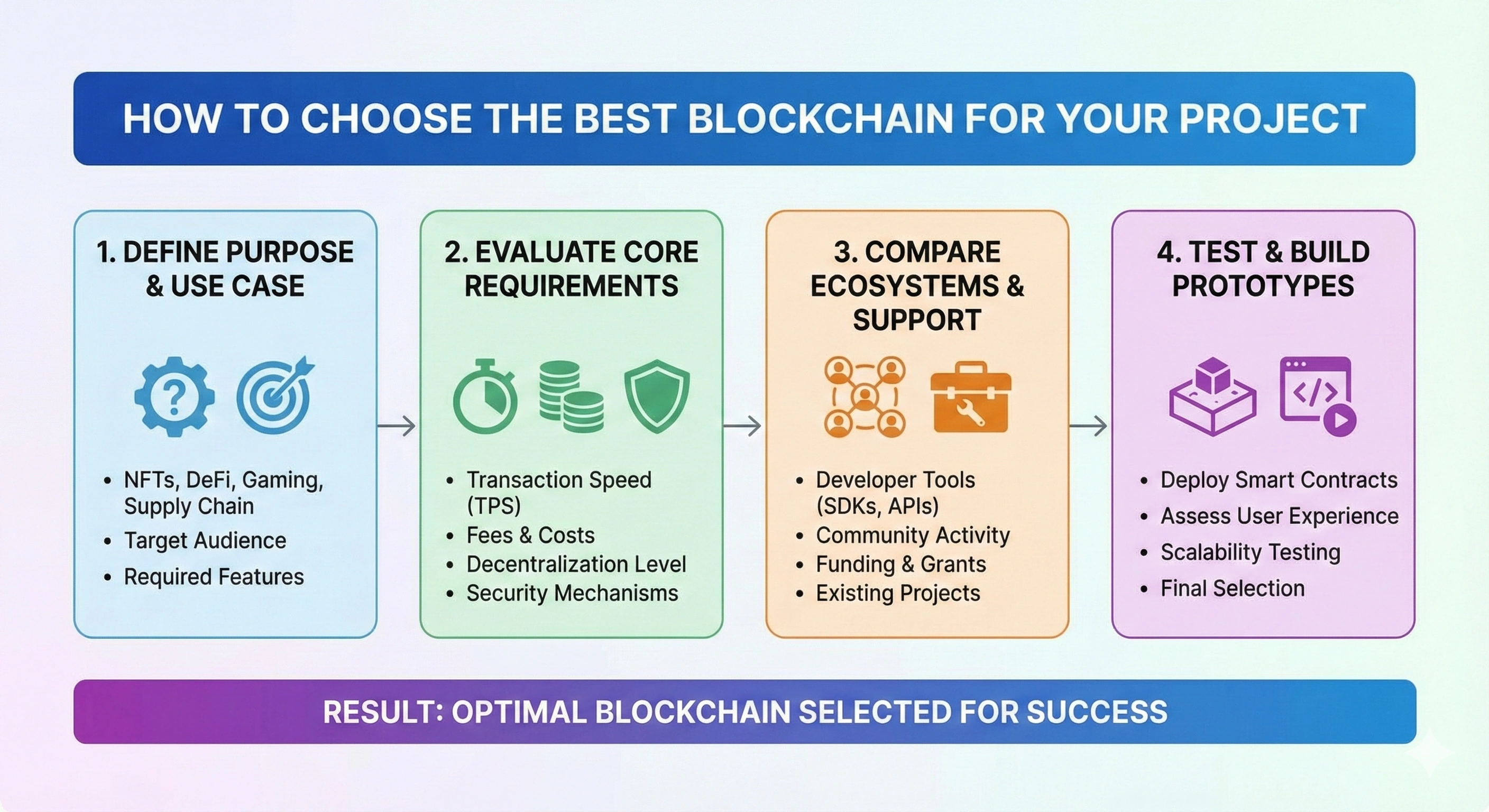
🎯 Step 1: Define what you are building
Most blockchain mistakes happen because teams pick a chain first, then try to force the product to fit.
Answer these in plain language:
What is the product: payments, DeFi, NFT, gaming, identity, RWA, enterprise records, DAO, data integrity
Who are users: crypto native, normal consumers, businesses, institutions
What is the “must win” metric: lowest fees, fastest UX, maximum security, best liquidity, easiest integrations, compliance readiness
What is the risk tolerance: experimental or conservative
If you cannot explain your use case in 1 sentence, you are not ready to choose a chain.
🧱 Step 2: Decide L1 vs L2 vs Appchain
L1 is a base chain like Ethereum, Solana, Avalanche
Best when you need maximum independence, unique architecture, or you are building core infrastructure.L2 is a scaling network that settles to an L1, especially common on Ethereum
Best when you want Ethereum security plus better fees and UX.Appchain is your own chain optimized for your app, often using frameworks like Cosmos SDK, Substrate, or Avalanche subnets
Best when you need custom rules, predictable fees, and high throughput at scale.
Rule of thumb: most startups should start on an existing L2 or major L1, and only move to an appchain when usage proves it.
⚖️ Step 3: Score chains on the factors that actually matter
💸 Fees and UX
If your app needs frequent actions like gaming, social, micro rewards, consider low fee environments.
If every click costs noticeable money, your growth will stall.
⚡ Speed and finality
Users feel latency. Some chains feel like Web2, others feel slow during congestion.
Ask: how fast does a transaction become “done enough” for my product.
🛡️ Security and battle testing
Security is not just code audits. It is:
Network security and validator decentralization
History of incidents and how they were handled
Maturity of developer security tooling
If you are handling large value, conservative wins.
🌍 Ecosystem and distribution
This is the hidden growth lever. A chain with a strong ecosystem gives you:
Wallet integrations and onramps
Liquidity, DEX depth, stablecoins
Dev tooling, SDKs, infra providers
Grants, accelerators, partner introductions
A “technically better” chain can still lose if it has weak distribution.
🧑💻 Developer experience
Look at:
Language and tooling comfort for your team
Debugging and testing maturity
Availability of experienced auditors and engineers
EVM ecosystems tend to win here due to depth of talent and tooling.
🏛️ Compliance and enterprise readiness
If you touch RWAs, healthcare, finance, or institutional users, you will care about:
Identity and permissioning options
Audit trails and data controls
Regulated stablecoin support and onramps
Not every chain is equally friendly for compliance heavy products.
🔥 Practical chain mapping by common use case
DeFi and token liquidity first: Ethereum and major Ethereum L2s are often the safest bet because liquidity and composability matter
Consumer scale apps like games and social: chains optimized for low fees and fast UX can win
Enterprise and regulated workflows: look for strong identity, permissioning options, and mature vendor support
RWAs: prioritize compliance tooling, stablecoin rails, custody ecosystem, and institutional integrations
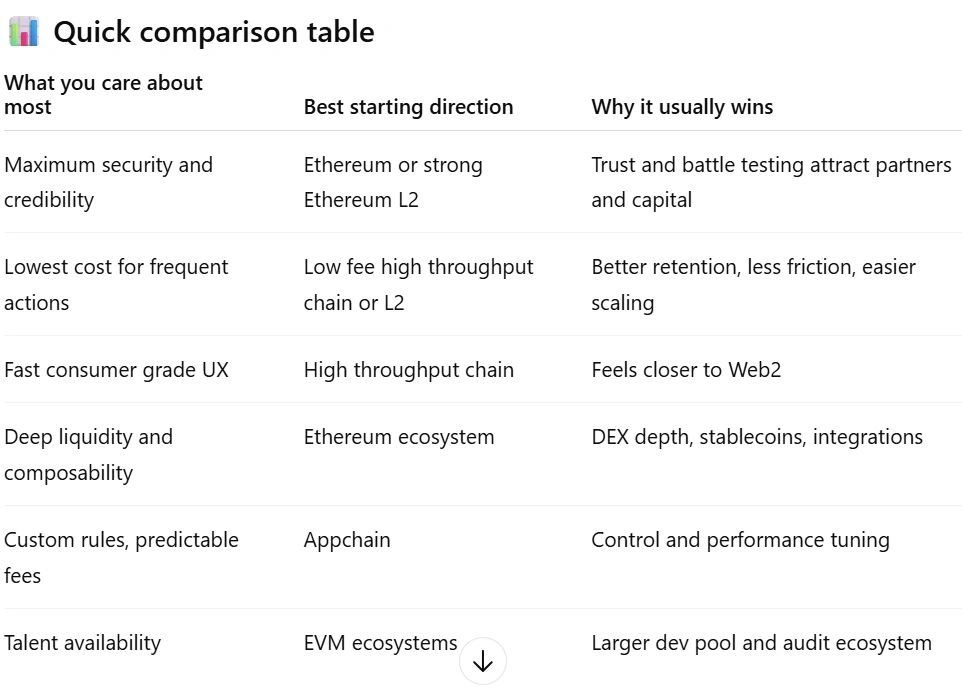
📊 Quick comparison table
🧪 Step 4: Run a simple decision test before committing
Do this before you pick:
Build a minimal prototype on your top 2 chains
Measure real costs for 1000 typical user actions
Check wallet flow friction on mobile
Confirm your top 5 integrations exist: wallet, indexer, RPC, analytics, fiat onramp
Talk to 2 auditor firms and ask which chain they see most incidents on in your category
If a chain fails basics like wallet UX, infra reliability, or developer speed, it is not “best” for you.
✅ Step 5: Avoid the most common mistakes
Picking a chain because it is trending on X
Ignoring ecosystem and liquidity
Assuming TPS alone means better UX
Underestimating bridging complexity across chains
Optimizing for fees so hard that you sacrifice trust
🧠 Final takeaway
The “best blockchain” is the one that matches your product’s constraints, user experience needs, security requirements, and go to market distribution. If you are early, pick the chain that helps you ship fastest with the least friction, while keeping a credible path to scale.
🔍 Need Expert Blockchain Advisory and Consulting?
Choosing the right blockchain is not just a technical decision. It directly impacts security, scalability, regulatory readiness, developer velocity, liquidity, and long-term cost. A wrong choice can lock your product into years of friction and expensive migrations.
If you are evaluating blockchains for a token, DeFi platform, enterprise system, RWA project, or AI-driven application and want an experienced, vendor-neutral perspective, C# Corner Consulting provides end-to-end blockchain advisory and architecture guidance.
C# Corner brings decades of real-world engineering, enterprise architecture, and large-scale platform experience across Web3, AI, cloud, and regulated industries. The focus is practical execution, not hype driven recommendations.
👉 Learn more or request an advisory session:
https://www.c-sharpcorner.com/consulting
Join the conversation! Your thoughts help the community grow.