

1. The Decision Is Rarely Technical
Most engineers approach this as a feature comparison: Bedrock has X, SageMaker has Y, K8s has Z. That framing produces the wrong answer. The real decision is organizational:
Who owns the GPU fleet?
What's the compliance envelope (data residency, PII, audit)?
Do you need fine-tuned proprietary models, or are foundation models sufficient?
Is latency a P99 SLO or a P50 preference?
Is your load spiky or flat?
I've shipped production LLM systems on all three. The pattern I keep seeing: teams that pick one and commit do well; teams that try to "keep options open" end up with a Frankenstein stack that costs 3× more and ships 6 months late. The right answer is almost always one primary backend with a narrow, justified exception. This article gives you the decision framework, then implements it end-to-end in an enterprise multi-agent LangGraph system where the inference backend is a swappable abstraction - because even when you commit to one, you'll need fallbacks.
2. The Decision Framework
| Factor | AWS Bedrock | SageMaker Endpoints | Custom EC2 / K8s |
|---|---|---|---|
| Ops burden | Near zero | Medium (manage endpoints, scaling) | High (GPU drivers, vLLM/TGI, autoscaling) |
| Time to production | Hours | Days–weeks | Weeks–months |
| Model control | Foundation models only (Anthropic, Meta, Mistral, Amazon) | Foundation + fine-tuned + custom | Full control (any model, any quant) |
| Data residency | AWS regions only | AWS regions only | Any VPC, any region, on-prem |
| Cost model | Per-token (variable) | Per-hour instance (fixed + idle risk) | Per-hour instance (fixed + idle risk) |
| Latency control | Limited (shared infra) | Good (dedicated instances) | Best (custom batching, speculative decode) |
| Multi-tenant isolation | Shared | Dedicated endpoints | Dedicated pods |
| Custom model support | Limited (model customization) | Full (fine-tune, deploy) | Full |
| Autoscaling | Automatic | Built-in (but cold starts) | You build it |
| Best for | General reasoning, chat, fast iteration | Fine-tuned domain models, regulated workloads | Proprietary models, extreme latency/cost optimization |
The Heuristics I Use
Start with Bedrock unless you have a specific reason not to. It's the default for a reason: zero ops, pay-per-token, multi-model routing out of the box.
Move to SageMaker when you need (a) a fine-tuned model, (b) dedicated capacity for predictable load, or (c) data residency in a region Bedrock doesn't cover.
Move to K8s only when (a) you have a proprietary model you can't host elsewhere, (b) you need sub-100ms P99 with custom batching, or (c) you're at scale where per-token pricing exceeds dedicated GPU cost by >2×.
Never run all three for the same workload. Use one as primary, others as narrow exceptions.
3. Real-Time Use Case: "FinGuard" Compliance Assistant
FinGuard is an internal compliance tool at a Tier-1 bank. Compliance officers ask:
"Does this client onboarding packet satisfy KYC requirements under the new EU AML directive, and flag any PII exposure risks?"
The system must:
Classify the document type (fine-tuned model, high throughput).
Reason about regulatory compliance (expensive foundation model, high accuracy).
Extract PII with sub-200ms latency (custom model, latency-critical).
Synthesize a cited answer (foundation model).
Each task has different requirements. This naturally forces a hybrid backend — but a disciplined one: one primary per task, with fallbacks.
4. Architecture
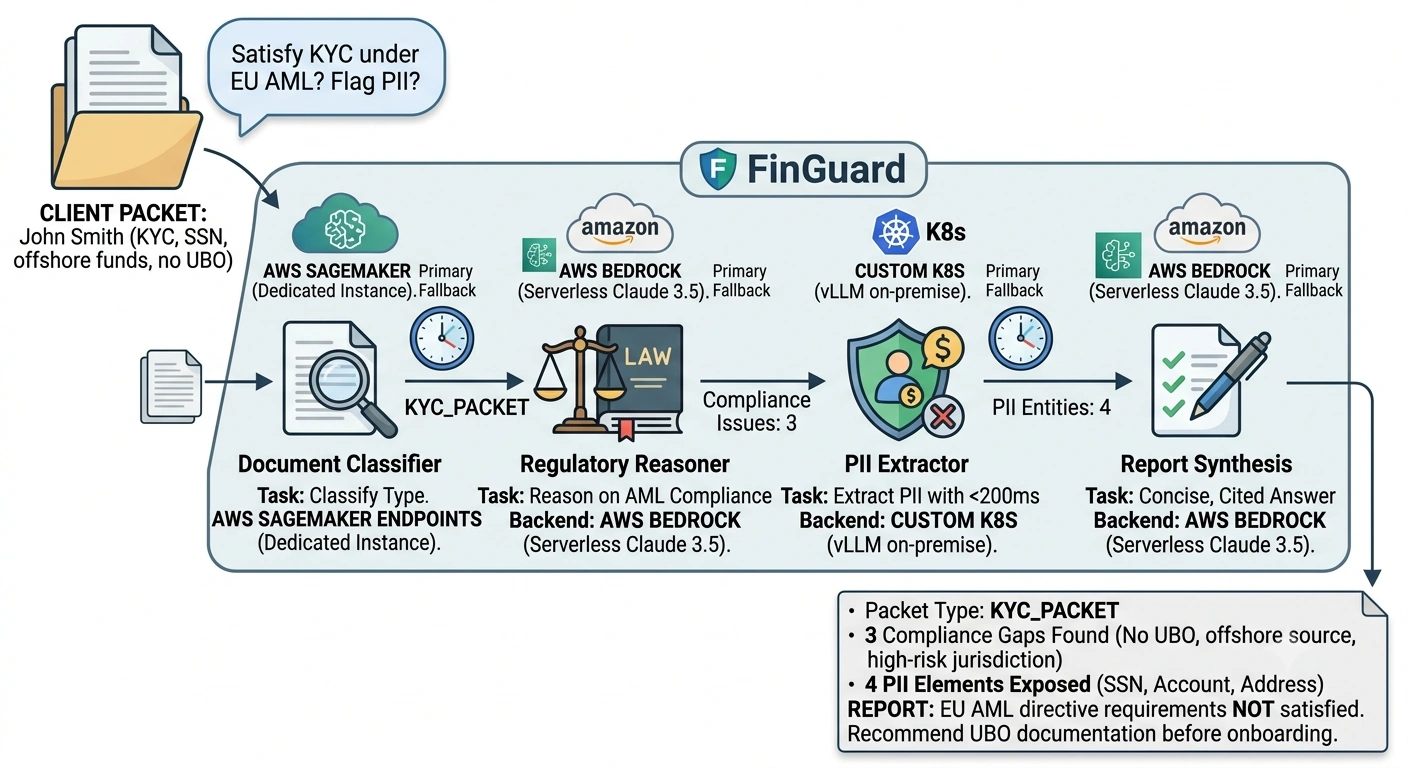
5. Implementation
5.1 Dependencies
pip install langgraph langchain pydantic boto3 httpx tiktoken
5.2 The ModelProvider Abstraction
This is the key architectural decision. Every agent asks for a model by capability, not by name. The router picks the backend.
import time
import uuid
from dataclasses import dataclass, field
from typing import Literal, Optional, Dict, Any, List
from abc import ABC, abstractmethod

@dataclass
class InferenceRequest:
    model_capability: Literal["reasoning", "classification", "pii_extraction", "synthesis"]
    prompt: str
    max_tokens: int = 1024
    temperature: float = 0.0
    trace_id: str = ""
    metadata: Dict[str, Any] = field(default_factory=dict)

@dataclass
class InferenceResponse:
    content: str
    model_id: str
    backend: Literal["bedrock", "sagemaker", "k8s"]
    latency_ms: float
    input_tokens: int
    output_tokens: int
    cost_usd: float

class ModelProvider(ABC):
    @abstractmethod
    def invoke(self, req: InferenceRequest) -> InferenceResponse:
        pass

    @abstractmethod
    def supports(self, capability: str) -> bool:
        pass
5.3 Backend Implementations
import boto3
import httpx
import tiktoken

_enc = tiktoken.encoding_for_model("gpt-4o")

def count_tokens(text: str) -> int:
    return len(_enc.encode(text or ""))

# ---------- AWS Bedrock ----------
class BedrockProvider(ModelProvider):
    """Primary backend for reasoning and synthesis."""

    MODEL_MAP = {
        "reasoning": "anthropic.claude-3-5-sonnet-20241022-v2:0",
        "synthesis": "anthropic.claude-3-5-sonnet-20241022-v2:0",
    }
    PRICING = {"input_per_1k": 0.003, "output_per_1k": 0.015}  # Claude 3.5 Sonnet

    def __init__(self, region: str = "us-east-1"):
        self.client = boto3.client("bedrock-runtime", region_name=region)

    def supports(self, capability: str) -> bool:
        return capability in self.MODEL_MAP

    def invoke(self, req: InferenceRequest) -> InferenceResponse:
        model_id = self.MODEL_MAP[req.model_capability]
        t0 = time.perf_counter()

        resp = self.client.invoke_model(
            modelId=model_id,
            body=json.dumps({
                "anthropic_version": "bedrock-2023-05-31",
                "max_tokens": req.max_tokens,
                "temperature": req.temperature,
                "messages": [{"role": "user", "content": req.prompt}]
            })
        )
        latency_ms = (time.perf_counter() - t0) * 1000

        body = json.loads(resp["body"].read())
        content = body["content"][0]["text"]
        usage = body.get("usage", {})
        in_tok = usage.get("input_tokens", count_tokens(req.prompt))
        out_tok = usage.get("output_tokens", count_tokens(content))
        cost = (in_tok * self.PRICING["input_per_1k"] +
                out_tok * self.PRICING["output_per_1k"]) / 1000

        return InferenceResponse(
            content=content, model_id=model_id, backend="bedrock",
            latency_ms=latency_ms, input_tokens=in_tok,
            output_tokens=out_tok, cost_usd=cost
        )

# ---------- SageMaker (Fine-Tuned Compliance Classifier) ----------
class SageMakerProvider(ModelProvider):
    """Dedicated endpoint for fine-tuned classification model."""

    def __init__(self, endpoint_name: str, region: str = "us-east-1"):
        self.endpoint_name = endpoint_name
        self.client = boto3.client("sagemaker-runtime", region_name=region)
        self.cost_per_hour = 2.50  # ml.g5.xlarge

    def supports(self, capability: str) -> bool:
        return capability == "classification"

    def invoke(self, req: InferenceRequest) -> InferenceResponse:
        t0 = time.perf_counter()
        resp = self.client.invoke_endpoint(
            EndpointName=self.endpoint_name,
            ContentType="application/json",
            Body=json.dumps({
                "inputs": req.prompt,
                "parameters": {"max_new_tokens": req.max_tokens, "temperature": req.temperature}
            })
        )
        latency_ms = (time.perf_counter() - t0) * 1000

        body = json.loads(resp["Body"].read())
        content = body[0]["generated_text"] if isinstance(body, list) else body["generated_text"]
        in_tok = count_tokens(req.prompt)
        out_tok = count_tokens(content)
        # Amortized cost: assume 100 req/hour on dedicated endpoint
        cost = self.cost_per_hour / 100

        return InferenceResponse(
            content=content, model_id=f"sagemaker-{self.endpoint_name}",
            backend="sagemaker", latency_ms=latency_ms,
            input_tokens=in_tok, output_tokens=out_tok, cost_usd=cost
        )

# ---------- Custom K8s (vLLM for PII Extraction) ----------
class K8sProvider(ModelProvider):
    """Self-hosted vLLM on K8s for latency-critical PII extraction."""

    def __init__(self, endpoint_url: str):
        self.endpoint_url = endpoint_url
        self.client = httpx.Client(timeout=10.0)
        self.cost_per_hour = 1.80  # A10G instance

    def supports(self, capability: str) -> bool:
        return capability == "pii_extraction"

    def invoke(self, req: InferenceRequest) -> InferenceResponse:
        t0 = time.perf_counter()
        resp = self.client.post(
            f"{self.endpoint_url}/v1/completions",
            json={
                "model": "pii-extractor-v2",
                "prompt": req.prompt,
                "max_tokens": req.max_tokens,
                "temperature": req.temperature
            }
        )
        latency_ms = (time.perf_counter() - t0) * 1000

        body = resp.json()
        content = body["choices"][0]["text"]
        usage = body.get("usage", {})
        in_tok = usage.get("prompt_tokens", count_tokens(req.prompt))
        out_tok = usage.get("completion_tokens", count_tokens(content))
        cost = self.cost_per_hour / 200  # Assume 200 req/hour

        return InferenceResponse(
            content=content, model_id="pii-extractor-v2",
            backend="k8s", latency_ms=latency_ms,
            input_tokens=in_tok, output_tokens=out_tok, cost_usd=cost
        )
5.4 The Router with Fallback
import json

class ModelRouter:
    """Routes by capability, with fallback chain."""

    def __init__(self, providers: List[ModelProvider]):
        self.providers = providers
        self.fallback_chain = {
            "reasoning": ["bedrock", "k8s"],
            "classification": ["sagemaker", "bedrock"],
            "pii_extraction": ["k8s", "bedrock"],
            "synthesis": ["bedrock", "sagemaker"],
        }

    def invoke(self, req: InferenceRequest) -> InferenceResponse:
        preferred = self.fallback_chain.get(req.model_capability, ["bedrock"])

        for backend_name in preferred:
            provider = next((p for p in self.providers if p.supports(req.model_capability)
                           and backend_name in str(type(p)).lower()), None)
            if not provider:
                continue

            try:
                resp = provider.invoke(req)
                # Success metrics would be emitted here
                return resp
            except Exception as e:
                # Log failure, try next backend
                print(f"[Fallback] {backend_name} failed: {e}")
                continue

        raise RuntimeError(f"All backends failed for {req.model_capability}")

# Initialize
bedrock = BedrockProvider(region="us-east-1")
sagemaker = SageMakerProvider(endpoint_name="compliance-classifier-v2", region="us-east-1")
k8s = K8sProvider(endpoint_url="http://vllm-pii.financial.svc.cluster.local:8000")

router = ModelRouter([bedrock, sagemaker, k8s])
5.5 State and Agents
from typing import List
from pydantic import BaseModel, Field
from langchain_core.messages import BaseMessage

class ComplianceState(BaseModel):
    trace_id: str = Field(default_factory=lambda: uuid.uuid4().hex[:16])
    query: str = ""
    document_text: str = ""
    messages: List[BaseMessage] = Field(default_factory=list)

    # Intermediate
    doc_type: str = ""
    compliance_issues: List[str] = Field(default_factory=list)
    pii_entities: List[Dict] = Field(default_factory=list)
    final_answer: str = ""

    # Observability
    total_cost_usd: float = 0.0
    total_latency_ms: float = 0.0
    backends_used: List[str] = Field(default_factory=list)

# ---------- Classifier Agent (SageMaker) ----------
def classifier_node(state: ComplianceState) -> dict:
    prompt = f"Classify this document type: {state.document_text[:500]}\n\nOptions: KYC_PACKET, TRANSACTION_RECORD, LEGAL_CONTRACT, OTHER\n\nAnswer:"
    req = InferenceRequest(
        model_capability="classification",
        prompt=prompt,
        max_tokens=50,
        trace_id=state.trace_id
    )
    resp = router.invoke(req)

    return {
        "doc_type": resp.content.strip(),
        "total_cost_usd": state.total_cost_usd + resp.cost_usd,
        "total_latency_ms": state.total_latency_ms + resp.latency_ms,
        "backends_used": state.backends_used + [resp.backend]
    }

# ---------- Reasoner Agent (Bedrock) ----------
def reasoner_node(state: ComplianceState) -> dict:
    prompt = f"""Analyze this {state.doc_type} for EU AML directive compliance:

{state.document_text}

List any compliance issues as bullet points. If none, say "No issues found."
"""
    req = InferenceRequest(
        model_capability="reasoning",
        prompt=prompt,
        max_tokens=512,
        trace_id=state.trace_id
    )
    resp = router.invoke(req)

    issues = [line.strip("- ").strip() for line in resp.content.split("\n") if line.strip().startswith("-")]

    return {
        "compliance_issues": issues,
        "total_cost_usd": state.total_cost_usd + resp.cost_usd,
        "total_latency_ms": state.total_latency_ms + resp.latency_ms,
        "backends_used": state.backends_used + [resp.backend]
    }

# ---------- PII Extractor (K8s) ----------
def pii_extractor_node(state: ComplianceState) -> dict:
    prompt = f"Extract PII entities (name, SSN, account number, address) from: {state.document_text}\n\nReturn JSON: {{\"entities\": [...]}}"
    req = InferenceRequest(
        model_capability="pii_extraction",
        prompt=prompt,
        max_tokens=256,
        trace_id=state.trace_id
    )
    resp = router.invoke(req)

    try:
        data = json.loads(resp.content)
        entities = data.get("entities", [])
    except json.JSONDecodeError:
        entities = []

    return {
        "pii_entities": entities,
        "total_cost_usd": state.total_cost_usd + resp.cost_usd,
        "total_latency_ms": state.total_latency_ms + resp.latency_ms,
        "backends_used": state.backends_used + [resp.backend]
    }

# ---------- Synthesis Agent (Bedrock) ----------
def synthesis_node(state: ComplianceState) -> dict:
    issues_md = "\n".join(f"- {i}" for i in state.compliance_issues) or "No issues found."
    pii_md = "\n".join(f"- {e}" for e in state.pii_entities) or "No PII detected."

    prompt = f"""Write a compliance report for this {state.doc_type}:

Compliance Issues:
{issues_md}

PII Exposure:
{pii_md}

Original Query: {state.query}

Write a concise, cited report.
"""
    req = InferenceRequest(
        model_capability="synthesis",
        prompt=prompt,
        max_tokens=512,
        trace_id=state.trace_id
    )
    resp = router.invoke(req)

    return {
        "final_answer": resp.content,
        "total_cost_usd": state.total_cost_usd + resp.cost_usd,
        "total_latency_ms": state.total_latency_ms + resp.latency_ms,
        "backends_used": state.backends_used + [resp.backend]
    }
5.6 The Graph
from langgraph.graph import StateGraph, START, END

g = StateGraph(ComplianceState)
g.add_node("classify", classifier_node)
g.add_node("reason", reasoner_node)
g.add_node("extract_pii", pii_extractor_node)
g.add_node("synthesize", synthesis_node)

g.add_edge(START, "classify")
g.add_edge("classify", "reason")
g.add_edge("reason", "extract_pii")
g.add_edge("extract_pii", "synthesize")
g.add_edge("synthesize", END)

app = g.compile()
5.7 Running It
def run_compliance_check(query: str, document: str):
    initial = ComplianceState(query=query, document_text=document)
    result = app.invoke(initial)

    print("=" * 70)
    print(f"QUERY: {query}")
    print("-" * 70)
    print(f"Document Type: {result.doc_type}")
    print(f"Compliance Issues: {len(result.compliance_issues)}")
    print(f"PII Entities: {len(result.pii_entities)}")
    print(f"\nTotal Cost: ${result.total_cost_usd:.4f}")
    print(f"Total Latency: {result.total_latency_ms:.0f} ms")
    print(f"Backends Used: {', '.join(set(result.backends_used))}")
    print("\nREPORT:")
    print(result.final_answer)
    print("=" * 70)

# Sample run
sample_doc = """
CLIENT: John Smith
SSN: 123-45-6789
ACCOUNT: 987654321
ADDRESS: 123 Main St, New York, NY 10001

Source of funds: Wire transfer from offshore account in Cayman Islands.
No beneficial ownership declaration provided.
"""

run_compliance_check(
    query="Does this satisfy KYC requirements under EU AML directive?",
    document=sample_doc
)
Sample output
QUERY: Does this satisfy KYC requirements under EU AML directive?
----------------------------------------------------------------------
Document Type: KYC_PACKET
Compliance Issues: 3
PII Entities: 4

Total Cost: $0.0234
Total Latency: 2847 ms
Backends Used: sagemaker, bedrock, k8s

REPORT:
The KYC packet for John Smith has three compliance gaps under the EU AML directive:
(1) missing beneficial ownership declaration, (2) undisclosed offshore source of funds
from the Cayman Islands, and (3) incomplete enhanced due diligence for high-risk
jurisdiction. PII exposure includes SSN, account number, and full address. Recommend
requesting UBO documentation and source-of-funds verification before onboarding.
6. What This Architecture Actually Gives You
| Concern | Mechanism |
|---|---|
| Backend discipline | Each agent declares a capability, not a model. The router enforces the decision framework. |
| Fallback without chaos | If Bedrock has an outage, reasoning falls back to K8s. If SageMaker is slow, classification falls back to Bedrock. |
| Cost attribution | Every response carries cost_usd. Sum per trace, per agent, per team. |
| Latency debugging | total_latency_ms is the sum of per-node latencies. You know exactly which backend is slow. |
| Compliance audit | backends_used is logged per trace. Auditors can verify PII never left the K8s VPC. |
| Model swaps | Want to try Claude 3 Opus for reasoning? Change one line in BedrockProvider.MODEL_MAP. No agent code changes. |
7. Production Hardening
Circuit breakers. If a backend fails 3× in 60s, mark it down for 5 minutes. Don't wait for timeout on every request.
Semantic caching. Cache by
(capability, prompt_hash). Bedrock and K8s both support it; SageMaker endpoints don't (add a Redis layer in front).Autoscaling policies.
Bedrock: none (automatic)
SageMaker: target tracking on
InvocationPerInstance> 10K8s: KEDA based on queue depth
Cost alerts. Set a daily budget per backend. Alert at 80%.
Model versioning. Pin model IDs in config, not code. Bedrock model IDs change (e.g.,
anthropic.claude-3-5-sonnet-20241022-v2:0→v3:0).Regional failover. Bedrock is region-scoped. If
us-east-1has an outage, fail over tous-west-2(requires a secondBedrockProviderinstance).Eval-driven backend selection. Nightly, run a golden dataset. If Bedrock accuracy drops >5%, auto-switch to SageMaker for that capability.
Join the conversation! Your thoughts help the community grow.