

Introduction
When I started working with Microsoft Fabric, one of the first architectural decisions I had to make was whether to use a Lakehouse or a Warehouse.
Initially, I thought both were simply different places to store data. However, while implementing an end-to-end project, I realized that the decision is much bigger than that. The right choice depends on how the data will be processed, who will consume it, and what the business is trying to achieve.
In this article, I'll share one of my Microsoft Fabric projects and explain why I chose a Lakehouse over a Warehouse.
Business Scenario
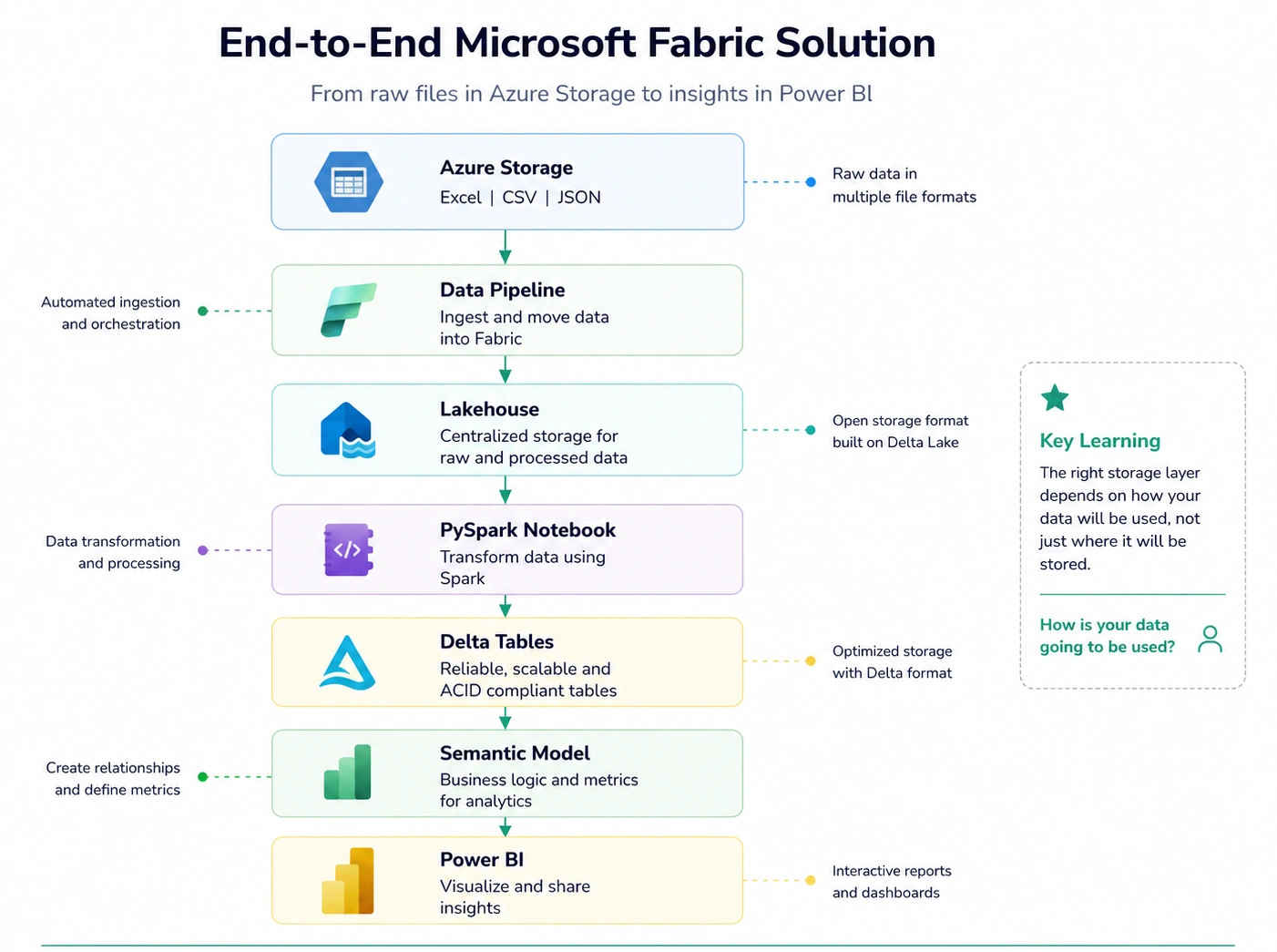
The project requirement was to build an end-to-end analytics solution using Microsoft Fabric.
The source data was stored in Azure Storage and consisted of three different file formats:
Orders.xlsx
Products.csv
Returns.json
The business requirement was to:
Load the files into Microsoft Fabric.
Transform the data using PySpark.
Store the transformed data as Delta Tables.
Build a Semantic Model.
Create a Power BI report for business users.
At first, the implementation looked straightforward. However, one design decision made me stop and think.
Should I use a Lakehouse or a Warehouse?
Solution Architecture
My Initial Thought Process
Since the final goal was reporting, my first instinct was to use a Warehouse.
But before building the solution, I asked myself one simple question.
How will this data be used before it reaches the report?
The answer changed everything.
The project required:
Reading multiple file formats
Spark-based transformations
PySpark notebooks
Delta Tables
A scalable architecture for future enhancements
These requirements clearly aligned with a Lakehouse.
Why I Chose a Lakehouse
A Lakehouse was the right choice for this project because it allowed me to:
Load data from multiple file formats without any issues.
Use Spark notebooks for transformations.
Store data as Delta Tables.
Build a scalable foundation for future Bronze, Silver, and Gold layers.
Integrate seamlessly with Semantic Models and Power BI.
The flexibility of a Lakehouse made it a natural fit for this project
When Would I Choose a Warehouse?
A Warehouse is an excellent option when:
Most users are comfortable with SQL.
The data is already structured.
Business reporting is the primary requirement.
Spark processing is not needed.
The workload focuses mainly on analytics and reporting.
In those scenarios, a Warehouse provides a familiar SQL-first experience.
| Feature | Lakehouse | Warehouse |
|---|---|---|
| Data Types | Structured & Semi-Structured | Structured |
| Processing Engine | Apache Spark | SQL Engine |
| Delta Tables | Yes | Managed Internally |
| PySpark Support | Yes | No |
| Best For | Data Engineering, ELT, Data Science | SQL Analytics & Reporting |
Key Learning from This Project
Before working on this project, my thought process was:
"Where should I store my data?"
After implementing the solution, my thinking changed completely.
Now I ask:
"How is this data going to be used?"
That single question usually leads to the right architectural decision.
Technology should always support the business requirement—not the other way around.
Best Practices
While implementing similar solutions in Microsoft Fabric, consider these practices:
Understand the complete business workflow before selecting Fabric components.
Use a Lakehouse when Spark processing and multiple file formats are involved.
Use a Warehouse when SQL-based reporting is the primary objective.
Store transformed data as Delta Tables to take advantage of Delta Lake features.
Design the solution keeping future scalability in mind.
Common Mistakes
Some common mistakes engineers make while starting with Microsoft Fabric include:
Choosing a component without understanding the complete business requirement.
Assuming Lakehouse and Warehouse are competing technologies.
Ignoring future scalability while designing the solution.
Treating every workload as purely SQL-based.
Questions an Interviewer Might Ask
1. Why did you choose a Lakehouse instead of a Warehouse?
Because the project required PySpark transformations, Delta Tables, and support for multiple file formats. A Lakehouse is designed for these workloads.
2. When would you choose a Warehouse instead?
When the workload is primarily SQL-based, the data is structured, and reporting is the main objective.
3. Can Lakehouse and Warehouse be used together?
Yes.
A common enterprise architecture is to use a Lakehouse for ingestion and transformation, while exposing curated business data through a Warehouse for SQL analytics and reporting.
4. What was the most important factor behind your decision?
Understanding how the data would be consumed.
The storage layer should be selected based on the complete data journey rather than the source system alone.
5. Can this architecture be extended in the future?
Absolutely.
The Lakehouse can later be expanded into a complete Medallion Architecture with Bronze, Silver, and Gold layers. Additional pipelines, incremental loading, and enterprise governance can also be introduced without redesigning the entire solution.
Conclusion
One of the biggest lessons I learned from this project is that Microsoft Fabric offers multiple components because different business problems require different solutions.
There isn't a single correct answer.
Choosing between a Lakehouse and a Warehouse should always begin with understanding the business requirement, the data processing needs, and how the data will be consumed.
For this project, a Lakehouse was the right choice because the solution involved Spark transformations, multiple file formats, Delta Tables, and future scalability.
As I continue exploring Microsoft Fabric, I plan to share more practical implementation experiences and the design decisions behind them. I hope these articles help others who are learning Fabric or preparing for real-world projects and interviews.
Join the conversation! Your thoughts help the community grow.