

What is Claude Opus 4.5?
Claude Opus 4.5 is Anthropic’s most powerful AI model and is considered one of the top models in the industry for coding, AI agents, computer use, and complex enterprise workflows. It supports a 200K token context window and up to 64K tokens of output, which makes it suitable for production-grade code, advanced agents, office automation, financial analysis, cybersecurity, and general computer use.
This model is available in Azure AI Foundry as part of the “Models from Partners and Community” category, where Anthropic provides the Claude family of models. These models support both text and image input, text output, multilingual capabilities, and strong vision features.
Models from Partners and Community
In Azure AI Foundry, most models come from trusted third‑party organizations, partners, research labs, and the open community. Anthropic’s Claude models are one example of these partner models, offering advanced language and vision capabilities.
Key characteristics of partner and community models include:
Developed and supported by external providers and contributors
Wide range of specialized models for niche and broad use cases
Usually validated by the model provider, with Azure integration guidance
Fast access to cutting‑edge models through community innovation
Standard Azure AI integration, with support and maintenance done by each provider
These models can be deployed either on Managed Compute or as serverless API endpoints, depending on what the model provider supports.
Key Capabilities of Claude Opus 4.5
Claude Opus 4.5 focuses on being highly intelligent and practical for real applications across coding, agents, and enterprise workflows. Some major capabilities are:
Extended thinking: Gives the model stronger reasoning skills to handle complex, multi‑step tasks more reliably.
Image and text input: With strong vision capabilities, it can analyze images like charts, graphs, technical diagrams, and reports, and return helpful text explanations.
Computer use: It is Anthropic’s most accurate model for “computer use”, meaning it can be guided to interact with a computer similar to how a human would, supporting browsing, workflow automation, and richer user experiences.
Advanced tool use: Developers can build agents that call tools programmatically, use a tool search feature, and learn from tool use examples to take actions in external systems.
200:

{
  "content": [
    {
      "text": "Hi! My name is Claude.",
      "type": "text"
    }
  ],
  "id": "msg_013Zva2CMHLNnXjNJJKqJ2EF",
  "model": "claude-opus-4-5-20251101",
  "role": "assistant",
  "stop_reason": "end_turn",
  "stop_sequence": null,
  "type": "message",
  "usage": {
    "input_tokens": 31,
    "cache_creation_input_tokens": 0,
    "cache_read_input_tokens": 0,
    "cache_creation": {
      "ephemeral_5m_input_tokens": 0,
      "ephemeral_1h_input_tokens": 0
    },
    "output_tokens": 25,
    "service_tier": "standard"
  }
}
Error response:
4XX:

{ "error": { "message": "Invalid request", "type": "invalid_request_error" }, "request_id": "", "type": "error" }
Main Use Cases and Limitations
Claude Opus 4.5 is designed for several high‑value use cases.
Coding: It can complete multi‑day software projects in hours, with strong performance across languages, better planning, and good architectural decisions, making it ideal for enterprise developers.
Agents: When combined with advanced tool use, it can power more capable AI agents with richer behaviors and multi‑step reasoning.
Computer use: It is optimized for tasks like web QA, workflow automation, and interactive experiences that require navigating new interfaces or websites.
Enterprise workflows: It can manage large, ongoing professional projects end‑to‑end, maintain context across many files, and generate spreadsheets, slides, and documents with consistent quality.
Financial analysis: It can connect data from regulatory filings, market reports, and internal systems to support predictive modeling and compliance workflows.
Cybersecurity: It can analyze security logs, vulnerability data, and threat intelligence to support proactive threat detection and automated incident response.
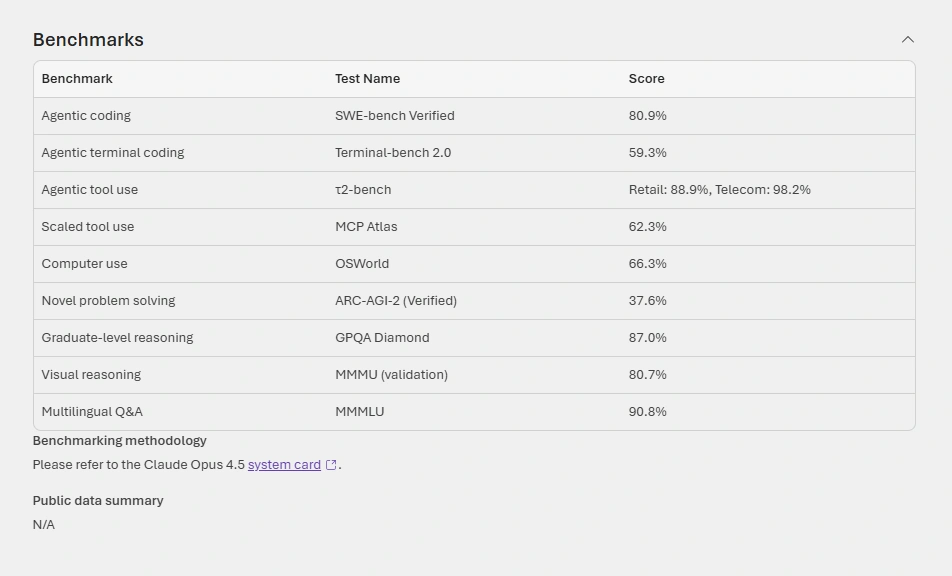
Some use cases are out of scope, and Anthropic describes those in the Claude Opus 4.5 system card, along with detailed safety guidance.
Pricing, Specs, and Benchmarks
Pricing for Claude Opus 4.5 depends on usage and is documented in Microsoft’s pricing pages for this model. The model’s training data goes up to September 2025, so it is relatively current in terms of knowledge.
Technical details like architecture, optimization tips, and responsible use are explained in the Claude Opus 4.5 system card. It supports:
Image and text as input
Text output in many formats (prose, lists, Markdown tables, JSON, HTML, code, etc.)
Multiple languages, including French, Arabic, Mandarin, Japanese, Korean, Spanish, and Hindi (with quality depending on language resources)
The model is available in Azure across global regions.
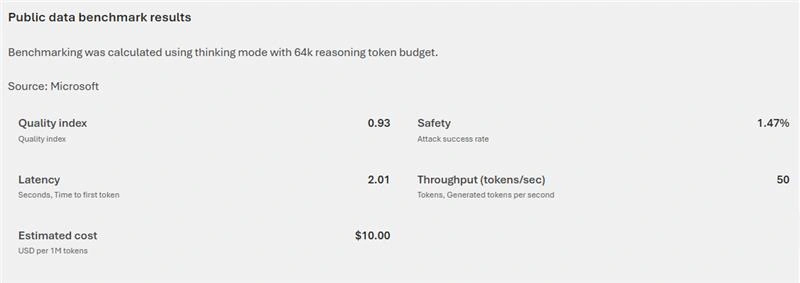
From Microsoft’s benchmarking view, Claude Opus 4.5 has:
Quality index: 0.93
Safety attack success rate: 1.47%
Time to first token (latency): around 2 seconds
Throughput: about 50 tokens per second
Estimated cost: about $10 per 1M tokens
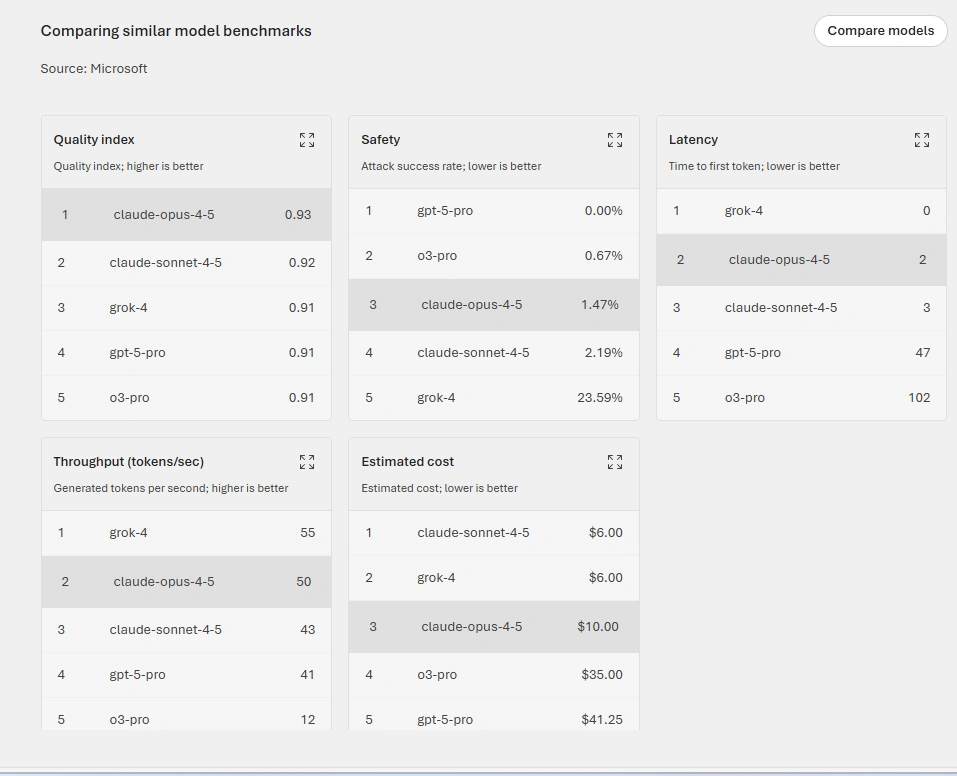
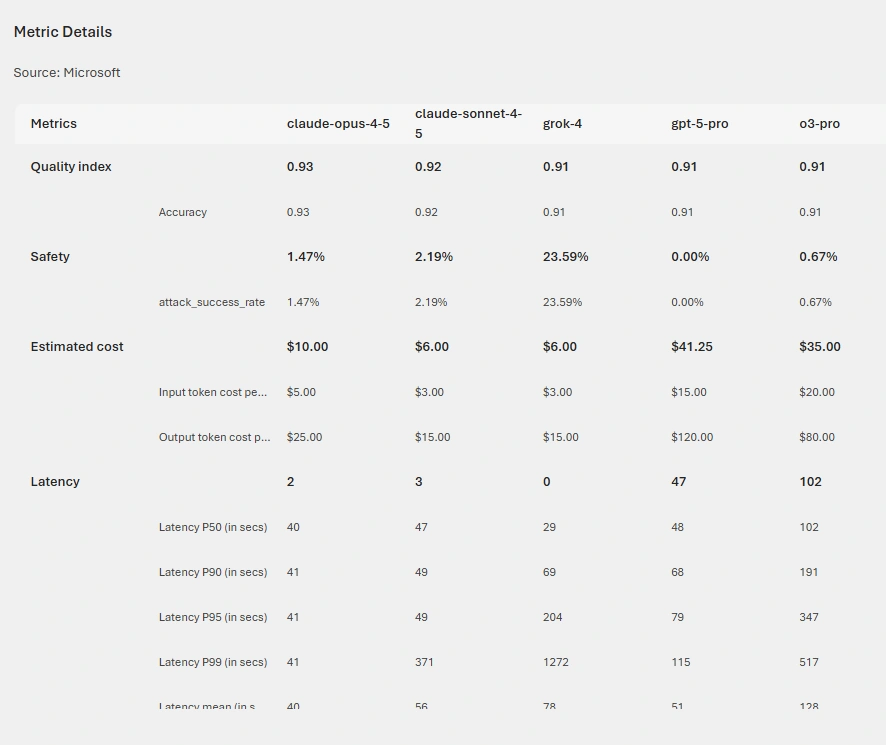
Compared with similar models like Claude Sonnet 4.5, Grok‑4, GPT‑5 Pro, and o3‑pro, it scores among the best on quality while having competitive cost and performance.
Extra Resources and Responsible AI
Anthropic and Microsoft provide several resources to get more out of Claude Opus 4.5:
Claude documentation: Guides on capabilities, prompting, and use cases
Extended thinking guide: How to use extended reasoning effectively
Prompting resources: Tips and tools for better prompts
Claude cookbooks (GitHub): Example code for RAG, SQL, function calling, multimodal prompting, and more
For responsible AI and safety, Anthropic’s system card explains:
Safety evaluations and safeguards
Agentic safety evaluations for computer use and coding
Reward‑hacking checks, alignment tests, and misalignment risk assessments
Known limitations and responsible scaling commitments
Join the conversation! Your thoughts help the community grow.