

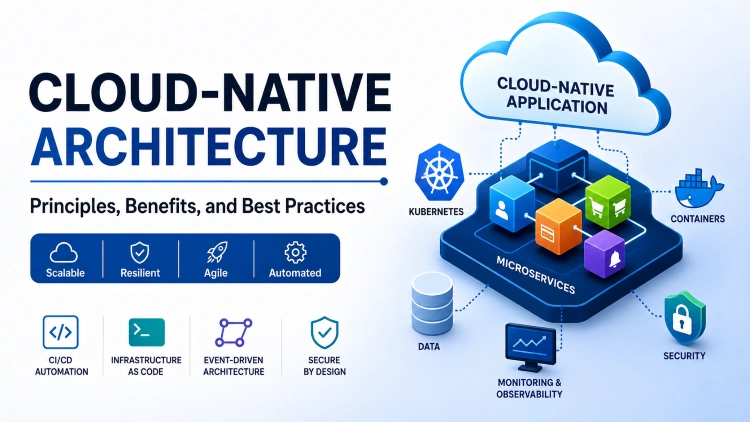
Introduction
Cloud computing has transformed how applications are built, deployed, and managed. Organizations are moving away from traditional monolithic systems and adopting cloud-native architectures to improve scalability, reliability, and development speed.
Companies such as Netflix, Amazon, Microsoft, Uber, and Spotify have demonstrated how cloud-native approaches enable rapid innovation and the ability to serve millions of users globally.
However, cloud-native architecture is more than simply hosting applications in the cloud. It involves designing systems specifically to take advantage of cloud infrastructure, automation, containers, microservices, and modern DevOps practices.
In this article, you'll learn what cloud-native architecture is, its core principles, benefits, challenges, and best practices for building modern cloud applications.
What Is Cloud-Native Architecture?
Cloud-native architecture is an approach to designing and building applications specifically for cloud environments.
Instead of adapting traditional applications to run in the cloud:
Traditional Application
       ↓
Cloud Infrastructure
Cloud-native systems are designed from the beginning to leverage cloud capabilities:
Cloud Infrastructure
       ↓
Cloud-Native Application
This enables applications to achieve greater scalability, resilience, and agility.
Core Characteristics of Cloud-Native Applications
Cloud-native applications typically share several characteristics.
Microservices
Applications are divided into smaller independent services.
Example:
User Service

Order Service

Payment Service

Notification Service
Each service can be developed, deployed, and scaled independently.
Containers
Applications are packaged with all required dependencies.
Example:
Application
     +
Dependencies
     ↓
Container
Containers ensure consistency across environments.
Dynamic Scaling
Resources scale automatically based on demand.
Example:
100 Users
   ↓
2 Instances

10,000 Users
   ↓
20 Instances
Cloud-native systems can adjust dynamically.
Automation
Deployment, testing, monitoring, and scaling are automated whenever possible.
Why Cloud-Native Architecture Matters
Modern applications face increasing demands:
Global users
High availability requirements
Rapid feature releases
Variable traffic patterns
Large-scale data processing
Traditional architectures often struggle with these requirements.
Cloud-native architectures provide:
Better scalability
Faster deployment cycles
Improved reliability
Reduced operational overhead
Greater development agility
These advantages make cloud-native development the preferred approach for many organizations.
Cloud-Native Architecture Components
A typical cloud-native application includes multiple layers.
Users
   ↓
Load Balancer
   ↓
API Gateway
   ↓
Microservices
   ↓
Databases
   ↓
Monitoring & Logging
Each layer contributes to system scalability and resilience.
Microservices Architecture
Microservices are one of the foundational pillars of cloud-native systems.
Instead of:
Monolithic Application
Applications are decomposed into:
Authentication Service

Product Service

Cart Service

Order Service
Benefits include:
Independent deployment
Easier scaling
Fault isolation
Faster development cycles
However, microservices also introduce additional complexity.
Containers and Docker
Containers package applications with their dependencies.
Example Dockerfile:
FROM mcr.microsoft.com/dotnet/aspnet:9.0

WORKDIR /app

COPY . .

ENTRYPOINT ["dotnet", "App.dll"]
Benefits:
Environment consistency
Faster deployments
Portability
Efficient resource usage
Docker remains one of the most widely used container technologies.
Container Orchestration with Kubernetes
Managing a few containers is simple.
Managing hundreds is not.
Kubernetes automates:
Deployment
Scaling
Service discovery
Load balancing
Self-healing
Example:
Kubernetes Cluster
       ↓
Pod A

Pod B

Pod C
Kubernetes has become the industry standard for cloud-native orchestration.
API Gateway
Cloud-native applications often use API gateways.
Example:
Client
   ↓
API Gateway
   ↓
Microservices
Responsibilities include:
Authentication
Routing
Rate limiting
Monitoring
Request aggregation
Popular solutions include:
Azure API Management
Kong
NGINX
AWS API Gateway
Service Discovery
In dynamic cloud environments, services frequently change.
Example:
Order Service
   ↓
IP Address Changes
Service discovery enables services to locate one another automatically.
Examples:
Kubernetes DNS
Consul
Eureka
This reduces configuration complexity.
Cloud-Native Data Management
Cloud-native applications often use:
Relational Databases
Examples:
Azure SQL
PostgreSQL
MySQL
NoSQL Databases
Examples:
Cosmos DB
MongoDB
DynamoDB
Distributed Caches
Examples:
Redis
Memcached
Different services may use different storage technologies depending on requirements.
Observability and Monitoring
Observability is essential in cloud-native systems.
Key areas include:
Logs
Application events and errors.
Metrics
Performance measurements.
Traces
Request flow tracking.
Popular tools:
OpenTelemetry
Prometheus
Grafana
Application Insights
Datadog
Without observability, troubleshooting distributed systems becomes difficult.
CI/CD Pipelines
Cloud-native development relies heavily on Continuous Integration and Continuous Deployment.
Workflow:
Code Commit
      ↓
Build
      ↓
Test
      ↓
Deploy
Popular tools include:
GitHub Actions
Azure DevOps
GitLab CI/CD
Jenkins
Automation reduces deployment risks and accelerates delivery.
Infrastructure as Code
Infrastructure should be managed like application code.
Popular tools:
Terraform
terraform apply
Bicep
az deployment group create
AWS CloudFormation
Infrastructure as Code provides:
Repeatability
Version control
Automation
Consistency
This is a key cloud-native practice.
Event-Driven Communication
Many cloud-native systems use asynchronous communication.
Example:
Order Created
      ↓
Message Broker
      ↓
Inventory Service

Billing Service

Notification Service
Popular technologies include:
Apache Kafka
Azure Service Bus
RabbitMQ
Amazon SQS
Event-driven systems improve scalability and resilience.
Security in Cloud-Native Applications
Security must be integrated throughout the architecture.
Important practices include:
Identity Management
Examples:
Microsoft Entra ID
OAuth 2.1
OpenID Connect
Secrets Management
Examples:
Azure Key Vault
AWS Secrets Manager
Zero Trust Security
Every request should be authenticated and authorized.
Container Security
Scan images for vulnerabilities before deployment.
Security should never be an afterthought.
Benefits of Cloud-Native Architecture
Faster Development
Teams can release features independently.
Improved Scalability
Applications scale based on demand.
Better Reliability
Failures are isolated to individual services.
Reduced Infrastructure Costs
Resources can be optimized dynamically.
Greater Flexibility
Teams can choose technologies best suited for each service.
These advantages drive widespread adoption.
Challenges of Cloud-Native Architecture
Despite its benefits, cloud-native development introduces challenges.
Operational Complexity
More services mean more infrastructure.
Monitoring Requirements
Observability becomes critical.
Distributed System Challenges
Examples:
Network failures
Latency
Data consistency
Security Management
More components create a larger attack surface.
Organizations must invest in proper tooling and processes.
Real-World Example
Consider an online retail platform.
Architecture:
Users
   ↓
CDN
   ↓
API Gateway
   ↓
Microservices

Product Service

Cart Service

Order Service

Payment Service
   ↓
Cloud Databases
Benefits:
Independent scaling
Faster deployments
High availability
Better user experience
This architecture is common among modern cloud-native applications.
Best Practices
When building cloud-native applications:
Design for failure.
Use containers consistently.
Automate deployments.
Implement observability early.
Adopt Infrastructure as Code.
Secure secrets properly.
Use managed cloud services when possible.
Implement CI/CD pipelines.
Monitor performance continuously.
Scale services independently.
Following these practices improves reliability and maintainability.
Common Mistakes to Avoid
Avoid these common issues:
Moving monoliths to the cloud without redesign.
Ignoring observability.
Overcomplicating microservices.
Manual infrastructure management.
Poor security practices.
Lack of automation.
Insufficient monitoring.
Cloud-native success requires both technology and operational maturity.
Conclusion
Cloud-native architecture has become the foundation of modern software development. By leveraging microservices, containers, Kubernetes, automation, observability, and cloud-managed services, organizations can build applications that are scalable, resilient, and capable of evolving rapidly.
While cloud-native development introduces new challenges, the benefits of agility, scalability, reliability, and operational efficiency often outweigh the complexity. As cloud adoption continues to grow, understanding cloud-native architecture is becoming an essential skill for developers, architects, DevOps engineers, and technology leaders.
Join the conversation! Your thoughts help the community grow.