

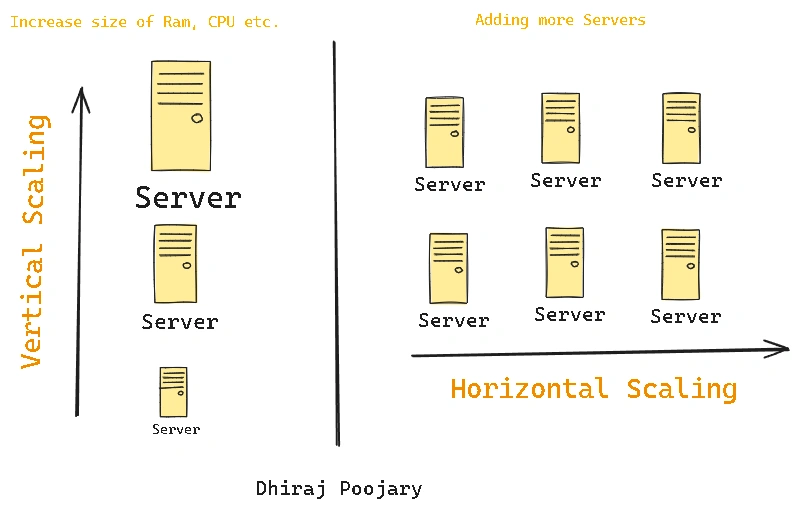
Introduction
In the realm of system design, scalability plays a pivotal role in ensuring that applications can handle growing workloads and provide a seamless user experience. Two primary approaches to scalability are Vertical Scaling and Horizontal Scaling.
- Vertical Scaling: This involves adding more resources, such as CPU, memory, or storage, to a single server in order to enhance its performance.
- Horizontal Scaling: In this approach, the system expands by adding more machines or nodes to the network, distributing the load across multiple servers.
The importance of scalability in system design cannot be overstated. As applications grow, the ability to scale efficiently becomes crucial to maintaining performance, reliability, and user satisfaction.
Vertical Scaling Limitations
While vertical scaling offers a straightforward way to boost a server's capabilities, it comes with inherent limitations. One major drawback is the hard limit on the amount of CPU, memory, and other resources that can be added to a single server. This limitation can result in performance bottlenecks and potential downtime when the server reaches its maximum capacity.
Hitting the vertical scaling limit can lead to various issues, including decreased system responsiveness, slower transaction processing, and an increased risk of service interruptions. In addition, upgrading hardware components becomes increasingly expensive and may not be a sustainable solution in the long run.
Horizontal Scaling Advantages
In contrast, horizontal scaling provides an alternative solution to the limitations of vertical scaling. By adding more servers to a system, horizontal scaling distributes the load, improving overall performance and reliability. This approach also offers better fault tolerance, as a failure in one server does not necessarily impact the entire system.
Horizontal scaling addresses the challenges of vertical scaling by allowing for easier expansion and better utilization of resources. It provides a more cost-effective and flexible solution to handle increasing workloads.
Real-world Use Cases
To better illustrate the concepts of vertical and horizontal scaling, let's look at real-world examples from popular streaming platforms like Netflix and Hotstar. These platforms handle massive fluctuations in user traffic, making scalability a critical aspect of their architecture.
- Netflix: The streaming giant employs horizontal scaling to handle the vast number of users streaming content simultaneously. By distributing the load across a multitude of servers, Netflix ensures a smooth and uninterrupted streaming experience for its global user base.
- Hotstar: Similar to Netflix, Hotstar leverages horizontal scaling to manage the demands of live sports events and popular TV shows. The platform dynamically allocates resources based on the traffic, ensuring optimal performance during peak usage periods.
Pros and Cons Comparison:
| Aspect | Vertical Scaling | Horizontal Scaling |
|---|---|---|
| Scalability | Limited by hardware constraints of a single server. | Easily scalable by adding more servers. |
| Fault Tolerance | Vulnerable to single points of failure. | Distributed architecture enhances fault tolerance. |
| Cost | Scaling can become expensive as hardware upgrades are costly. | Generally more cost-effective due to the use of commodity hardware. |
| Ease of Implementation | Simpler to implement initially. | Requires a distributed architecture, which may be more complex. |
Conclusion
Choosing between vertical and horizontal scaling is a crucial decision in system design. While vertical scaling provides simplicity, it has limitations that may hinder long-term scalability. Horizontal scaling, on the other hand, offers a more flexible and cost-effective approach, especially for applications with unpredictable workloads. Ultimately, the choice depends on the specific needs of the application, anticipated growth, and the importance of factors such as fault tolerance and cost efficiency. Striking the right balance is essential for building a robust and scalable system that can adapt to evolving demands.
Mariusz PostolPosted Jan 11, 2024, 1:21 PM
Dhiraj Poojary, thanks for the detailed explanation. My point is that if we are thinking about scaling at the system level we should think about the multiplication of computation engines but not the improvement of engines itself. Let me ask you in another way. Is there any relationship between the servers in the context of the scenario you proposed? I mean are there any dependencies between the servers? Try to look at this problem from the software engineering point of view. Some details you can find in my article available at GitHub: https://github.com/mpostol/TP/tree/5.1/InformationComputation/LayeredArchitecture#program-layered-architecture
Mariusz PostolPosted Jan 11, 2024, 8:55 AM
Hi, I have noted that the servers in the vertical scaling scenario are of different sizes, but in the case of horizontal scaling are the same. What it means in practice. In both cases we should expect additional memory, processor power, and multiplication of resources, shouldn't we?rdgs,