

In this article, we are going to discuss consuming REST API inside PowerShell and performing CRUD operations through PowerShell Script.
Agenda
- Implementation of .NET Core 6 Web API
- Create PowerShell Script and consume API to perform CRUD operation
Prerequisites
- Visual Studio 2022
- .NET Core SDK 6
- SQL Server
- PowerShell
Implementation of .NET Core 6 Web API
Here we implement a product offer application for demo purposes which is managed by the admin and performed CRUD operations
Project Structure
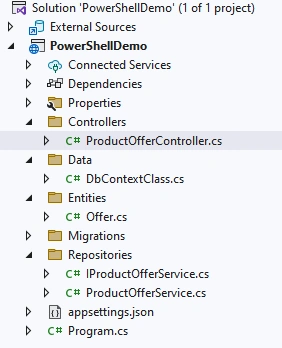
Step 1
Create a new .NET Core Web API
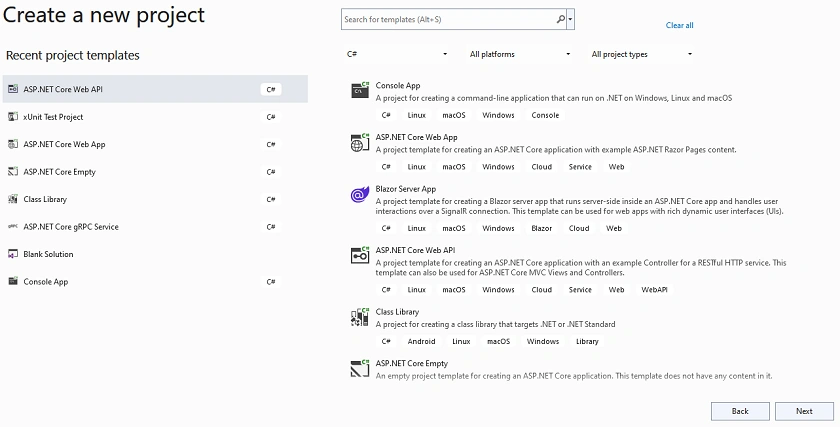
Step 2
Configure a new project
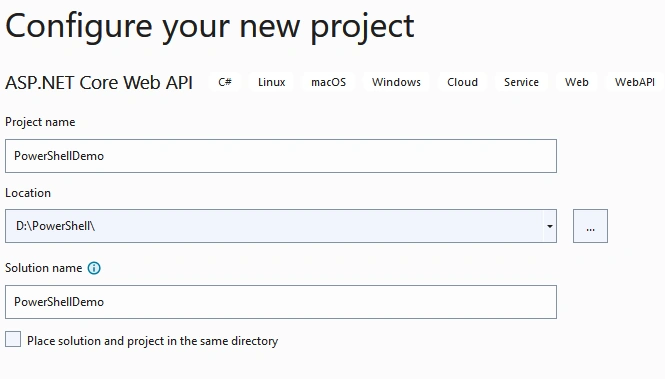
Step 3
Provide additional information
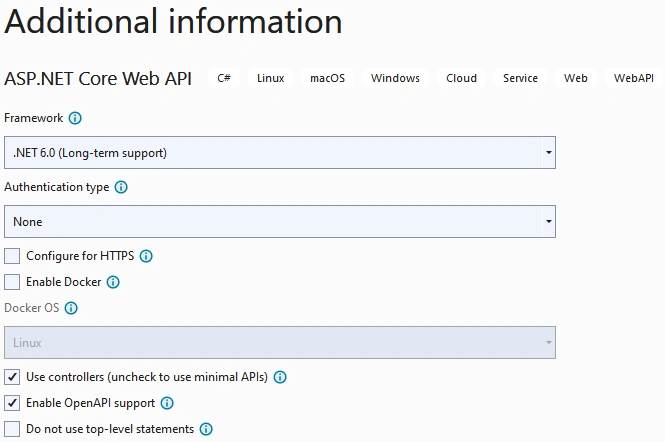
Step 4
Create an Offer class inside the Entities folder
namespace PowerShellDemo.Entities
{
    public class Offer
    {
        public int Id { get; set; }
        public string ProductName { get; set; }
        public string OfferDescription { get; set; }
    }
}
Step 5
Next, add DbContextClass inside the Data folder which provides a data context object to perform data-related all SQL operations
using Microsoft.EntityFrameworkCore;
using PowerShellDemo.Entities;

namespace PowerShellDemo.Data
{
    public class DbContextClass : DbContext
    {
        protected readonly IConfiguration Configuration;

        public DbContextClass(IConfiguration configuration)
        {
            Configuration = configuration;
        }
        protected override void OnConfiguring(DbContextOptionsBuilder options)
        {
            options.UseSqlServer(Configuration.GetConnectionString("DefaultConnection"));
        }

        public DbSet<Offer> Offer { get; set; }
    }
}
Step 6
Create IProductOfferService and ProductOfferService files inside the Repositories
IProductOfferService
using PowerShellDemo.Entities;

namespace PowerShellDemo.Repositories
{
    public interface IProductOfferService
    {
        public Task<List<Offer>> GetOfferListAsync();
        public Task<Offer> GetOfferByIdAsync(int Id);
        public Task<Offer> AddOfferAsync(Offer offer);
        public Task<Offer> UpdateOfferAsync(Offer offer);
        public Task<bool> DeleteOfferAsync(int Id);
    }
}
ProductOfferService
using Microsoft.EntityFrameworkCore;
using PowerShellDemo.Data;
using PowerShellDemo.Entities;

namespace PowerShellDemo.Repositories
{
    public class ProductOfferService : IProductOfferService
    {
        private readonly DbContextClass _dbContext;

        public ProductOfferService(DbContextClass dbContext)
        {
            _dbContext = dbContext;
        }

        public async Task<List<Offer>> GetOfferListAsync()
        {
            return await _dbContext.Offer.ToListAsync();
        }

        public async Task<Offer> GetOfferByIdAsync(int Id)
        {
            return await _dbContext.Offer.Where(x => x.Id == Id).FirstOrDefaultAsync();
        }

        public async Task<Offer> AddOfferAsync(Offer offer)
        {
            var result = _dbContext.Offer.Add(offer);
            await _dbContext.SaveChangesAsync();
            return result.Entity;
        }

        public async Task<Offer> UpdateOfferAsync(Offer offer)
        {
            var result = _dbContext.Offer.Update(offer);
            await _dbContext.SaveChangesAsync();
            return result.Entity;
        }
        public async Task<bool> DeleteOfferAsync(int Id)
        {
            var filteredData = _dbContext.Offer.Where(x => x.Id == Id).FirstOrDefault();
            var result = _dbContext.Remove(filteredData);
            await _dbContext.SaveChangesAsync();
            return result != null ? true : false;
        }
    }
}
Step 7
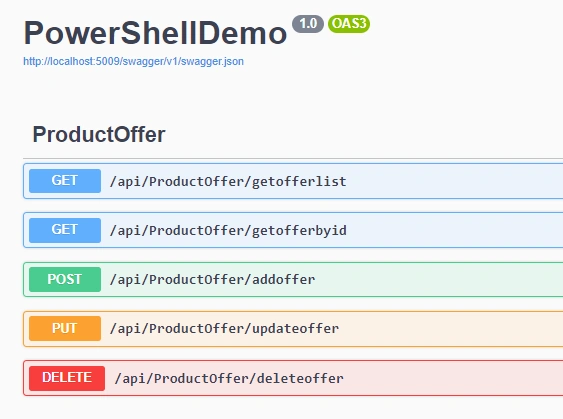
Next, create a new product to offer a controller
using Microsoft.AspNetCore.Mvc;
using PowerShellDemo.Entities;
using PowerShellDemo.Repositories;

namespace PowerShellDemo.Controllers
{
    [Route("api/[controller]")]
    [ApiController]
    public class ProductOfferController : ControllerBase
    {
        private readonly IProductOfferService productOfferService;

        public ProductOfferController(IProductOfferService productOfferService)
        {
            this.productOfferService = productOfferService;
        }

        [HttpGet("getofferlist")]
        public async Task<List<Offer>> GetOfferListAsync()
        {
            try
            {
                var response = await productOfferService.GetOfferListAsync();

                return response;
            }
            catch
            {

            }
            return null;
        }

        [HttpGet("getofferbyid")]
        public async Task<Offer> GetOfferByIdAsync(int Id)
        {
            try
            {
                var response = await productOfferService.GetOfferByIdAsync(Id);

                return response;
            }
            catch
            {

            }
            return null;
        }

        [HttpPost("addoffer")]
        public async Task<Offer> AddOfferAsync(Offer offer)
        {
            try
            {
                var response = await productOfferService.AddOfferAsync(offer);

                return response;
            }
            catch
            {

            }
            return null;
        }

        [HttpPut("updateoffer")]
        public async Task<Offer> UpdateOfferAsync(Offer offer)
        {
            try
            {
                var response = await productOfferService.UpdateOfferAsync(offer);

                return response;
            }
            catch
            {

            }
            return null;
        }

        [HttpDelete("deleteoffer")]
        public async Task<bool> DeleteOfferAsync(int Id)
        {
            try
            {
                var response = await productOfferService.DeleteOfferAsync(Id);
                return response;
            }
            catch
            {

            }
            return false;
        }
    }
}
Step 8
Later on, register a few services in the DI container inside the Program class
using PowerShellDemo.Data;
using PowerShellDemo.Repositories;

var builder = WebApplication.CreateBuilder(args);

// Add services to the container.

builder.Services.AddControllers();
// Learn more about configuring Swagger/OpenAPI at https://aka.ms/aspnetcore/swashbuckle
builder.Services.AddEndpointsApiExplorer();
builder.Services.AddSwaggerGen();
builder.Services.AddScoped<IProductOfferService, ProductOfferService>();
builder.Services.AddDbContext<DbContextClass>();

var app = builder.Build();

// Configure the HTTP request pipeline.
if (app.Environment.IsDevelopment())
{
    app.UseSwagger();
    app.UseSwaggerUI();
}

app.UseAuthorization();

app.MapControllers();

app.Run();
Join the conversation! Your thoughts help the community grow.