

Most organisations possess vast amounts of information. Documents, emails, reports, contracts, and operational records accumulate over years of activity. Yet much of this knowledge remains fragmented. Employees spend significant time searching for information that already exists somewhere inside the organisation. Azure enables enterprises to transform scattered information into structured, interconnected knowledge systems.

From documents to knowledge
Traditional information systems store documents but rarely understand their relationships. A research report may reference suppliers, products, customers, and regulatory policies, yet these connections remain implicit.
Knowledge graphs convert information into structured relationships. Entities such as people, organisations, products, and events become nodes in a network. Connections between them create a map of organisational intelligence.
Azure provides the infrastructure to build and maintain these knowledge graphs using scalable data services.
Extracting meaning from unstructured data
The challenge lies in extracting meaning from unstructured content. Azure AI services can analyse documents, contracts, and communications to identify entities and relationships automatically.
Azure AI Language identifies organisations, locations, and concepts within text. Azure Document Intelligence extracts structured fields from complex documents. Combined, these capabilities allow organisations to convert large document repositories into structured knowledge assets.
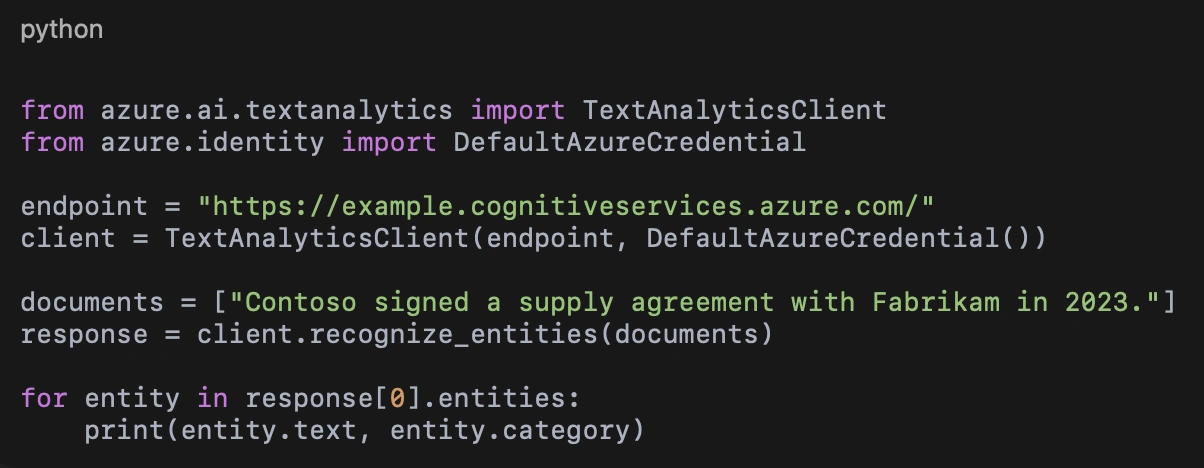

This process gradually builds a connected representation of enterprise knowledge.
Connecting information across systems
Enterprise information rarely resides in a single platform. Financial systems, CRM tools, project databases, and document repositories all contain pieces of organisational knowledge.
Azure Synapse Analytics and Azure Data Factory can integrate these data sources. Once integrated, relationships across departments become visible. A supplier mentioned in a procurement contract may also appear in compliance reports or customer delivery records.
The knowledge graph reveals these connections instantly.
Supporting faster decision-making
Executives and analysts often need answers that span multiple datasets. Traditional reporting requires complex queries and manual reconciliation. Knowledge graphs allow questions to be asked in relational terms.
For example, leaders can identify all suppliers linked to a specific product line, along with associated contracts and risk reports. Queries that once required days of investigation become immediate.
Decision-making accelerates because information is already structured.
Enhancing organisational memory
Employee turnover can weaken institutional knowledge. Critical insights stored in emails or personal files disappear when individuals leave. Knowledge graphs preserve these relationships by embedding them into shared systems.
Teams gain access to historical context, prior decisions, and organisational expertise even when personnel change.
This strengthens continuity across long-term projects.
Governance and information control
Enterprise knowledge systems must respect security boundaries. Azure identity management ensures that sensitive data remains visible only to authorised users. Encryption protects information both at rest and during processing.
Responsible AI practices also ensure that automated extraction processes remain transparent and auditable.
Organisations maintain trust while expanding information accessibility.
Strategic implications
As enterprises grow, information complexity increases. Without structure, knowledge becomes harder to locate and leverage. Azure knowledge graph architectures transform data into an interconnected intelligence layer that supports research, strategy, and operations.
Organisations move from searching for information to navigating it.
The future of enterprise intelligence
Knowledge graphs represent a shift in how organisations think about information. Instead of storing isolated documents, enterprises create living maps of relationships that evolve as new data arrives.
Azure provides the scalable tools required to build and maintain these systems across global operations.
Companies that structure their knowledge effectively will operate with greater clarity, faster insight, and stronger institutional memory.
🔗 Further Learning:
Join the conversation! Your thoughts help the community grow.