

The evolution of Generative Pre-trained Transformers (GPTs) has transformed how organizations and individuals interact with artificial intelligence. Beyond conversational capabilities, GPTs can be extended with Actions—custom integrations that connect models to external systems, APIs, and workflows. This article outlines a formal framework for creating GPTs with Actions, emphasizing design principles, governance, and implementation strategies.
GPT Actions Architecture Diagram
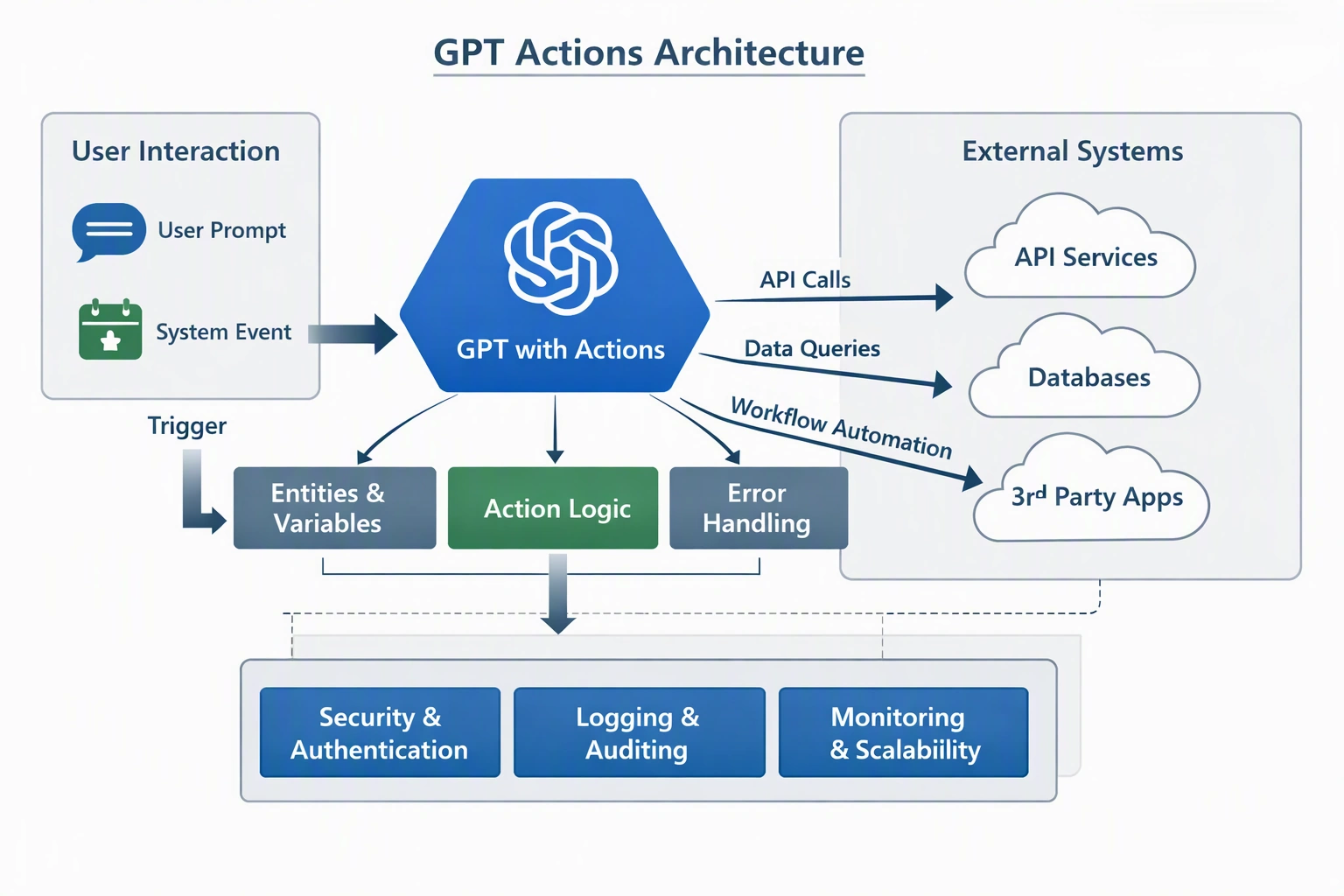
It visually maps how GPTs with Actions interact with triggers, entities, logic, and external systems, while embedding governance layers like security, auditing, and scalability.
User Interaction → Prompts or system events trigger the GPT.
GPT with Actions Core → Handles entities, variables, logic, and error management.
External Systems → APIs, databases, and third-party apps are connected via secure calls.
Governance Layer → Security, logging, and monitoring ensure compliance and resilience.
This diagram provides a structured reference for implementation teams to design and deploy GPTs with Actions in enterprise environments.
Understanding GPTs with Actions
GPTs with Actions are specialized AI agents that:
Extend core capabilities by integrating with external APIs or services.
Execute tasks such as retrieving data, triggering workflows, or performing calculations.
Provide contextual intelligence by combining generative responses with structured outputs.
This approach transforms GPTs from passive conversational models into active digital assistants capable of driving enterprise processes.
Key Components of Actions
When designing GPTs with Actions, three foundational elements must be considered:
Triggers Define when an Action should be invoked. Triggers can be user prompts, system events, or contextual signals.
Actions Represent the executable logic—API calls, database queries, or workflow automation. Actions must be designed with clear input/output specifications.
Entities and Variables Capture structured data from user input or external sources. These ensure that Actions operate with precision and consistency.
Governance and Best Practices
To ensure reliability and compliance, organizations should adopt governance frameworks:
Security and Authentication Implement OAuth, API keys, or managed identities to safeguard integrations.
Error Handling Design fallback mechanisms for failed Actions, ensuring graceful degradation.
Auditability Maintain logs of Action executions for compliance and monitoring.
Scalability Architect Actions to handle concurrent requests and enterprise-level workloads.
Implementation Workflow
A structured workflow for creating GPTs with Actions includes:
Requirement Analysis Identify business processes that benefit from automation or augmentation.
Action Design Define APIs, parameters, and expected outputs. Ensure alignment with enterprise standards.
Integration Connect GPTs to external systems using secure connectors or middleware.
Testing and Validation Simulate diverse scenarios to validate accuracy, resilience, and compliance.
Deployment and Monitoring Roll out GPTs with Actions in controlled environments, followed by continuous monitoring and iterative improvements.
Use Cases
Customer Support: GPTs trigger ticket creation, knowledge base lookups, or escalation workflows.
Enterprise Automation: GPTs initiate approval processes, update ERP records, or generate compliance reports.
Data Insights: GPTs query analytics platforms, summarize dashboards, and deliver actionable intelligence.
Creating GPTs with Actions represents a significant step toward intelligent automation. By combining generative capabilities with structured integrations, organizations can unlock scalable, secure, and context-aware AI agents. A disciplined approach—anchored in governance, design rigor, and enterprise alignment—ensures that GPTs with Actions deliver measurable business value.
Join the conversation! Your thoughts help the community grow.