

Step 1. First of all, let's create a new app on Facebook to get the app id and app secret and select a website.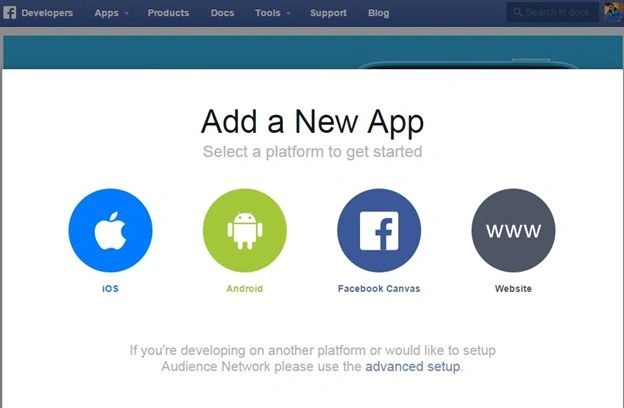
Image 1.
Now enter the app name and click the create button.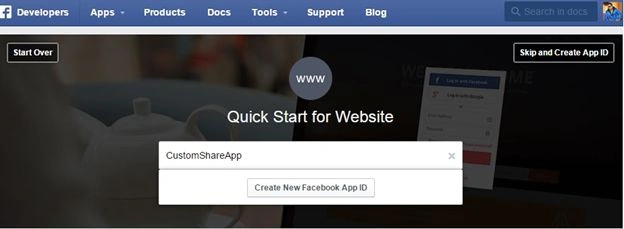
Image 2.
You can choose the app category.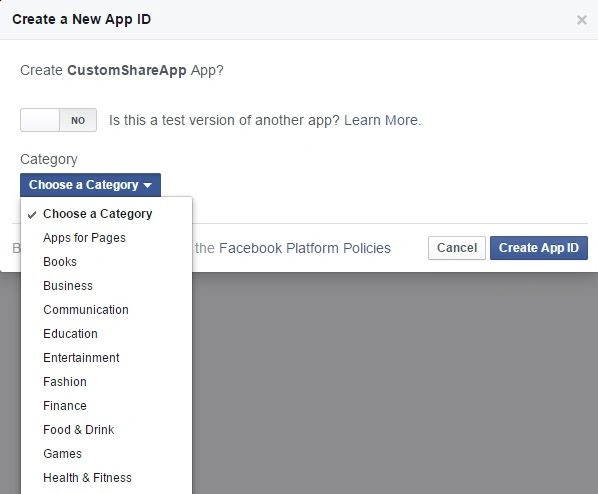
Image 3.
Here your app id and app secret are ready.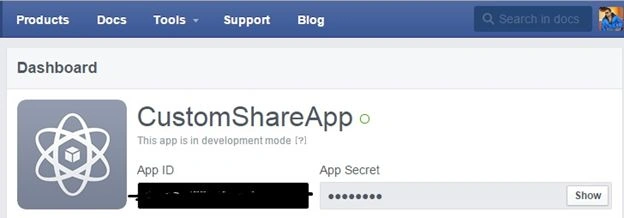
Image 4.
Copy the app id and app secret.
Step 2. Now let's make a Twitter app and generate an API key and secret. Open: Twitter App and click the Create New App button and fill in all the app details and click create.
Image 5.
Image 6.
You can see the consumer key, callback URL and access level. Note down the consumer key.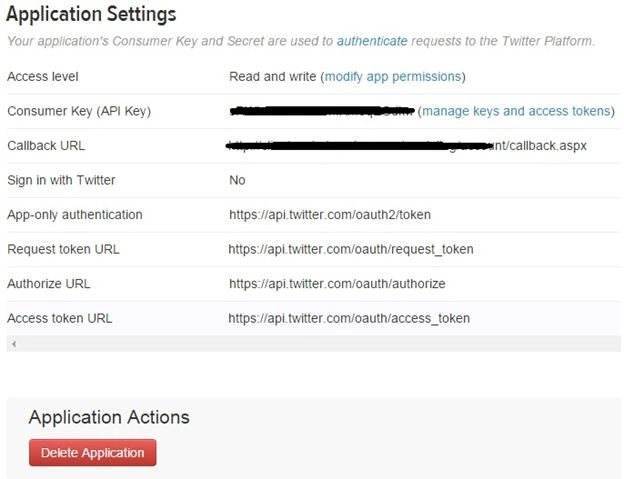
Image 7.
Here we are done with the app things. Now let's go to the project and implement the custom share functionality on Facebook and Twitter.
Add Facebook and Twitter keys generated in previous steps to the Web.config. You can add any name keys you like with your valies by copying the API keys and secret.
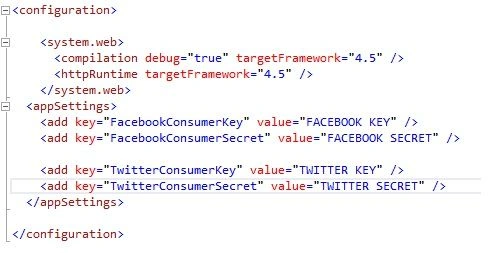
Image 8.
- <div id="DetailDiv">
- </div>
- <script src="Scripts/jquery-2.1.3.min.js"></script>
- <script type="text/javascript">
- $(document).ready(function () {
- createHtml();
- });
- //create html //
- function createHtml() {
- var title = "How to Authenticate and Get Data Using Instagram API";
- var summary = "This article explains how to authenticate an Instagram API and how to get user photos, user details and popular photos using the Instagram API.";
- var url = "https://www.facebook.com/raj2511984";
- var image = 'https://fbcdn-sphotos-d-a.akamaihd.net/hphotos-ak-xpa1/v/t1.0-9/10153182_10153281334431040_8373343421018856197_n.jpg?oh=2f5cbcae8d125e72e0cbc6131c3634ea&oe=552C0BE0&__gda__=1429949942_5641254857be91dda7dd0653815ebf48';
- var appid = '<%=ConfigurationManager.AppSettings["FacebookConsumerKey"].ToString() %>';
- //login pop height, width
- var w = 600;
- var h = 400;
- var left = Number((screen.width / 2) - (w / 2));
- var top = Number((screen.height / 2) - (h / 2));
- //****//
- //facebook login window and pass paramemters like title, summary, url, image
- var fb = '<a rel="nofollow" title=\"Share this post on Facebook\" onclick="FbApp_Login(\'' + title + '\',\'' + summary + '\',\'' + url + '\',\'' + image + '\');"><img src="Images/fb.png" /></a>';
- //****//
- //twitter login window and pass paramemters like title, url
- var twitter = "<a href=https://twitter.com/intent/tweet?original_referer=" + encodeURIComponent(url) + "&related=ModelQ-Job&text=" + encodeURIComponent(title) + "&tw_p=tweetbutton&url=" + encodeURIComponent(url) + "&via=_ModelQ title=\"Share this post on Twitter\" onclick=\"javascript:window.open(this.href, '', 'menubar=no,toolbar=no,resizable=yes,scrollbars=yes,width=" + w + ", height=" + h + ", top=" + top + ", left=" + left + "');return false;\"><img src='Images/twitter.png' /></a>";
- //****//
- var socialMediaButtons = fb + " " + twitter;
- //bind social variables into div
- jQuery("#DetailDiv").append(' <div><table width="100%"><tr><td valign="top" style=" width:100px; height:100px;"><div>' + socialMediaButtons + '</div></td></tr></table> </div>');
- //****//
- }
- // Facebook login
- function FbApp_Login(title, sumary, url, image) {
- FB.login(function (response) {
- if (response.authResponse) {
- statusChangeCallback(response, title, summary, url, image);
- }
- }, { scope: 'email,user_photos,publish_actions' });
- }
- window.fbAsyncInit = function () {
- FB.init({
- appId: '<%=ConfigurationManager.AppSettings["FacebookConsumerKey"].ToString() %>',
- cookie: true, // enable cookies to allow the server to access
- xfbml: true, // parse social plugins on this page
- version: 'v2.0' // use version 2.0
- });
- };
- // This is called with the results from from FB.getLoginStatus().
- function statusChangeCallback(response, title, summary, url, image) {
- if (response.status === 'connected') {
- // Logged into your app and Facebook.
- FB.ui(
- {
- method: 'feed',
- name: title,
- link: url,
- picture: image,
- caption: title,
- description: summary,
- // source: url,
- redirect_uri: url,
- }
- )
- }
- }
- // Load the SDK asynchronously
- (function (d, s, id) {
- var js, fjs = d.getElementsByTagName(s)[0];
- if (d.getElementById(id)) return;
- js = d.createElement(s); js.id = id;
- js.src = "//connect.facebook.net/en_US/sdk.js";
- fjs.parentNode.insertBefore(js, fjs);
- }(document, 'script', 'facebook-jssdk'));
- </script>

Image 9.
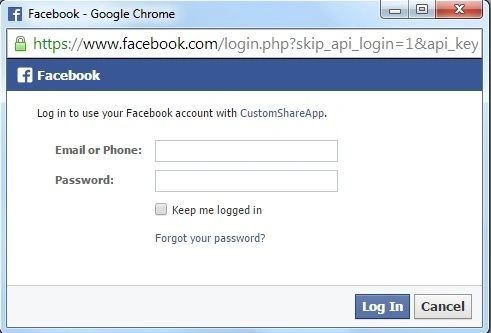
Image 10.
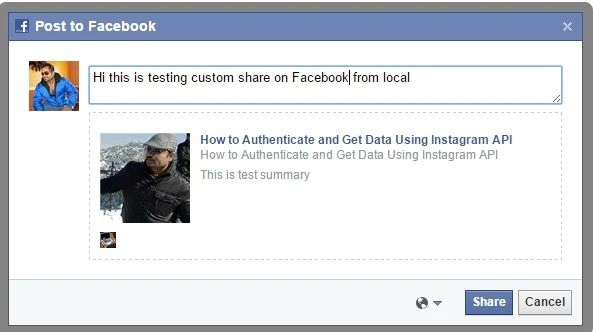
Image 11.
Click share. Now login to Facebook and check in my account.
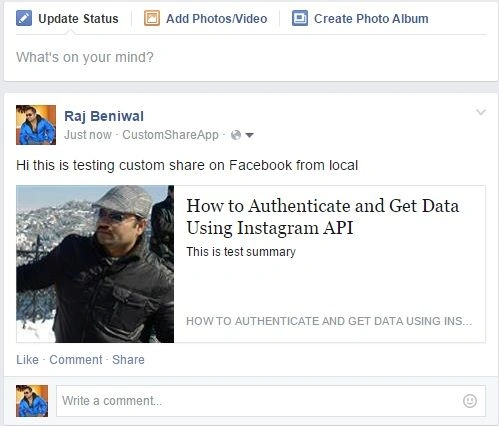
Image 12.
Now let's share on Twitter. Click on the Twitter share icon.
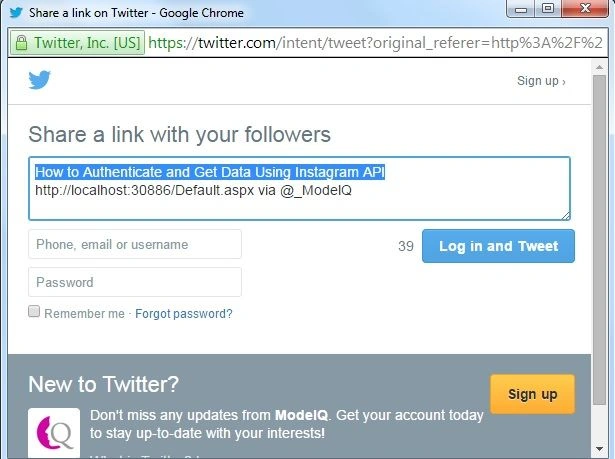
Image 13.
And fill in the email and password and click the Log in and Tweet buttons. Now we are logged into Twitter and can check the latest tweets.
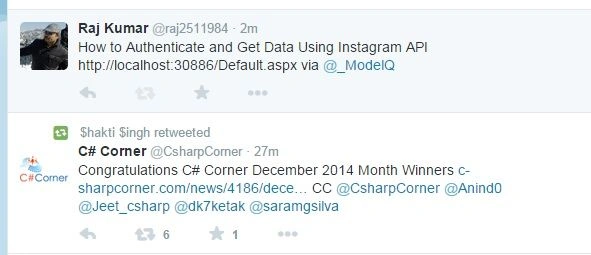
Image 14.
Conclusion
In this article, we learned how to share custom parameters on Facebook and on Twitter from local. For more details I have attached the sample application.
Imran HusainPosted Apr 15, 2021, 7:03 AM
Facebook button is not working same like as twitter
suresh babuPosted Mar 12, 2018, 7:31 AM
Hai Raj Kumar, i have a textbox and button . fill the textbox then click on buton it will be post in who loged in facebook wall. please share the code. thanking you
Manav PandyaPosted Oct 17, 2016, 9:28 AM
Raj Kumar Thanks sir ...
Raj KumarPosted Oct 17, 2016, 7:34 AM
Provide localhost url. That will work.
Manav PandyaPosted Oct 16, 2016, 9:47 AM
In Twitter app form , what should i specify at "URL" textbox because i want to use with local asp.net application
Manav PandyaPosted Oct 2, 2016, 4:02 AM
Nice share ..
Anu VPosted May 27, 2016, 6:56 AM
Nice
Sarvesh TiwariPosted Mar 16, 2016, 5:11 AM
How to share customized image using google plus and twitter in asp.net
Haris BilalPosted Jun 16, 2015, 12:02 PM
Raj can you help me in doing the same thing for linkedin.
Ammar AhmedPosted May 12, 2015, 4:02 AM
If you want to embed this Url in your html file you have to add like this it's working fine<li class="facebook-bg"><a id="fbAnchor" onclick="FbApp_Login('@title','@completeSrcUrl','@image');"></a></li>
Botlhale Jonathan MatlouPosted Feb 2, 2015, 5:32 AM
How can I change this line( var fb = '<a rel="nofollow" title=\"Share this post on Facebook\" onclick="FbApp_Login(\'' + title + '\',\'' + url + '\',\'' + image + '\');"><img src="Images/fb.png" height="50px" /></a>'; ) to have like button_count rather than share button
Rahul Kumar SaxenaPosted Jan 30, 2015, 11:20 PM
Congrts Sir... Article Is selected in Community Spotlight on Microsoft ASP.NET Site.......
Arweb AroshanzamirPosted Jan 29, 2015, 9:37 AM
Nice one..thanks sir..
K P Singh ChundawatPosted Jan 10, 2015, 11:40 AM
great ..