

Introduction
In this article, we'll explore how re-evaluation, reconciliation, and re-rendering collaborate to create seamless user interfaces in React applications.
React's Foundation
React, is a JavaScript library that has completely changed how programmers create interactive user interfaces. The secret to React's success is its novel approach to effectively managing the DOM (Document Object Model), which makes it possible for rendering to happen quickly and for users to have a flawless experience. React uses the Virtual DOM, which is a lightweight representation of the real DOM, and updates the Virtual DOM when changes take place inside a React component. Because JavaScript actions on the Virtual DOM usually happen far faster than direct DOM manipulations, this procedure is incredibly rapid.
Re-evaluation, reconciliation, and re-rendering work together to provide React's effective UI update management. Every one of these procedures is essential to ensure that modifications to the application's state produce seamless updates to the user interface.
Now, let's break down the three crucial processes involved in React's efficient UI updates.
1. Re-evaluation
- React keeps an eye on the props and state of components in order to identify any changes.
- When a change occurs, React initiates the re-evaluation process by invoking the component's render() method to obtain a new virtual DOM representation.
2. Reconciliation
- Once React has the new virtual DOM representation, it compares it with the previous one.
- React's reconciliation algorithm identifies the differences between the new and previous virtual DOM representations.
- It determines the minimal set of changes needed to update the actual DOM to reflect the changes in the UI.
3. Re-rendering
- After reconciliation, React performs the necessary updates to the actual DOM.
- It selectively re-renders only the components that have changed or require updates, optimizing performance by minimizing unnecessary DOM manipulations.
- The updated UI is then rendered to the user, reflecting the changes made to the application's state or props.
React's rendering process is efficient because it compares virtual DOM representations, updates the actual DOM only when necessary to reflect changes, and continuously monitors for changes. React ensures a seamless and responsive user experience by minimizing needless UI updates through the combination of re-evaluation, reconciliation, and re-rendering.
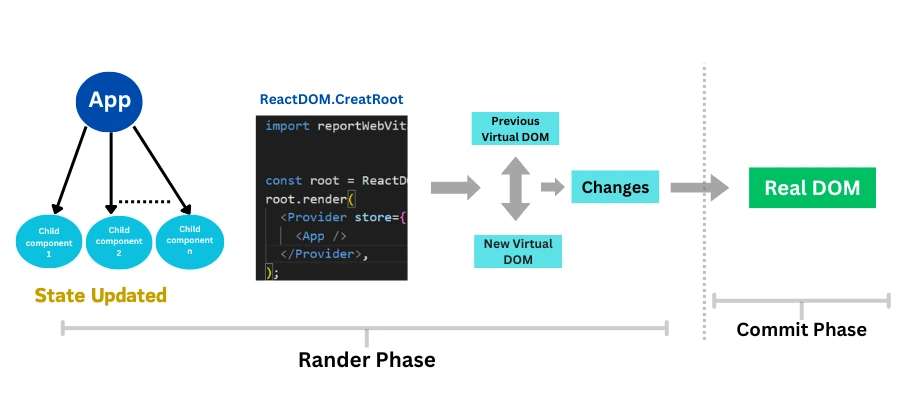
How do they work together?
Re-evaluation, reconciliation, and re-rendering are three crucial steps in React's rendering process that work together to create smooth user experiences. React can quickly identify changes by continuously monitoring the state and props, which starts the re-evaluation process. React carefully examines the virtual DOM representations from the past and present to determine exactly what needs to be updated during reconciliation. By reducing pointless DOM changes, this step improves efficiency. Then, selectively updating only the components that have changed or need updates, re-rendering takes place. React enhances responsiveness and speed by precisely performing updates, making sure that UI changes smoothly reflect the application state. Because of their concerted effort, React applications maintain a fluid and intuitive user experience in addition to responding quickly to user interactions, which makes them a top choice for producing dynamic web interfaces.
Conclusion
React ensures responsive and intuitive user experiences by effectively managing state changes, minimizing DOM operations, and selectively re-rendering components. Its ground-breaking methodology transforms web development by enabling programmers to easily design dynamic interfaces.
Join the conversation! Your thoughts help the community grow.