

Pre-requisite to understand this
IT infrastructure (servers, networks, storage)
Application tiers (presentation, business, data)
Virtualization and containers
CAPEX vs OPEX financial models
Security, compliance, and governance concepts
Public cloud concepts (IaaS, PaaS, SaaS)
In short about CAPEX and OPEX
CAPEX and OPEX represent two core categories of business expenditures with distinct accounting treatments and strategic implications.
CAPEX covers one-time investments in long-term assets like equipment or buildings, while OPEX funds ongoing operational costs such as salaries or utilities.
Introduction
Choosing between cloud deployment and on-premises deployment is a strategic architectural decision, not just a technical one. Enterprise architects must balance cost, scalability, security, compliance, performance, operational maturity, and business agility. The decision directly impacts long-term enterprise capabilities, risk posture, and digital transformation outcomes.
Cloud deployment emphasizes elasticity, speed, and managed services, while on-premises deployment prioritizes control, predictability, and compliance. Most modern enterprises adopt a hybrid or multi-cloud strategy, but understanding when to favor one over the other is critical.
What problem we can solve with this?
This decision framework helps enterprises solve problems related to infrastructure strategy alignment with business goals.
Problems addressed:
Proposed solution tackles critical infrastructure challenges head-on, eliminating over- or under-provisioning through intelligent, demand-driven resource allocation that optimizes usage and prevents wasteful spending. It slashes high operational costs and inefficient capital investments by automating efficiency and enabling pay-as-you-go models, while ensuring full compliance with regulatory requirements and data sovereignty laws to avoid violations and penalties. During demand spikes, seamless auto-scaling capabilities guarantee uninterrupted performance without downtime, accelerating time-to-market for new products via rapid deployment pipelines. Finally, built-in security and risk management tools provide robust protection against threats, minimizing vulnerabilities and enhancing overall resilience.
Over- or under-provisioning of infrastructure
High operational costs or inefficient capital investments
Regulatory or data sovereignty violations
Inability to scale during demand spikes
Slow time-to-market for new products
Security and risk management challenges
Typical decision drivers:
Business agility vs control
Innovation speed vs stability
Cost optimization vs sunk investments
Compliance vs flexibility
FYI:
Data sovereignty laws refer to regulations that govern data based on the country or region where it is collected, stored, or processed, ensuring it falls under that jurisdiction's legal authority
How to implement / use this?
At an enterprise level, the decision is made using architecture principles, workload classification, and governance models.
Implementation approach:
Classify workloads (core, customer-facing, experimental)
Assess non-functional requirements (NFRs)
Evaluate regulatory and data sensitivity constraints
Analyze cost models
Define enterprise reference architectures
Decide:
Cloud-first
On-prem-first
Hybrid-by-design
Decision guidelines:
Choose Cloud when agility, scalability, and innovation dominate
Choose On-Premises when control, latency, and compliance dominate
Sequence Diagram: Deployment Decision Flow (Enterprise Level)
This sequence shows how enterprise architects decide deployment strategy based on compliance, latency, and business requirements.
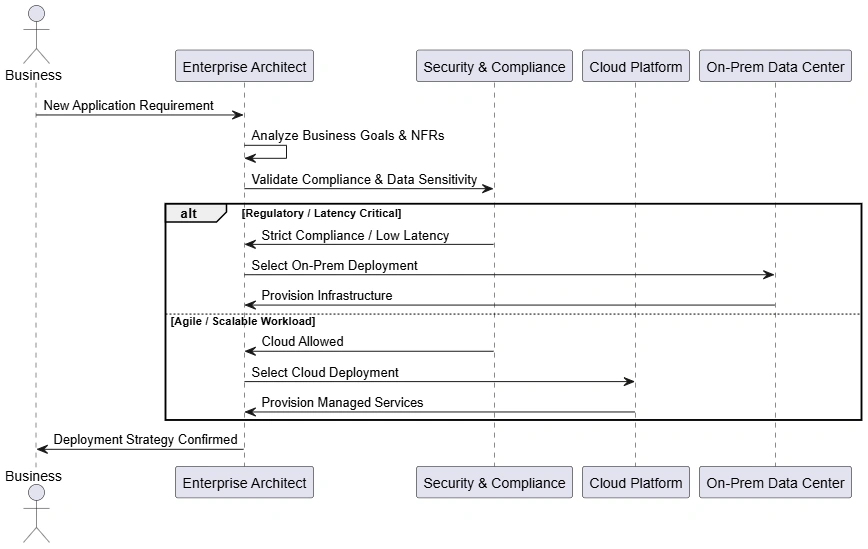
Key observations:
Decision should be policy-driven and customer need driven
Security and compliance act as gatekeepers
Cloud and on-prem are peer options, not defaults
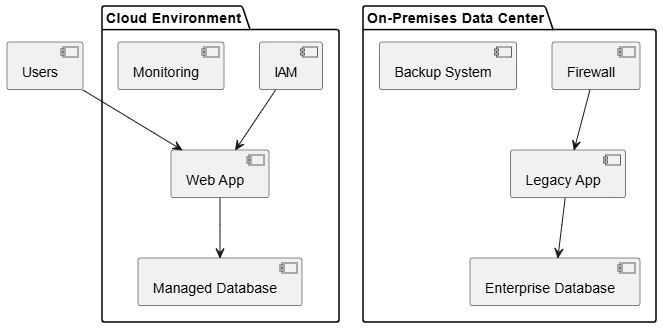
Component Diagram: Cloud vs On-Prem Reference Architecture
This component diagram highlights architectural differences.
Cloud characteristics:
Managed services (DB, IAM, Monitoring)
Loose coupling
High automation
On-Prem characteristics:
Custom security controls
Tight integration with legacy systems
Manual or semi-automated operations
In the cloud environment, the Web App component represents a customer-facing or business application hosted on a public cloud platform. It is designed to be stateless, scalable, and accessible over the internet. The Managed Database component highlights a key cloud principle: offloading operational responsibility (patching, backups, scaling, high availability) to the cloud provider. This allows enterprises to focus on business logic rather than infrastructure maintenance. The IAM (Identity and Access Management) component provides centralized authentication, authorization, and role-based access control, which is essential in cloud environments where resources are elastic and distributed. Monitoring represents cloud-native observability services that provide real-time metrics, logs, and alerts, enabling proactive operations and SLA management without heavy custom tooling.
In the on-premises data center, the Legacy App component represents a tightly coupled, often monolithic enterprise application that may depend on specific hardware, operating systems, or internal networks. These systems are typically critical to core business operations and are not easily refactored for cloud environments. The Enterprise Database is a self-managed data store where the organization maintains full control over data placement, encryption, performance tuning, and backup strategies—often required for regulatory or compliance reasons. The Firewall component plays a critical role in enforcing perimeter security, controlling inbound and outbound traffic, and ensuring that only authorized access is permitted within the corporate network. The Backup System reflects traditional enterprise responsibility for disaster recovery, data retention, and audit compliance, which must be explicitly designed and operated in on-prem environments.
At a high level, each component exists to address a specific enterprise concern. Application components (Web App, Legacy App) deliver business functionality. Data components (Managed Database, Enterprise Database) ensure persistence, integrity, and availability of information. Security components (IAM, Firewall) enforce identity, access, and network controls aligned with organizational risk policies. Operational components (Monitoring, Backup System) ensure reliability, observability, and recoverability of systems. Together, these components illustrate how cloud architectures emphasize managed services and automation, while on-premises architectures emphasize control, customization, and responsibility ownership—a distinction that is central to enterprise deployment decisions.
When to Choose Cloud Deployment (Enterprise View), Best suited when:
Need rapid scalability and elasticity
Variable or unpredictable workloads
Digital-native or customer-facing systems
DevOps, CI/CD, microservices adoption
Global user base
Innovation and experimentation are key
Typical workloads:
Web & mobile applications
Analytics and AI/ML
Dev/Test environments
SaaS platforms
When to Choose On-Premises Deployment (Enterprise View), Best suited when:
Strict regulatory or data sovereignty requirements
Ultra-low latency systems (manufacturing, trading)
Legacy systems with hardware dependencies
High, predictable workloads
Existing sunk infrastructure investments
Typical workloads:
Core banking systems
Defense and government systems
Industrial control systems (ICS)
ERP systems with heavy customization
Advantages
Cloud Deployment
Elastic scalability
Faster time-to-market
Reduced infrastructure management
Pay-as-you-go cost model
Access to advanced managed services
Global availability
On-Premises Deployment
Full control over infrastructure
Strong data governance
Predictable performance
Easier integration with legacy systems
No dependency on external providers
Compliance assurance
Summary
From an enterprise architecture perspective, cloud vs on-premises is not a binary choice but a context-driven decision. Cloud deployment excels in agility, scalability, and innovation, while on-premises deployment provides control, compliance, and predictability. Mature enterprises define clear workload placement criteria, adopt hybrid architectures, and continuously reassess decisions as business, regulatory, and technology landscapes evolve.
Join the conversation! Your thoughts help the community grow.