

In today’s digital economy, FinTech companies are not just building applications—they are building trust. A successful FinTech solution must handle millions of secure transactions, comply with stringent regulations, scale seamlessly under load, and deliver a frictionless user experience.
As a Solution Architect, my role is to design systems that balance security, scalability, compliance, and business agility. In this article, I’ll walk through a system design for a FinTech company, highlight the technologies that can power it, and showcase a real-world problem we can solve.
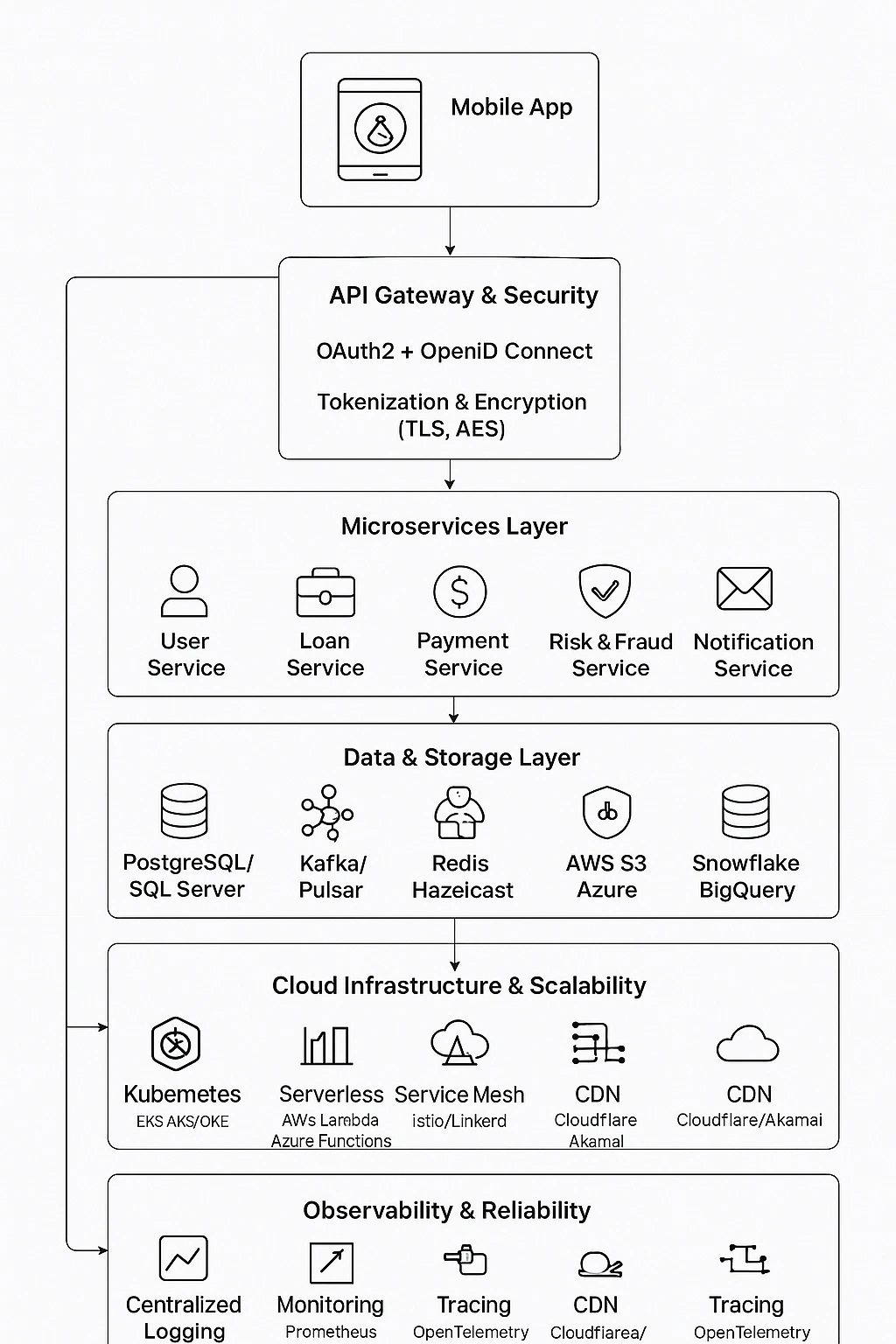
🔹 Real-World Problem: Instant Loan Disbursement with Risk Control
Imagine a FinTech company that wants to launch an instant micro-loan platform where customers can:
Apply for a loan in minutes.
Get instant approval based on credit/risk scoring.
Receive funds directly into their digital wallet or bank account.
Challenges:
Risk of fraud and defaults.
Real-time KYC/AML compliance.
Handling loan requests from millions of users simultaneously.
Integration with banks, credit bureaus, and payment gateways.
Ensuring zero downtime and secure transactions.
🔹 High-Level System Design
1. Client Layer
Mobile Apps (iOS/Android) using React Native / Flutter.
Web Application for account management (React/Angular).
2. API Gateway & Security
Kong / Apigee / Azure API Management for routing, throttling, and rate limiting.
OAuth2 + OpenID Connect for secure authentication.
Tokenization & Encryption (TLS, AES) to protect sensitive data.
3. Microservices Layer
Each critical domain is modeled as a separate microservice:
User Service – manages customer profiles, KYC, and authentication.
Loan Service – handles loan applications, eligibility, and disbursement logic.
Payment Service – integrates with UPI/NEFT/IMPS, payment gateways, and digital wallets.
Risk & Fraud Service – ML-driven fraud detection, credit scoring, and anomaly detection.
Notification Service – SMS, email, WhatsApp updates using Twilio/SendGrid.
4. Data & Storage Layer
Transactional Data → PostgreSQL / SQL Server (ACID compliance).
High-Volume Events → Kafka / Pulsar (streaming transactions and logs).
Cache → Redis / Hazelcast for fast loan lookups and risk scores.
Data Lake → AWS S3 / Azure Data Lake for storing raw customer and transaction data.
Data Warehouse → Snowflake / BigQuery for analytics and reporting.
5. Risk & Compliance Layer
AML & KYC API Integrations → Aadhar/PAN verification, credit bureau checks.
Rule Engine (Drools / Decision Model) → configurable rules for fraud detection.
Audit Logging → Immutable logs in Elasticsearch for regulatory compliance.
6. Cloud Infrastructure & Scalability
Kubernetes (EKS/AKS/GKE) for orchestrating microservices.
Serverless Functions (AWS Lambda, Azure Functions) for on-demand tasks (fraud checks, transaction alerts).
Service Mesh (Istio/Linkerd) for observability, traffic management, and zero-trust security.
CDN (Cloudflare/Akamai) for faster app performance.
7. Observability & Reliability
Centralized Logging – ELK Stack (Elasticsearch, Logstash, Kibana).
Monitoring – Prometheus + Grafana for system metrics.
Tracing – OpenTelemetry/Jaeger for transaction flow debugging.
Chaos Engineering – tools like Gremlin to test system resilience.
🔹 Example Workflow: Loan Approval in <2 Seconds
User applies for loan via mobile app.
Request hits API Gateway, which authenticates via OAuth2.
Loan Service calls Risk & Fraud Service, which fetches:
Credit score (from bureau).
Past repayment history.
Real-time fraud checks (velocity, device fingerprinting).
Decision Engine calculates approval/rejection instantly.
If approved, Payment Service disburses loan via UPI/IMPS.
Notification Service sends confirmation via SMS/Email.
Event logs flow to Kafka → Data Lake → Analytics dashboard.
🔹 Technologies at a Glance
Frontend → React Native, React.js.
Backend → .NET 8, Java Spring Boot, Node.js.
Messaging → Kafka, RabbitMQ.
Database → PostgreSQL, MongoDB, Redis.
Cloud → AWS (EKS, Lambda, S3) or Azure (AKS, Functions, CosmosDB).
Security → OAuth2, Tokenization, Zero-Trust.
AI/ML → Credit scoring, anomaly detection.
🎯 Final Thoughts
Designing a FinTech system is not just about technology—it’s about trust, speed, and compliance. A well-architected platform ensures that customers can transact securely, regulators are satisfied with audit and compliance, and businesses can scale without fear of downtime or fraud.
As a Solution Architect, I believe the future of FinTech will be powered by API-first architectures, cloud-native platforms, AI-driven risk management, and seamless customer experiences.
The companies that master this balance will lead the next wave of financial innovation.
Join the conversation! Your thoughts help the community grow.