

The evolution of Artificial Intelligence has shifted from Generative AI (creating text and images) to Agentic AI (executing tasks, making decisions, and interacting with systems). In the enterprise, AI agents are no longer just answering questions; they are querying databases, triggering workflows, and controlling physical infrastructure via APIs.
However, giving an AI agent the "keys to the kingdom" introduces catastrophic risks. A hallucination in a customer service bot is an inconvenience; a hallucination in an agent controlling manufacturing IoT infrastructure can result in millions of dollars in physical damage, supply chain paralysis, or severe safety hazards.
To deploy agents safely, organizations must build robust Guardrail Architectures. This article explores how to design end-to-end guardrails for AI agents operating on sensitive enterprise APIs, using a high-stakes, real-time use case in a smart manufacturing plant.
The Real-World Use Case: Smart Manufacturing IoT
The Scenario
AeroForge, an aerospace components manufacturer, operates a fleet of 500 high-precision CNC machining centers. They deploy an Agentic AI system called "ForgeBot."
ForgeBot’s Mandate
Ingest Real-Time IoT Data: Continuously monitor vibration, temperature, and acoustic sensors on the CNC machines.
Predictive Maintenance: Query the enterprise ERP (SAP) API to check inventory for replacement bearings and spindles.
Automated Procurement: Automatically generate Purchase Orders (POs) via the ERP API if parts are low.
Dynamic Process Control: Send commands back to the SCADA/PLC (Supervisory Control and Data Acquisition) APIs to adjust machine RPM or feed rates if thermal thresholds are approached.
The Stakes & Risks
Financial Risk: A prompt injection via a spoofed maintenance log tricks ForgeBot into ordering 10,000 titanium spindles instead of 10.
Physical/Safety Risk: ForgeBot misinterprets a sensor anomaly and commands a CNC machine to increase RPM to 25,000, causing the spindle to shatter and sending shrapnel through the factory floor.
Data/IP Risk: ForgeBot leaks proprietary acoustic vibration signatures (which reveal trade secrets about their alloy milling process) to an external LLM provider for "analysis."
To prevent these disasters, AeroForge must implement a multi-layered Agent Guardrail Architecture.
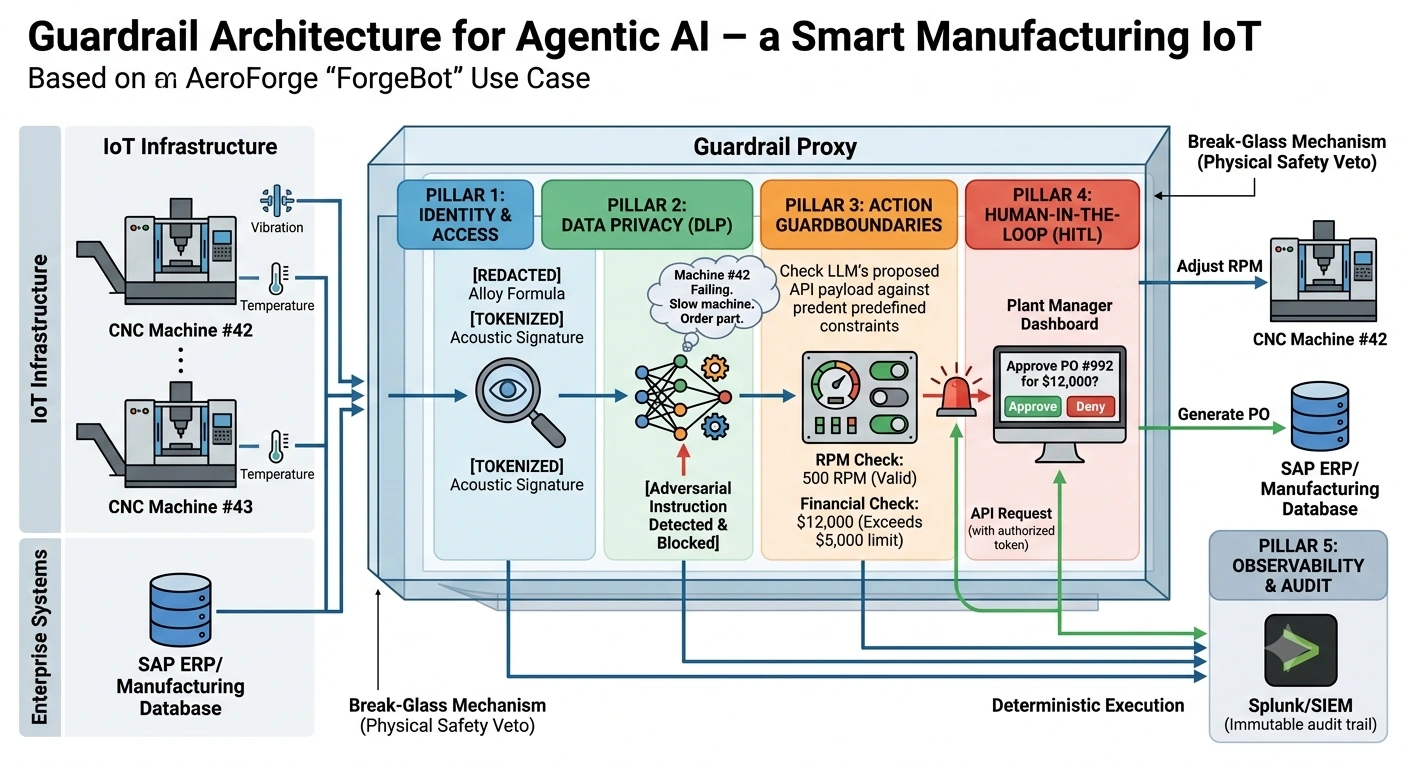
The 4 Pillars of Enterprise Agent Guardrails
Designing guardrails for agents requires moving beyond simple LLM prompt-filtering. You must secure the entire lifecycle of the agent's action loop:
Perception (Input) → Reasoning (LLM) → Action (API) → Observation (Output)
Pillar 1: Identity, Access, and Zero-Trust Boundaries
Agents cannot operate using hardcoded human credentials or overly broad service accounts.
Agent-Specific IAM: Every agent must have its own unique digital identity (e.g., via OIDC/OAuth2).
Micro-Scoped Permissions: ForgeBot gets READ access to SCADA sensor APIs and WRITE access only to the specific inventory SKU endpoints. It is explicitly denied access to HR, Payroll, or Financial Routing APIs.
Ephemeral Tokens: The agent requests Just-In-Time (JIT) access tokens for specific tasks, which expire immediately after the API call.
2. Data Privacy & DLP (Data Loss Prevention) Guardrails
Agents often need to pass enterprise data to an LLM to reason over it. This is where IP and PII leakage can occur.
Pre-LLM Sanitization: Before IoT telemetry or ERP data is sent to the LLM context window, a DLP guardrail intercepts it. Proprietary alloy formulas, employee IDs, or financial routing numbers are masked or tokenized.
PII/Redaction Policies: If the agent reads a maintenance ticket containing a technician's personal phone number, the guardrail strips it before the LLM processes the text.
3. Action & Execution Guardrails (The "Speed Limits")
This is the most critical layer for IoT and enterprise APIs. The LLM should propose an action, but a deterministic, rules-based engine must approve it before the API is called.
Business Logic Constraints: Hardcode physical and business limits.
Rule: CNC RPM cannot exceed 18,000.
Rule: Auto-approved POs cannot exceed $5,000.
State-Machine Validation: Ensure the agent isn't trying to execute out-of-order operations (e.g., trying to order a part for a machine that isn't scheduled for maintenance).
Rate Limiting & Circuit Breakers: If an agent enters an infinite loop trying to fix a sensor error, the circuit breaker cuts off its API access to prevent DDoS-ing the internal ERP system.
4. Human-in-the-Loop (HITL) & Escalation
Not all actions can be fully autonomous. Guardrails must classify actions by risk tier.
Tier 1 (Low Risk): Read sensor data, update dashboard. → Agent acts autonomously.
Tier 2 (Medium Risk): Order $500 worth of standard lubricants. → Agent acts, logs for asynchronous human review.
Tier 3 (High Risk): Alter CNC feed rates, order $50,000 in raw materials. → Agent pauses and triggers a Slack/Teams approval request to a human engineer.
End-to-End Architecture: The Guardrail Proxy
To implement this without rewriting every enterprise API, organizations use a Guardrail Proxy / Agent Orchestrator Layer (utilizing frameworks like NVIDIA NeMo Guardrails, AWS Bedrock Guardrails, or custom API gateways).
The Real-Time Flow: A Day in the Life of ForgeBot
Let’s trace a real-time event through the guardrail architecture.
Event: Sensor API reports that CNC Machine #42 is vibrating abnormally and overheating.
Step 1: Perception & Data Sanitization (Input Guardrail)
Action: ForgeBot queries the SCADA API for Machine #42's telemetry.
Guardrail Intervention: The data stream includes a proprietary acoustic signature. The DLP Guardrail intercepts the payload, hashes the proprietary frequency data, and replaces it with a generic token
[REDACTED_IP_ACOUSTIC]before passing it to the LLM's context window.
Step 2: Reasoning & Intent Classification
Action: The LLM analyzes the tokenized data and decides: "Machine #42 is failing. I must slow the machine to prevent damage and order a replacement spindle."
Guardrail Intervention: The Intent Guardrail classifies the proposed actions:
ADJUST_MACHINE_RPMandGENERATE_PO.
Step 3: Execution Boundary Check (Action Guardrail)
Action: The Agent generates the API payload to set Machine #42 RPM to 500 (Emergency Slowdown) and requests a PO for 1 spindle ($12,000).
Guardrail Intervention (The Proxy Layer):
Check 1 (Physical Safety): The proxy checks the SCADA API schema. An RPM of 500 is valid. (Pass)
Check 2 (Financial Limit): The proxy checks the ERP financial limits. The PO is $12,000. The auto-approve limit is $5,000. (Fail – Escalation Triggered)
Check 3 (Hallucination/Safety): What if the LLM hallucinated and tried to set the RPM to -5000 or 99999? The deterministic proxy rejects any value outside the 0–18000 integer bounds. (Pass/Fail based on LLM output)
Step 4: Human-in-the-Loop (HITL)
Action: Because the PO exceeded the financial threshold, the Guardrail Proxy blocks the ERP API call.
Intervention: The Proxy sends a notification to the Plant Manager's dashboard: "ForgeBot requests PO #992 for $12,000 due to Machine #42 anomaly. Approve/Deny?"
Resolution: The human clicks "Approve." The Proxy injects the human authorization token into the API header and executes the ERP call.
Step 5: Output & Observability
Action: The machine slows down; the PO is placed.
Guardrail Intervention: The Observability Layer logs the entire trace:
Sensor Input → DLP Masking → LLM Reasoning → Proxy Rule Check → HITL Approval → API Execution
This immutable audit trail is sent to the enterprise SIEM (e.g., Splunk) for compliance and debugging.
Best Practices for Enterprise Deployment
If you are building agentic systems for sensitive environments, adhere to these golden rules:
Treat Prompts as Untrusted Input: Assume that any data the agent reads (IoT logs, emails, PDFs) could contain a "Prompt Injection" designed to hijack the agent's behavior. Use input guardrails to detect and strip adversarial instructions.
Separate the "Brain" from the "Hands": Never let the LLM directly construct the final HTTP request to a critical API. The LLM should output a structured JSON intent, for example:
{
  "action": "set_rpm",
  "value": 500
}
A deterministic, non-LLM code layer must validate that JSON and execute the API call.
Implement "Break-Glass" Mechanisms: In IoT and manufacturing, network latency or LLM hallucinations can be fatal. Always maintain a parallel, hard-coded, rule-based PLC/SCADA safety system that operates independently of the AI agent. If the AI agent tries to override physical safety limits, the hardware-level guardrail must veto it.
Red-Team Your Agents: Before deploying, use automated red-teaming tools to attack your agent. Feed it poisoned IoT data, attempt prompt injections via maintenance logs, and try to trick it into accessing out-of-scope ERP databases.
Conclusion
The transition from AI as a "copilot" to AI as an "autonomous agent" is the next great leap in enterprise productivity. However, in environments like manufacturing IoT, the cost of failure is measured in broken machinery, halted production lines, and physical safety.
By implementing a robust, multi-layered guardrail architecture—encompassing Zero-Trust IAM, DLP sanitization, deterministic action boundaries, and Human-in-the-Loop escalations—enterprises can harness the power of Agentic AI without surrendering control. Guardrails are not a bottleneck to innovation; they are the very foundation that makes enterprise-scale AI possible.
Join the conversation! Your thoughts help the community grow.