

Introduction
In the era of AI-driven architectures, deploying a Retrieval-Augmented Generation (RAG) system is only half the battle. When an enterprise multi-agent system fails—whether through silent hallucinations, latency spikes, vector database timeouts, or state corruption—Mean Time To Recovery (MTTR) becomes the ultimate measure of engineering effectiveness.
Traditional debugging approaches break down quickly in distributed AI systems because a single user request can traverse multiple microservices, trigger several LLM calls, execute graph transitions, interact with memory stores, and query vector databases before generating a response.
This article provides an end-to-end blueprint for building an observability framework for Python microservices specifically designed for Enterprise Multi-Agent LangGraph RAG systems with persistent state and memory. We will explore architectural patterns, telemetry standards, distributed tracing, structured logging, and provide a complete implementation using OpenTelemetry, Structlog, and LangGraph.
The Enterprise Multi-Agent LangGraph RAG Use Case
To ground the observability design, consider an Enterprise Knowledge Assistant deployed as multiple microservices for scalability and fault isolation.
Architecture
The system consists of three primary services:
Orchestrator Microservice
Responsible for:
Hosting the LangGraph workflow
Managing state transitions
Coordinating agent execution
Maintaining memory persistence
Retriever Microservice
Responsible for:
Vector database queries
Embedding generation
Chunk retrieval
Relevance filtering
Generator Microservice
Responsible for:
Prompt construction
LLM orchestration
Response synthesis
Answer generation
LangGraph State and Memory
The workflow persists state through a checkpointer such as PostgreSQL.
The state contains:
Conversation history
Retrieved context
Relevance scores
Routing decisions
Agent outputs
This persistence enables:
Long-running workflows
Human-in-the-loop interventions
Recovery after failures
The MTTR Challenge
Imagine a user asks:
What is our Q3 revenue policy?
The assistant responds with outdated Q2 information.
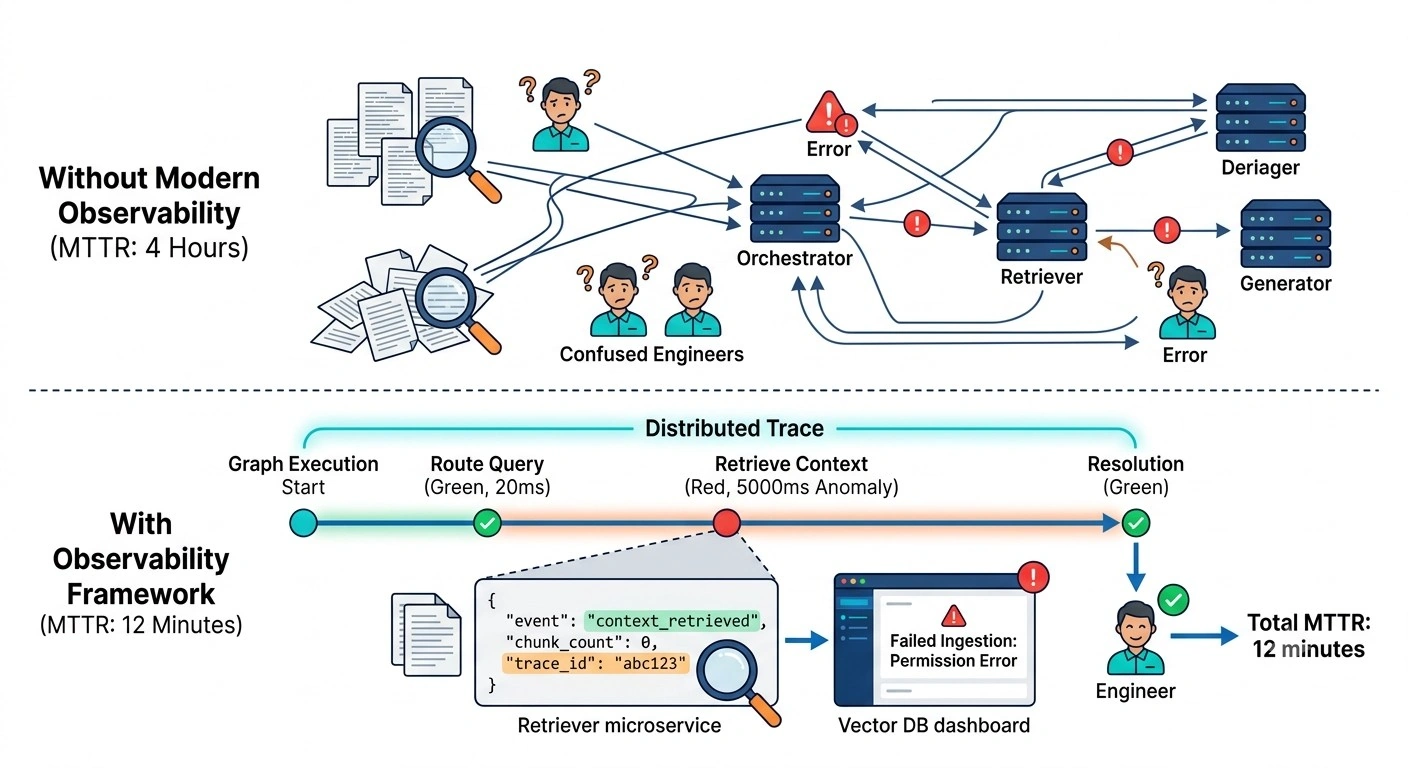
Without observability, engineers must manually investigate:
Did the Orchestrator route correctly?
Did the Retriever return incorrect chunks?
Did the Generator ignore context?
Did memory contain stale data?
Correlating logs across services can take hours.
With proper observability, the root cause becomes visible in minutes.
Observability Patterns to Enforce
To reduce MTTR, four mandatory patterns should be implemented across every service.
Pattern 1: W3C Trace Context Propagation
Every incoming request should generate a distributed trace.
The trace context must propagate across:
LangGraph nodes
HTTP requests
Vector database calls
LLM requests
This creates a single end-to-end execution trace.
Benefits
Complete request visibility
Cross-service debugging
Dependency analysis
Performance bottleneck detection
Pattern 2: Structured JSON Logging
Plain text logging should be avoided.
Instead, all logs should be emitted as structured JSON.
Every log entry should include:
trace_id
span_id
service_name
graph_run_id
agent_name
Benefits
Fast filtering
Machine-readable logs
Better dashboards
Easier incident response
Pattern 3: GenAI Semantic Conventions
OpenTelemetry semantic conventions should be used for AI workloads.
Examples include:
gen_ai.system
gen_ai.request.model
gen_ai.response.finish_reason
gen_ai.usage.prompt_tokens
gen_ai.usage.completion_tokens
Additional LangGraph-specific attributes should be added:
langgraph.node.name
langgraph.route.decision
langgraph.state.transition
langgraph.thread_id
Benefits
Standardized telemetry
Cross-platform compatibility
Better observability dashboards
Pattern 4: State Checkpoint Telemetry
Every state transition should emit telemetry.
Important events include:
Checkpoint creation
State restoration
Graph interrupts
Human review actions
Benefits
State replay
Root cause analysis
Compliance auditing
Recovery workflows
End-to-End Implementation
Prerequisites
pip install \
langgraph \
langchain-openai \
langchain-core \
opentelemetry-api \
opentelemetry-sdk \
opentelemetry-exporter-otlp \
structlog \
httpx
Step 1: Configure OpenTelemetry and Structlog
The observability foundation combines distributed tracing with structured logging.
import structlog

from opentelemetry import trace
from opentelemetry.sdk.trace import TracerProvider
from opentelemetry.sdk.trace.export import (
    BatchSpanProcessor
)
from opentelemetry.exporter.otlp.proto.grpc.trace_exporter import (
    OTLPSpanExporter
)
from opentelemetry.sdk.resources import Resource

resource = Resource.create(
    {
        "service.name":
        "orchestrator-rag-agent"
    }
)

provider = TracerProvider(
    resource=resource
)

exporter = OTLPSpanExporter(
    endpoint="http://localhost:4317",
    insecure=True
)

provider.add_span_processor(
    BatchSpanProcessor(exporter)
)

trace.set_tracer_provider(provider)

tracer = trace.get_tracer(__name__)
Inject Trace Context Into Logs
def add_otel_context(
    logger,
    method_name,
    event_dict
):
    span = trace.get_current_span()

    if span.is_recording():
        ctx = span.get_span_context()

        event_dict["trace_id"] = format(
            ctx.trace_id,
            "032x"
        )

        event_dict["span_id"] = format(
            ctx.span_id,
            "016x"
        )

    return event_dict
Configure Structlog
structlog.configure(
    processors=[
        structlog.stdlib.add_log_level,
        add_otel_context,
        structlog.processors.TimeStamper(
            fmt="iso"
        ),
        structlog.processors.JSONRenderer()
    ]
)

log = structlog.get_logger()
Step 2: Define LangGraph State
The workflow state serves as the shared memory layer.
from typing import (
    TypedDict,
    Annotated,
    Sequence
)

from langchain_core.messages import (
    BaseMessage
)

from langgraph.graph.message import (
    add_messages
)

class AgentState(TypedDict):

    messages: Annotated[
        Sequence[BaseMessage],
        add_messages
    ]

    retrieved_context: str

    is_context_relevant: bool

    memory_key: str
Step 3: Distributed Microservice Calls
Every downstream call should automatically propagate tracing headers.
from opentelemetry.propagate import inject

def call_downstream_microservice(
    url: str,
    payload: dict
):

    headers = {}

    inject(headers)

    log.info(
        "downstream_call",
        url=url,
        headers=headers
    )

    return {
        "mock_response":
        "retrieved context"
    }
Step 4: Implement LangGraph Nodes
Router Agent
def route_query(state):

    with tracer.start_as_current_span(
        "route_query_node"
    ) as span:

        span.set_attribute(
            "langgraph.node.name",
            "route_query"
        )

        query = state["messages"][-1].content

        route = (
            "retrieve"
            if "policy" in query.lower()
            else "general_chat"
        )

        span.set_attribute(
            "langgraph.route.decision",
            route
        )

        log.info(
            "routing_query",
            query=query
        )

        return {
            "route": route
        }
Retriever Agent
def retrieve_context(state):

    with tracer.start_as_current_span(
        "retrieve_context_node"
    ) as span:

        query = state["messages"][-1].content

        result = call_downstream_microservice(
            "http://retriever/api/search",
            {
                "query": query,
                "top_k": 5
            }
        )

        span.set_attribute(
            "gen_ai.system",
            "pinecone"
        )

        span.set_attribute(
            "retrieved.chunk_count",
            5
        )

        log.info(
            "context_retrieved",
            chunk_count=5
        )

        return {
            "retrieved_context":
            result["mock_response"]
        }
Context Grader
def grade_context(state):

    with tracer.start_as_current_span(
        "grade_context_node"
    ) as span:

        relevant = (
            len(
                state.get(
                    "retrieved_context",
                    ""
                )
            ) > 10
        )

        span.set_attribute(
            "context.relevance_score",
            0.95
            if relevant
            else 0.2
        )

        return {
            "is_context_relevant":
            relevant
        }
Generator Agent
def generate_answer(state):

    with tracer.start_as_current_span(
        "generate_answer_node"
    ) as span:

        result = call_downstream_microservice(
            "http://generator/api/generate",
            {
                "context":
                state["retrieved_context"]
            }
        )

        span.set_attribute(
            "gen_ai.request.model",
            "gpt-4o"
        )

        log.info(
            "answer_generated",
            token_count=150
        )

        return {
            "messages": [
                HumanMessage(
                    content=
                    "Mock final answer."
                )
            ]
        }
Step 5: Build the LangGraph
from langgraph.graph import (
    StateGraph,
    START,
    END
)

workflow = StateGraph(
    AgentState
)

workflow.add_node(
    "route",
    route_query
)

workflow.add_node(
    "retrieve",
    retrieve_context
)

workflow.add_node(
    "grade",
    grade_context
)

workflow.add_node(
    "generate",
    generate_answer
)
Define Edges
workflow.add_edge(
    START,
    "route"
)

workflow.add_conditional_edges(
    "route",
    lambda state:
    state.get(
        "route",
        "general_chat"
    ),
    {
        "retrieve":
        "retrieve",

        "general_chat":
        END
    }
)

workflow.add_edge(
    "retrieve",
    "grade"
)

workflow.add_conditional_edges(
    "grade",
    lambda state:
    "generate"
    if state[
        "is_context_relevant"
    ]
    else END
)

workflow.add_edge(
    "generate",
    END
)
Compile With Memory
from langgraph.checkpoint.memory import (
    MemorySaver
)

memory = MemorySaver()

graph = workflow.compile(
    checkpointer=memory
)
Real-Time Incident Analysis
The Incident
Users report:
The assistant is ignoring the new Q3 policy and returning outdated Q2 information.
Without Observability
Typical MTTR:
3–4 hours
Engineers must:
SSH into containers
Search logs manually
Compare timestamps
Correlate services manually
With This Framework
Typical MTTR:
10–15 minutes
Step 1: Locate Trace
Search:
langgraph.thread_id
or
trace_id
Step 2: Visualize Execution
Example trace:
route_query_node      20ms
retrieve_context_node 5000ms
generate_answer_node  200ms
The anomaly becomes immediately obvious.
Step 3: Inspect Span
Attributes reveal:
{
  "gen_ai.system": "pinecone",
  "retrieved.chunk_count": 0
}
Step 4: Root Cause
Structured logs show:
{
  "event": "context_retrieved",
  "chunk_count": 0,
  "trace_id": "abc123"
}
The retriever returned no documents.
Step 5: Resolution
Investigation reveals:
Q3 documents failed ingestion
Permission issue in vector indexing pipeline
Reindexing resolves the incident
MTTR drops from hours to minutes.
Enterprise Production Enhancements
Metrics
Track:
Retrieval latency
LLM latency
Token usage
State transitions
Cache hit rates
Hallucination scores
Dashboards
Build dashboards for:
Agent execution timelines
LangGraph node durations
Retrieval quality
Cost tracking
Memory growth
Alerting
Alert on:
Empty retrievals
High latency
Failed checkpoints
Excessive token usage
Hallucination indicators
Compliance
Persist:
Trace IDs
Prompt versions
State snapshots
Retrieved documents
Model responses
This creates a complete audit trail.
Conclusion
Observability is a foundational requirement for enterprise AI systems. Multi-agent RAG architectures introduce distributed workflows, state persistence, memory layers, vector retrieval, and LLM orchestration, all of which increase debugging complexity. By combining OpenTelemetry distributed tracing, structured JSON logging, GenAI semantic conventions, and LangGraph state telemetry, organizations gain complete visibility into every stage of execution.
Rather than spending hours correlating logs across services, engineers can identify failures, trace execution paths, inspect state transitions, and resolve incidents within minutes. The result is a resilient, debuggable, and enterprise-ready AI platform that minimizes downtime and dramatically improves operational reliability.
Join the conversation! Your thoughts help the community grow.