

Pre-requisite to understand this
API (Application Programming Interface) – A contract that allows clients to interact with backend services.
HTTP Requests/Responses – Communication model used by APIs.
DoS Attack – An attack that overwhelms a system with excessive requests to make it unavailable.
API Gateway – An entry point that manages, secures, and routes API traffic.
Client Identity – API key, IP address, OAuth token, or user ID used to identify callers.
Traffic Bursts – Sudden spikes in requests within a short time window.
Introduction
API Rate Limiting and Throttling are defensive mechanisms used to control the volume and speed of incoming API requests. They act as protective barriers that prevent systems from being overwhelmed by excessive or malicious traffic. In the context of Denial-of-Service (DoS) attacks, these mechanisms ensure that backend services remain available and responsive even under abnormal request loads. By enforcing usage limits and regulating request flow, systems can distinguish between legitimate users and abusive patterns. These techniques are widely implemented at API gateways, load balancers, or middleware layers. Together, they form a critical part of modern API security and resilience strategies.
What problem we can solve with this?
DoS attacks aim to exhaust system resources such as CPU, memory, threads, or database connections by flooding APIs with requests. Without control mechanisms, a single malicious client or botnet can consume all available capacity, denying service to legitimate users. Rate limiting and throttling directly address this by placing boundaries on how APIs can be consumed. They prevent uncontrolled traffic growth, protect backend dependencies, and ensure fair resource distribution. These controls also help mitigate accidental overloads caused by buggy clients or misconfigured integrations. By applying limits early in the request lifecycle, systems fail fast and conserve critical resources. This results in higher availability, predictable performance, and improved system stability.
Problems solved:
Prevents APIs from being overwhelmed by excessive requests
Blocks or slows malicious traffic patterns
Protects backend services and databases
Ensures fair usage among all clients
Reduces infrastructure cost caused by traffic spikes
Improves system availability during attack scenarios
How to implement/use this?
Rate limiting and throttling are typically implemented at the API Gateway or edge layer, where all requests pass before reaching backend services. Each request is evaluated based on client identity such as IP address, API key, or user token. Counters or tokens are maintained using in memory stores like Redis for fast lookups. When a request exceeds the allowed rate, it is either rejected with an HTTP 429 response or delayed based on throttling rules. Advanced implementations use algorithms like Token Bucket, Leaky Bucket, or Sliding Window. Limits can be dynamic, tier-based, or adaptive depending on traffic behavior. Proper monitoring and alerting are essential to tune limits without impacting legitimate users.
Implementation steps:
Identify clients using IP, API key, or authentication token
Define request limits per time window
Track request counts using fast storage (Redis, in-memory cache)
Reject or delay requests when limits are exceeded
Return proper HTTP status codes and headers
Monitor traffic and adjust thresholds dynamically
Sequence Diagram (Rate Limiting & Throttling Flow)
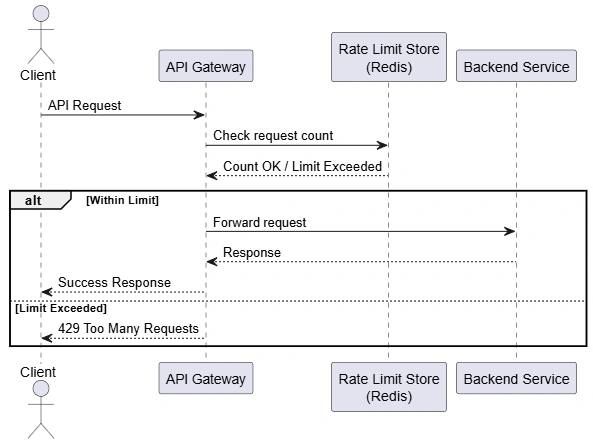
This sequence diagram shows how rate limiting and throttling operate in real time. When a client sends a request, it first reaches the API Gateway, which acts as a control checkpoint. The gateway consults a rate-limit store (commonly Redis) to verify whether the client is within allowed limits. If the request count is acceptable, the request proceeds to the backend service and returns a normal response. If the limit is exceeded, the request is blocked immediately with a 429 error. This early rejection prevents backend resource exhaustion during DoS attacks.
Key points:
API Gateway is the enforcement point
Rate limit store enables fast decision making
Backend is protected from excessive traffic
429 response signals clients to slow down
Component Diagram (Logical Architecture)
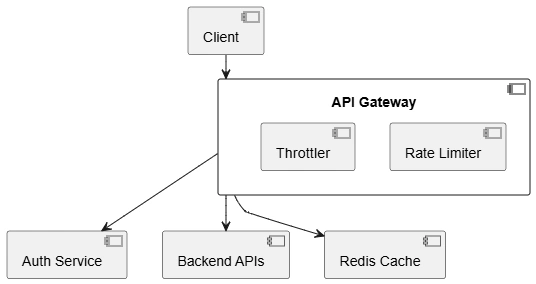
This component diagram illustrates the logical building blocks involved in rate limiting and throttling. The API Gateway hosts dedicated components responsible for enforcing request limits and traffic shaping. Authentication services help identify clients and apply appropriate policies. Redis acts as a centralized, high-performance store for counters and tokens. Backend APIs are isolated behind the gateway, ensuring they only receive approved traffic. This modular architecture allows independent scaling and configuration of traffic control mechanisms.
Key points:
Rate limiting and throttling are gateway responsibilities
Redis provides low-latency request tracking
Authentication enables client-specific policies
Backend services remain shielded from attacks
Deployment Diagram (Physical Deployment)
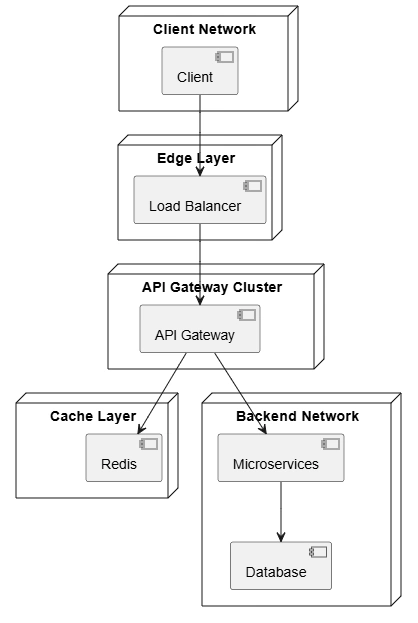
This deployment diagram shows how rate limiting and throttling fit into real infrastructure. Client traffic enters through a load balancer and is routed to an API Gateway cluster. The gateway enforces rate limits by consulting Redis before forwarding requests. Backend microservices and databases are deployed in a protected network zone. During a DoS attack, excessive traffic is filtered at the gateway layer, preventing internal services from being impacted. This layered deployment significantly improves system resilience.
Key points:
Rate limiting occurs at the edge of the system
Gateway cluster scales independently
Redis supports distributed rate limiting
Backend services are isolated from attack traffic
Advantages
Prevents denial-of-service attacks effectively
Protects backend systems and databases
Ensures fair usage across clients
Improves system availability and reliability
Reduces infrastructure cost from overload
Enables predictable API performance
Summary
API Rate Limiting and Throttling are essential mechanisms for defending systems against Denial-of-Service attacks. By controlling both the volume and speed of incoming requests, they prevent malicious or accidental overloads from disrupting services. Implemented primarily at the API Gateway layer, these techniques ensure that backend resources are used efficiently and fairly. Sequence, component, and deployment architectures clearly demonstrate how traffic is evaluated and controlled before reaching critical services. When properly designed and monitored, rate limiting and throttling significantly enhance system resilience, security, and overall performance in modern distributed architectures.
Join the conversation! Your thoughts help the community grow.