
Introduction
Every digital product we use today — from social media apps to AI tools — runs on one foundation: Cloud Computing.
But as technology moves toward real-time experiences like autonomous vehicles, smart cities, and remote medical systems, a new architecture is becoming essential:
Edge Computing.
For developers in India and across the global tech industry, understanding Edge vs Cloud is no longer optional — it is a future-critical skill.
What Is Cloud Computing?
Cloud Computing means storing data and running application logic in centralized remote data centers.
When a user performs an action:
The request travels to a distant cloud server
The cloud processes the data
The result is sent back to the user
Cloud enables:
Massive data storage
Scalable applications
Global availability
High computing power
Popular services like Google Drive, Netflix, AWS, Azure, and AI tools like ChatGPT all operate on cloud infrastructure.
The Key Limitation of Cloud: Latency
While cloud is powerful, it has one unavoidable challenge:
Latency — delay caused by distance.
For most apps, small delays are acceptable.
But for next-generation systems, even milliseconds matter.
Examples:
Self-driving cars making instant decisions
Surgeons performing remote robotic operations
Real-time multiplayer gaming
Industrial IoT control systems
In such cases, sending data to distant cloud servers is too slow.
This is where Edge Computing enters.
What Is Edge Computing?
Edge Computing shifts data processing closer to the user.
Instead of sending every request to a central cloud:
Data is processed near the source
Edge devices handle real-time computation
Only necessary data is sent to the cloud
Examples of edge devices:
Smart cameras
IoT sensors
5G base stations
Autonomous vehicle systems
Smart factory controllers
The result is:
Near-zero latency
Instant response
Reduced bandwidth usage
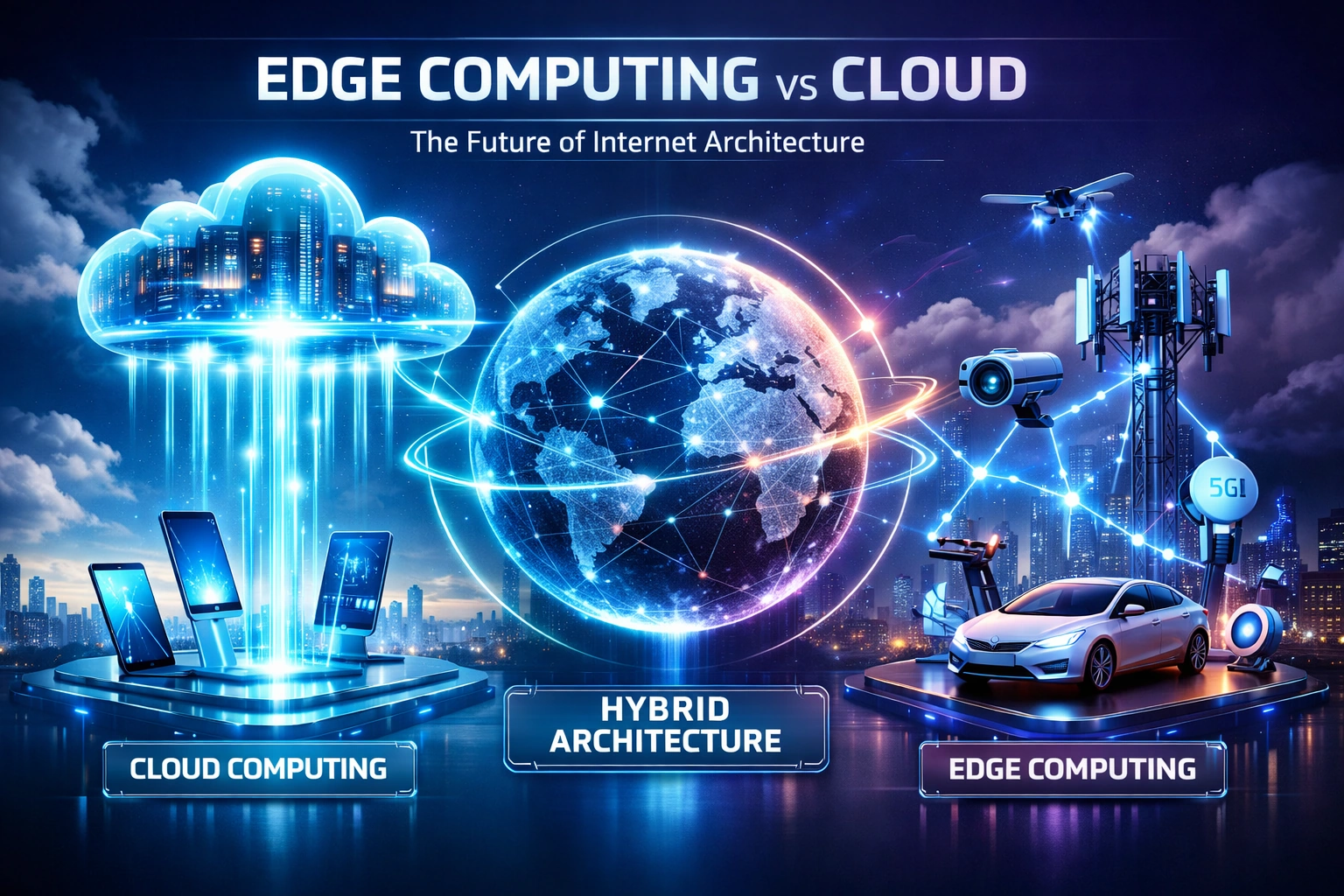
Edge vs Cloud
| Feature | Cloud Computing | Edge Computing |
|---|---|---|
| Processing Location | Central data centers | Near the user |
| Latency | Higher | Very low |
| Best For | Heavy computing & storage | Real-time decisions |
| Examples | AI model training, databases | IoT, autonomous systems |
The Future: Hybrid Cloud +Edge Architecture
The next internet architecture will follow a hybrid model:
Cloud handles storage, analytics, AI training
Edge handles instant data processing
Both work together seamlessly
This hybrid model will power:
Smart cities
Connected healthcare
Autonomous transport
Real-time AI systems
Industrial automation
Why Developers Must Understand Edge + Cloud
Future software systems will require:
Distributed system design
Edge device integration
Real-time data pipelines
Hybrid cloud deployment
New security architectures
Developers who master:
Cloud infrastructure
Edge computing frameworks
IoT integration
Network-aware application design
will be in high demand globally.
For India’s rapidly growing tech ecosystem, this skillset aligns directly with emerging startup and enterprise needs.
Global and Indian Market Shift
Across the world:
Telecom companies are deploying edge data centers
Cloud providers are offering edge services
Governments are investing in smart city infrastructure
In India:
5G expansion is accelerating edge adoption
IoT startups are scaling rapidly
Manufacturing automation is increasing
This creates strong demand for developers who understand hybrid computing models.
Final Thoughts
Cloud built the current digital world.
Edge will build the next one.
But the true future belongs to:
Cloud + Edge working together.
For developers in India and worldwide, learning this architecture today means being ready for tomorrow’s real-time, AI-driven, hyper-connected internet.
Join the conversation! Your thoughts help the community grow.