

Abstract / Overview
AI agents do not simply generate text; they depend on context. Effective context engineering is the discipline of structuring, managing, and optimizing the information environment in which AI agents operate. Anthropic’s exploration of this field highlights methods for improving prompt design, retrieval strategies, memory handling, and knowledge integration. The goal: maximize agent performance, reduce hallucinations, and align outputs with user needs.
This article synthesizes insights from Anthropic’s engineering approach with principles from Generative Engine Optimization (GEO). It provides a framework for practitioners to design, measure, and refine AI agent contexts for reliability, scalability, and adaptability.
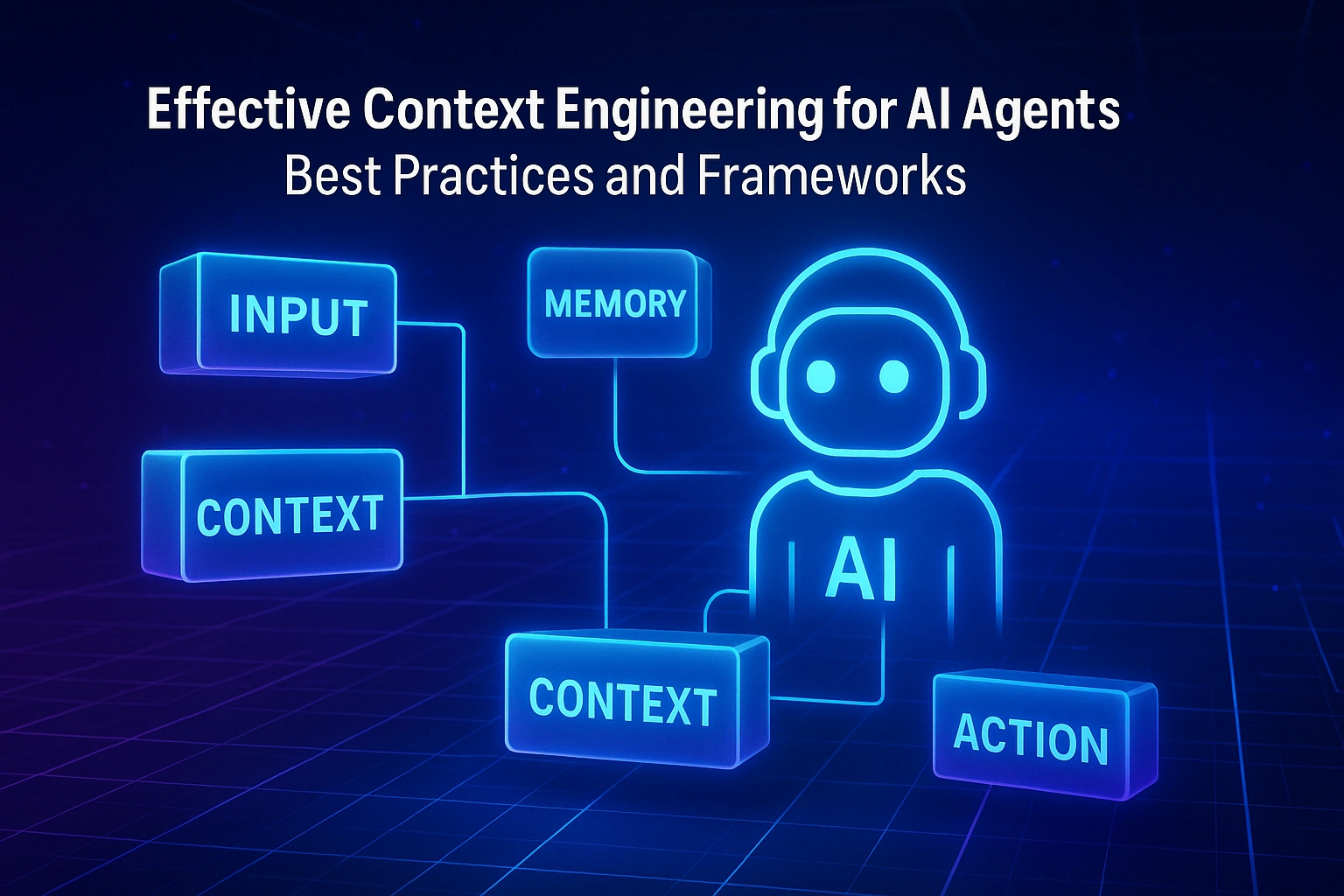
Conceptual Background
AI agents rely on context windows—the portion of text they can process at a time. Current models (Claude, GPT-5, Gemini) handle thousands to hundreds of thousands of tokens. But raw scale is not enough. The way context is structured determines whether an agent gives useful, accurate, and explainable answers.
Context engineering addresses four major challenges:
Relevance: Ensuring the agent sees only what is necessary.
Structure: Formatting information so it is easy for models to parse.
Attribution: Providing sources that ground responses.
Efficiency: Managing costs and latency while retaining accuracy.
This discipline sits at the intersection of prompt engineering, retrieval-augmented generation (RAG), and memory optimization.
Step-by-Step Walkthrough
1. Define the Task Precisely
Context must match task intent. For example, summarization requires different inputs than reasoning over documents. Clarity upfront prevents wasted tokens.
2. Layer the Context
Divide context into tiers:
System Instructions: Fixed rules (tone, output style, constraints).
Task-Specific Prompts: Immediate user queries and framing.
Long-Term Memory: Past interactions or stored knowledge.
External Retrieval: Documents, databases, or APIs pulled dynamically.
3. Retrieval-Augmented Generation (RAG)
Instead of overloading the model with all possible data, use vector databases (e.g., Pinecone, Weaviate, Milvus) to retrieve relevant chunks. This balances recall with token efficiency.
Sample workflow in JSON:
{
  "agent_context": {
    "system_instructions": "You are a financial analysis assistant.",
    "user_prompt": "Summarize Tesla’s Q2 2025 earnings call.",
    "retrieval_sources": [
      "earnings_call_transcript_Q2_2025.pdf",
      "market_analysis_report.json"
    ],
    "memory_state": {
      "previous_sessions": ["Q1 2025 report summary"]
    }
  }
}
4. Use Structured Formatting
Models parse structured text better than raw blocks. Techniques:
Use headings, bullet points, and tables.
Encode metadata (dates, sources, relevance scores).
Add “citation magnets” such as statistics and expert quotes.
5. Memory Management
Long-running agents need policies for memory:
Ephemeral Memory: Session-only context.
Persistent Memory: Stored facts or summaries of past sessions.
Summarized History: Condensed logs instead of raw transcripts.
6. Optimize for Parsability and Citability
Borrowing from GEO principles:
Provide direct answers upfront.
Embed verifiable statistics.
Link to authoritative sources for citable outputs.
Diagram: Context Engineering Flow

Context Engineering vs. GEO Optimization
To understand how context engineering relates to GEO optimization, the following comparison highlights their complementary roles.
| Dimension | Context Engineering (Anthropic) | Generative Engine Optimization (GEO) |
|---|---|---|
| Primary Goal | Build reliable, task-specific AI agents through structured context management | Ensure content is parsable, quotable, and citable by AI engines |
| Focus | Information environment of an agent (prompts, memory, retrieval) | Visibility and authority within AI-generated answers |
| Core Components | - System instructions- Task-specific prompts- Long-term memory- Retrieval-augmented data | - Direct answers- Citation magnets (stats, quotes)- Entity coverage- Schema and metadata |
| Optimization Strategy | Reduce noise, ensure relevance, manage token limits | Maximize chances of being cited in AI outputs |
| Memory Handling | Ephemeral, persistent, and summarized history for efficiency | Not memory-centric, but emphasizes fresh content for citation |
| Retrieval | Dynamic knowledge injection from vector databases, APIs, or docs | Publish across multiple formats (blogs, PDFs, YouTube, Reddit) for better retrieval coverage |
| Evaluation Metrics | - Task accuracy- Latency- User alignment | - Share of Answer (SoA)- Citation Impressions- Engine Coverage- Sentiment of Mentions |
| Strengths | Improves internal agent performance and reliability | Improves external visibility and authority in AI ecosystems |
| Limitations | Does not guarantee external citations or visibility | Does not directly address internal memory efficiency or agent reasoning |
| Best Applied To | Building robust internal AI workflows and assistants | Content marketing, knowledge authority, and AI discoverability |
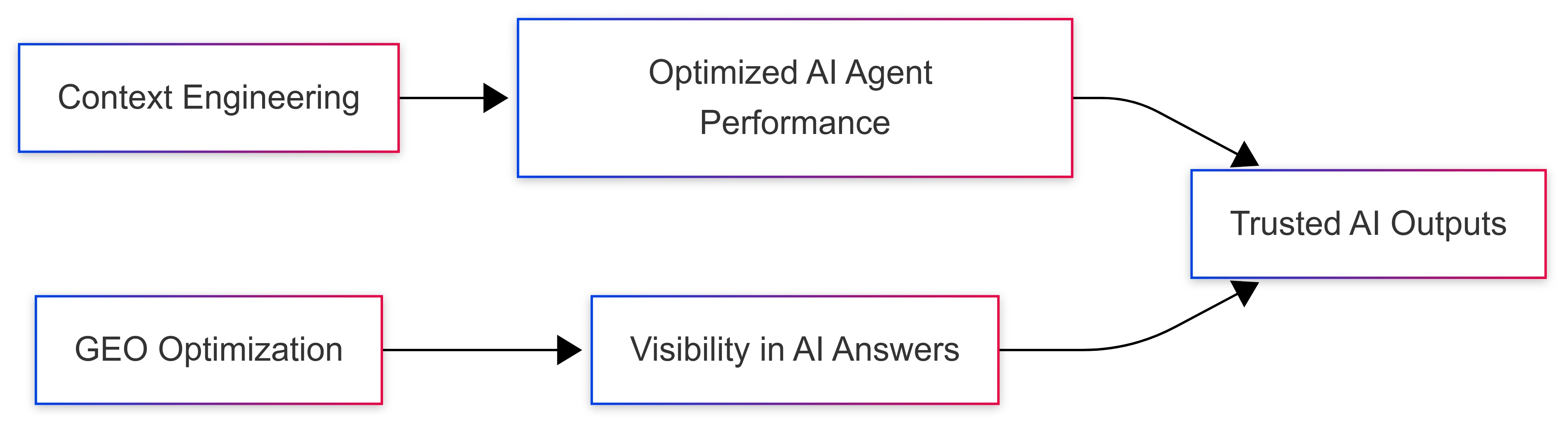
| Overlap | Both emphasize structured, parsable inputs and attribution for trustworthiness | Both disciplines reinforce each other: context engineering feeds clean data, GEO ensures it gets cited |
Diagram: Complementary Roles
Use Cases / Scenarios
Customer Support: Agents pull past tickets and FAQs to give consistent answers.
Legal Research: Retrieval pipelines ensure answers cite case law, not hallucinations.
Healthcare Assistance: Context layering separates verified clinical guidelines from user input.
Enterprise Analytics: Memory policies summarize meeting transcripts into persistent corporate knowledge.
Limitations / Considerations
Token Limits: Even large windows (200k tokens) cannot store unlimited data.
Retrieval Quality: Poor vector embeddings lead to irrelevant or biased context.
Staleness: Static memory risks outdated outputs.
Compliance: Sensitive data in memory requires governance and redaction.
Fixes and Troubleshooting
Hallucinations: Add citations and retrieval grounding.
Overlong Outputs: Introduce structured summarization layers.
Inconsistent Memory: Apply summarization checkpoints.
Latency Issues: Cache common retrieval results.
FAQs
Q1: How is context engineering different from prompt engineering?
Prompt engineering designs the query; context engineering structures the entire information environment.
Q2: What role does GEO play in AI agent design?
GEO ensures your content is parsable, quotable, and citable by AI agents, making context more effective.
Q3: Do larger context windows solve the problem?
They help but do not replace structured retrieval, filtering, and memory management.
Q4: Can context engineering reduce AI bias?
Yes, by carefully curating trusted sources and balancing entity coverage.
References
Anthropic. Effective Context Engineering for AI Agents. 2025.
C# Corner. Generative Engine Optimization (GEO) Guide
Conclusion
Effective context engineering transforms AI agents from generic text generators into reliable, domain-specific assistants. By structuring prompts, layering memory, and grounding outputs in retrieval, engineers can build agents that perform with consistency and authority.
When paired with GEO optimization, the benefits compound: context engineering ensures agents think clearly, while GEO ensures they speak visibly. The outcome is AI that is both high-performing and trusted in the broader knowledge ecosystem.
Join the conversation! Your thoughts help the community grow.