
Overview
Learn how to monitor a directory in Windows 10 using C# and .NET. This article will walk you through the different approaches and techniques for monitoring directories and implementing a directory monitoring system that allows you to track file changes and take action programmatically.
Introduction
File system monitoring refers to the process of observing and tracking changes within a file system, such as creating, modifying, or deleting files or directories. It allows applications to stay informed about file system events and take appropriate actions based on those events.
Techniques
There are several ways to implement file system monitoring:
- File System Watcher: The FileSystemWatcher class is provided in the .NET framework for monitoring file system events. It enables applications to receive notifications about changes in a specified directory, including file creations, modifications, deletions, and renames.
- Polling: In this approach, the application periodically checks the file system to detect changes. It involves regularly scanning directories and comparing the current state with a previous snapshot to identify modifications. While simple to implement, it may not be as efficient as event-driven approaches.
- Database-based Tracking: This method involves storing Metadata about the files and directories in a database and periodically comparing the database entries with the current file system state to identify changes. It offers more flexibility in tracking and managing file system events.
The choice of method depends on factors like the platform, specific requirements, performance considerations, and available tools or libraries. The FileSystemWatcher class in .NET is a commonly used and efficient way to monitor file system events in Windows environments using C# and .NET.
Implementation
To monitor a folder periodically in C# and check for new files, you can use different approaches, but in this article, I will cover all the approaches. Here first 2 approaches FileSystemWatcher and Polling, are simple and easy to follow. Comparing both, polling provides a more customized way of monitoring files, but we need to write everything from scratch. Still, when coming to FileSystemWatcher, it has everything we need to do with a folder as an out-of-box. So all the methods help in some sort of scenario; check which suits your case and know the approaches and examples given below.
Approach 1 - FileSystemWatcher
The FileSystemWatcher class provided by .NET allows you to monitor changes in a specified directory. It raises events when files or directories are created, deleted, changed, or renamed within the monitored folder. This approach is event-driven and efficient as it doesn't require continuous polling.
Here's an example of how to use the FileSystemWatcher to monitor a folder every 5 seconds:
using System;
using System.IO;
using System.Threading;

class Program
{
    static void Main()
    {
        // Specify the folder path to monitor
        string folderPath = "C:\\MyFolder";

        // Create a new instance of FileSystemWatcher
        using (FileSystemWatcher watcher = new FileSystemWatcher(folderPath))
        {
            // Set the filter to monitor all files
            watcher.Filter = "*.*";

            // Subscribe to the Created event
            watcher.Created += Watcher_Created;

            // Enable the notifications
            watcher.EnableRaisingEvents = true;

            // Run indefinitely (you can modify this based on your requirement)
            while (true)
            {
                // Sleep for 5 seconds
                Thread.Sleep(5000);
            }
        }
    }

    // Event handler for the Created event
    private static void Watcher_Created(object sender, FileSystemEventArgs e)
    {
        Console.WriteLine("New file created: " + e.FullPath);
    }
}
In this example, the program creates a FileSystemWatcher object, sets the folder path to monitor, and subscribes to the Created event. Whenever a new file is created within the specified folder, the event handler (Watcher_Created) is executed.
Output

Approach 2 - Polling
Another approach is to periodically poll the folder at a specified interval to check for new files. This approach involves checking the contents of the folder at regular intervals using a timer or a loop. While it's less efficient than the FileSystemWatcher approach, it can be useful in scenarios where using FileSystemWatcher is unsuitable or allowed. Here's an example of how to use polling to monitor a folder every 5 seconds:
using System;
using System.IO;
using System.Threading;

class Program
{
    static void Main()
    {
        // Specify the folder path to monitor
        string folderPath = "C:\\MyFolder";

        // Run indefinitely (you can modify this based on your requirement)
        while (true)
        {
            // Get the list of files in the folder
            string[] files = Directory.GetFiles(folderPath);

            // Process the files as needed
            foreach (string file in files)
            {
                Console.WriteLine("File found: " + file);
            }

             Console.WriteLine("--------------------------------");

            // Sleep for 5 seconds
            Thread.Sleep(5000);
        }
    }
}
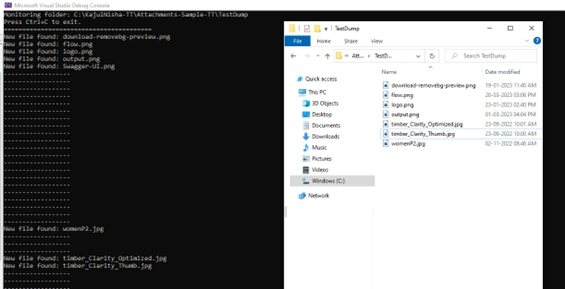
In this example, the program enters an infinite loop and periodically checks the contents of the specified folder using the Directory.GetFiles method. It then processes the files as needed.
Output
Approach 3 - Database-based Tracking:
Database-based tracking method for monitoring file system changes involves storing Metadata about files and directories in a database and periodically comparing the database entries with the current file system state to identify changes. Instead of directly monitoring the file system events, this method relies on a database to track and manage file system changes.
Here is an example, I have a class called FileSystemTracker, and I'm using this method to periodically check and update the Metadata in the DB table
1. Create a console app solution with program.cs and FileSystemTracker.cs
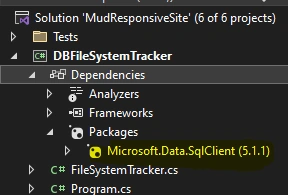
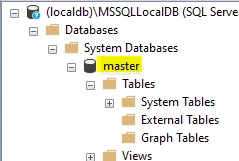
2. We are going to create a table in master DB, to track file changes and add/update records with file metadata ( this is the snap of Master DB before creating the table)
3. Add the below code in FIleSystemTracker.cs
using System.Data;
using Microsoft.Data.SqlClient;

namespace DBFileSystemTracker;

public class FileSystemTracker
{
    // Replace with your database connection string
    private string connectionString = $"Data Source=(localdb)\\MSSQLLocalDB;Initial Catalog=master;Integrated Security=True;";

    public void TrackChanges(string directoryPath)
    {
        // Connect to the database
        using (SqlConnection connection = new SqlConnection(connectionString))
        {
            connection.Open();

            // Create or update a table to store file system metadata
            string createTableQuery = "IF NOT EXISTS (SELECT * FROM sys.tables WHERE name = 'FileSystemMetadata' AND type = 'U')\r\nBEGIN\r\n    CREATE TABLE FileSystemMetadata\r\n    (\r\n        Id INT PRIMARY KEY IDENTITY,\r\n        FilePath NVARCHAR(MAX),\r\n        LastModified DATETIME\r\n    )\r\nEND\r\n";
            using (SqlCommand command = new SqlCommand(createTableQuery, connection))
            {
                command.ExecuteNonQuery();
            }

            // Retrieve existing file metadata from the database
            DataTable existingMetadata = new DataTable();
            string retrieveMetadataQuery = "SELECT FilePath, LastModified FROM FileSystemMetadata";
            using (SqlCommand command = new SqlCommand(retrieveMetadataQuery, connection))
            {
                using (SqlDataAdapter adapter = new SqlDataAdapter(command))
                {
                    adapter.Fill(existingMetadata);
                }
            }

            // Iterate through the files and directories in the specified directory
            foreach (string filePath in Directory.GetFiles(directoryPath, "*", SearchOption.AllDirectories))
            {
                // Get the last modified timestamp of the file
                DateTime lastModified = File.GetLastWriteTime(filePath);

                // Check if the file metadata exists in the database
                DataRow[] rows = existingMetadata.Select($"FilePath = '{filePath}'");
                if (rows.Length == 0)
                {
                    // File is new, insert its metadata into the database
                    string insertMetadataQuery = $"INSERT INTO FileSystemMetadata (FilePath, LastModified) VALUES ('{filePath}', '{lastModified.ToString("yyyy-MM-dd HH:mm:ss")}')";
                    using (SqlCommand command = new SqlCommand(insertMetadataQuery, connection))
                    {
                        command.ExecuteNonQuery();
                    }
                }
                else
                {
                    // File already exists, check if it has been modified
                    DateTime existingLastModified = (DateTime)rows[0]["LastModified"];
                    if (lastModified > existingLastModified)
                    {
                        // File has been modified, update its last modified timestamp in the database
                        string updateMetadataQuery = $"UPDATE FileSystemMetadata SET LastModified = '{lastModified.ToString("yyyy-MM-dd HH:mm:ss")}' WHERE FilePath = '{filePath}'";
                        using (SqlCommand command = new SqlCommand(updateMetadataQuery, connection))
                        {
                            command.ExecuteNonQuery();
                        }
                    }
                }
            }
        }
    }
}
The FileSystemTracker class provides a method called TrackChanges that takes a directory path as input and tracks changes in the file system using a database-based approach.
4. Add the below code to Program.cs
// See https://aka.ms/new-console-template for more information
using DBFileSystemTracker;

Console.WriteLine("----- Connecting FileSystem Tracker -----");

// Specify the folder path to monitor
string dirctoryPath = @"C:\Kajul\FolderNeedsToBeMonitored";

FileSystemTracker fileSystemTracker = new FileSystemTracker();

// Run indefinitely (you can modify this based on your requirement)
while (true)
{
    fileSystemTracker.TrackChanges(dirctoryPath);
    Console.WriteLine("--------------------------------");

    // Sleep for 2 seconds
    Thread.Sleep(2000);
}
Here's how it works:
- Establish a connection to the database using the provided connection string.
- Create or update a table named FileSystemMetadata in the database to store the file system metadata. This table has two columns: FilePath to store the file path and LastModified to store the last modified timestamp.
- Retrieve the existing file metadata from the database by executing a SELECT query. The retrieved Metadata is stored in a DataTable named existingMetadata.
- Iterate through the files and directories in the specified directory using Directory.GetFiles and SearchOption.AllDirectories.
- For each file, get the last modified timestamp using File.GetLastWriteTime.
- Check if the file metadata exists in the existingMetadata DataTable by using the Select method and querying for a matching file path.
- If the file metadata does not exist, the file is new. In this case, insert its Metadata into the database using an INSERT query.
- If the file metadata exists, compare the last modified timestamp of the file with the existing last modified timestamp from the database.
- If the file has been modified (the last modified timestamp is greater), update the last modified timestamp in the database using an UPDATE query.
- By periodically calling the TrackChanges method with the desired directory path, you can keep track of changes in the file system by comparing the database entries with the current file system state. This approach offers flexibility in tracking and managing file system events by leveraging the capabilities of a database.
Output

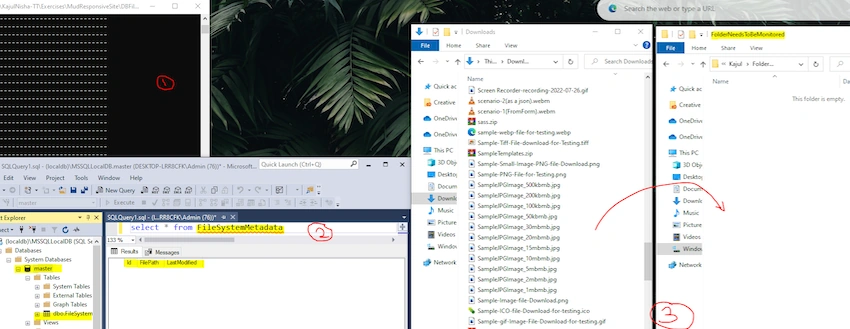
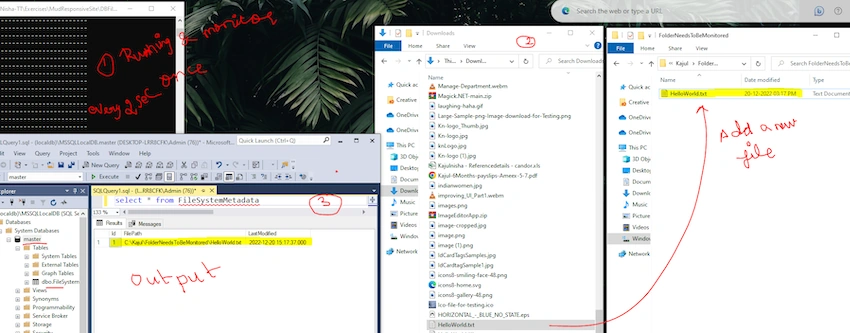
See the DB side to check whether the table has been created or not (it will be created)
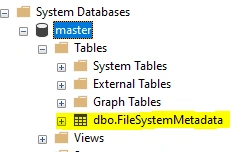
Before adding files in Path: C:\Kajul\FolderNeedsToBeMonitored
After Adding the file in the folder path: C:\Kajul\FolderNeedsToBeMonitored
I hope this article is helpful to you. Share your comments if you find this article really helpful :)
!!! Happy coding !!!
Join the conversation! Your thoughts help the community grow.