

As AI adoption accelerates, a new challenge has emerged. Many organisations can build models, but few can govern them effectively. Models move from experimentation to production quickly. Data sources change. Regulations tighten. Without proper governance, AI becomes a source of risk rather than advantage. Azure provides the structure needed to manage AI responsibly at enterprise scale.

From experimentation to accountability
In many organisations, AI initiatives begin in isolated teams. Data scientists build models, deploy endpoints, and move on to the next use case. Over time, dozens of models run in production with little oversight. No one knows which data they rely on, how they were trained, or whether they still perform as expected.
Azure Machine Learning introduces discipline into this process. Model registries track versions, metadata, and lineage. Every model is tied to training data, code, and evaluation metrics. This creates accountability and enables teams to answer a simple but critical question: why does this model behave the way it does.
Governing data before it governs outcomes
AI systems inherit the properties of their data. Bias, drift, and quality issues propagate directly into predictions. Azure helps organisations address this at the source.
Data pipelines built with Azure Data Factory and Azure Synapse Analytics ensure consistent ingestion and validation. Feature stores in Azure ML allow teams to reuse approved features rather than recreating them inconsistently across projects.
Monitoring tools detect drift when incoming data no longer matches training distributions. This prevents silent degradation that can undermine trust.
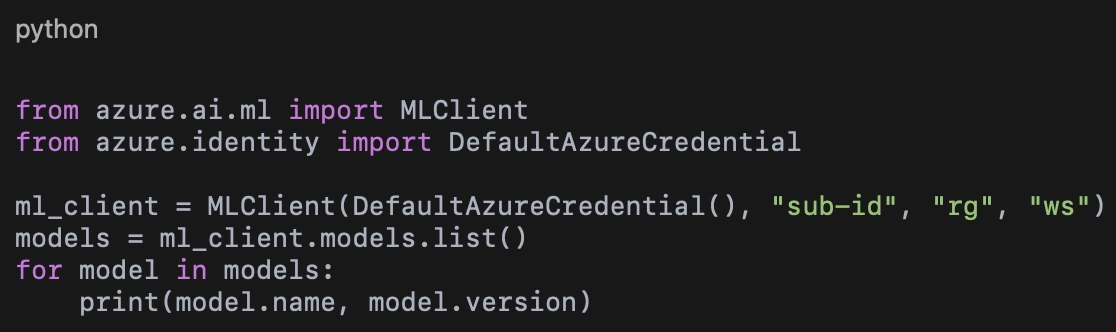
Visibility like this is the foundation of governance.
Managing risk in production
Once deployed, models must be monitored continuously. Performance metrics alone are not enough. Enterprises need to understand fairness, stability, and compliance impact.
Azure ML supports model monitoring that tracks prediction accuracy, latency, and data drift. Responsible AI dashboards provide insight into feature influence and potential bias. These tools allow risk teams and compliance officers to engage directly with AI systems, rather than relying on second-hand explanations.
Crucially, this monitoring can be automated. Alerts trigger when thresholds are breached. Rollbacks can be executed without manual intervention. AI becomes manageable at scale.
Aligning governance with regulation
Regulators are paying close attention to AI. Transparency, auditability, and explainability are becoming non-negotiable. Azure supports this shift by embedding governance into the platform rather than treating it as an afterthought.
Every training run, deployment, and inference request can be logged. Access is controlled through identity policies. Confidential Computing protects sensitive data during processing. When auditors ask how a decision was made, the evidence is already there.
This is especially important in regulated industries, but it applies to any organisation that values trust.
Organising for AI oversight
Technology alone is not enough. Governance requires organisational alignment. Azure enables clear separation of responsibilities. Data scientists build models. Platform teams manage infrastructure. Risk and compliance teams define guardrails.
With shared tooling and visibility, these groups collaborate instead of working in isolation. Decisions about model promotion, retirement, or retraining become deliberate rather than reactive.
This structure reduces friction and accelerates adoption rather than slowing it down.
Turning governance into an advantage
Strong governance is often seen as a brake on innovation. In reality, it enables scale. When teams trust the platform, they move faster. When leaders trust the outputs, they deploy AI more broadly.
Azure provides a unified environment where governance, security, and performance coexist. This reduces complexity and lowers the cost of managing risk across multiple AI initiatives.
The road ahead
AI will only become more embedded in core business processes. The organisations that succeed will be those that treat governance as a capability, not a constraint.
Enterprise AI governance on Azure allows leaders to scale innovation without losing control. Models become assets, not liabilities. Risk is managed proactively. Trust is built into the system.
In the long run, this discipline will separate organisations that experiment with AI from those that rely on it to run their business.
🔗 Further Learning:
Join the conversation! Your thoughts help the community grow.