

Introduction
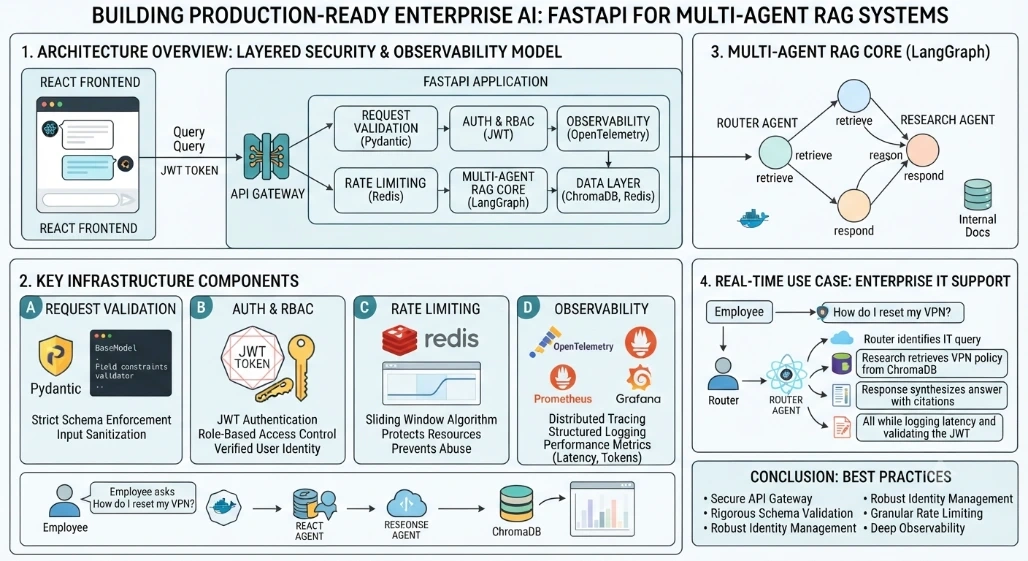
Building a production-ready AI service involves much more than just connecting an LLM to an API endpoint. In enterprise environments, the difference between a prototype and a scalable product lies in the robustness of its infrastructure layers: request validation, authentication, rate limiting, and observability. Without these pillars, even the most sophisticated multi-agent system is vulnerable to abuse, data corruption, and operational blindness. This article details how to structure these critical components within a FastAPI application designed for a complex, stateful Multi-Agent RAG (Retrieval-Augmented Generation) system. We will build a proof-of-concept for an "Enterprise Knowledge Assistant" where multiple agents collaborate to answer queries based on internal documentation. We will demonstrate how to enforce strict input schemas, secure endpoints with JWT authentication, prevent resource exhaustion through rate limiting, and maintain full visibility into system performance using structured logging and tracing.
Request Validation: The First Line of Defense
In a multi-agent system, malformed inputs can cause cascading failures across agent nodes. We use Pydantic’s BaseModel with Field constraints to enforce strict typing and validation at the API boundary. By leveraging FastAPI’s dependency injection, we ensure that only valid data reaches our business logic.
from pydantic import BaseModel, Field, validator
from typing import List, Optional

class AgentQuery(BaseModel):
    session_id: str = Field(..., min_length=32, description="Unique session identifier")
    query: str = Field(..., min_length=1, max_length=1000, description="User question")
    context_tags: Optional[List[str]] = Field(default_factory=list, description="Metadata tags")

    @validator('query')
    def sanitize_query(cls, v):
        # Basic sanitization to prevent prompt injection patterns
        if "<script>" in v.lower():
            raise ValueError("Invalid characters detected")
        return v.strip()
Authentication & Authorization
Enterprise systems require granular access control. We implement JWT (JSON Web Tokens) authentication using a custom dependency. This ensures that every request to the agent graph is associated with a verified user identity, allowing us to track usage per user and enforce permissions.
from fastapi import Depends, HTTPException, status
from jose import jwt, JWTError

SECRET_KEY = "your-secret-key"
ALGORITHM = "HS256"

async def get_current_user(token: str = Depends(oauth2_scheme)) -> dict:
    try:
        payload = jwt.decode(token, SECRET_KEY, algorithms=[ALGORITHM])
        user_id: str = payload.get("sub")
        if user_id is None:
            raise HTTPException(status_code=401, detail="Invalid credentials")
        return {"user_id": user_id, "role": payload.get("role")}
    except JWTError:
        raise HTTPException(status_code=401, detail="Could not validate credentials")
Rate Limiting: Preventing Resource Exhaustion
LLM inference is expensive and computationally intensive. To protect our backend from abuse and ensure fair usage, we implement a sliding window rate limiter using Redis. This allows us to limit requests per user per minute efficiently.
import redis
from fastapi import Request

redis_client = redis.Redis(host='localhost', port=6379, db=0)

def check_rate_limit(user_id: str, limit: int = 10, window: int = 60):
    key = f"rate_limit:{user_id}"
    current = redis_client.get(key)

    if current and int(current) >= limit:
        raise HTTPException(status_code=429, detail="Rate limit exceeded")

    pipe = redis_client.pipeline()
    pipe.incr(key)
    pipe.expire(key, window)
    pipe.execute()
Observability: Visibility into Black Boxes
AI systems are non-deterministic, making observability crucial. We integrate OpenTelemetry for distributed tracing and structured logging to capture latency, token usage, and agent decision paths. This data is exported to Prometheus for metrics and Grafana for visualization.
import logging
from opentelemetry import trace

logger = logging.getLogger("enterprise_ai")
tracer = trace.get_tracer("agent_graph")

async def process_query(query: AgentQuery, user: dict):
    with tracer.start_as_current_span("process_user_query") as span:
        span.set_attribute("user_id", user["user_id"])
        span.set_attribute("query_length", len(query.query))

        logger.info(f"Processing query for user {user['user_id']}", extra={
            "session_id": query.session_id,
            "tags": query.context_tags
        })

        # Agent logic here...
Multi-Agent RAG Core with LangGraph
The core intelligence resides in a LangGraph state graph. The state maintains conversation history and retrieved documents. We define nodes for retrieval, reasoning, and response generation, connected by conditional edges based on the complexity of the query.
from langgraph.graph import StateGraph, END
from typing import TypedDict, Annotated

class AgentState(TypedDict):
    messages: Annotated[list, add_messages]
    context: dict
    final_response: str

def retrieve_node(state: AgentState):
    # RAG retrieval logic using ChromaDB
    docs = rag_service.retrieve(state['messages'][-1].content)
    state['context'] = {"docs": docs}
    return state

def generate_node(state: AgentState):
    # LLM generation using context
    response = llm.invoke(state['context']['docs'] + state['messages'])
    state['final_response'] = response
    return state

workflow = StateGraph(AgentState)
workflow.add_node("retrieve", retrieve_node)
workflow.add_node("generate", generate_node)
workflow.set_entry_point("retrieve")
workflow.add_edge("retrieve", "generate")
workflow.add_edge("generate", END)
app_graph = workflow.compile()
Frontend Integration
The React frontend manages the user session and displays responses with source citations. It handles JWT storage securely and includes retry logic for rate-limited requests.
const sendQuery = async (query: string) => {
  try {
    const res = await axios.post('/api/ask', {
      query,
      session_id: sessionId
    }, {
      headers: { Authorization: `Bearer ${token}` }
    });
    setMessages(prev => [...prev, { role: 'ai', content: res.data.final_response }]);
  } catch (error) {
    if (error.response?.status === 429) {
      alert("Please wait before sending another message.");
    }
  }
};
Real-Time Use Case: Enterprise IT Support
Consider an IT support scenario where an employee asks, "How do I reset my VPN?" The Router Agent identifies this as a technical query. The Research Agent retrieves the latest VPN policy documents from ChromaDB. The Response Agent synthesizes an answer, citing the specific policy section. Throughout this process, the system logs the latency of each step, validates the user’s employment status via JWT, and ensures the user hasn’t exceeded their daily query limit.
Conclusion
Structuring FastAPI services for enterprise AI requires a disciplined approach to infrastructure. By integrating rigorous Pydantic validation, JWT-based authentication, Redis-backed rate limiting, and OpenTelemetry observability, we create a resilient foundation for complex multi-agent systems. This architecture not only protects the system from abuse but also provides the insights needed to optimize performance and cost. As AI adoption grows, these engineering best practices will distinguish robust production systems from fragile prototypes.
Join the conversation! Your thoughts help the community grow.