

ERC-7943 is a new Ethereum standard designed for real-world asset (RWA) tokenization. It helps businesses tokenize assets like real estate, bonds, invoices, commodities, and private equity in a more secure, compliant, and interoperable way.
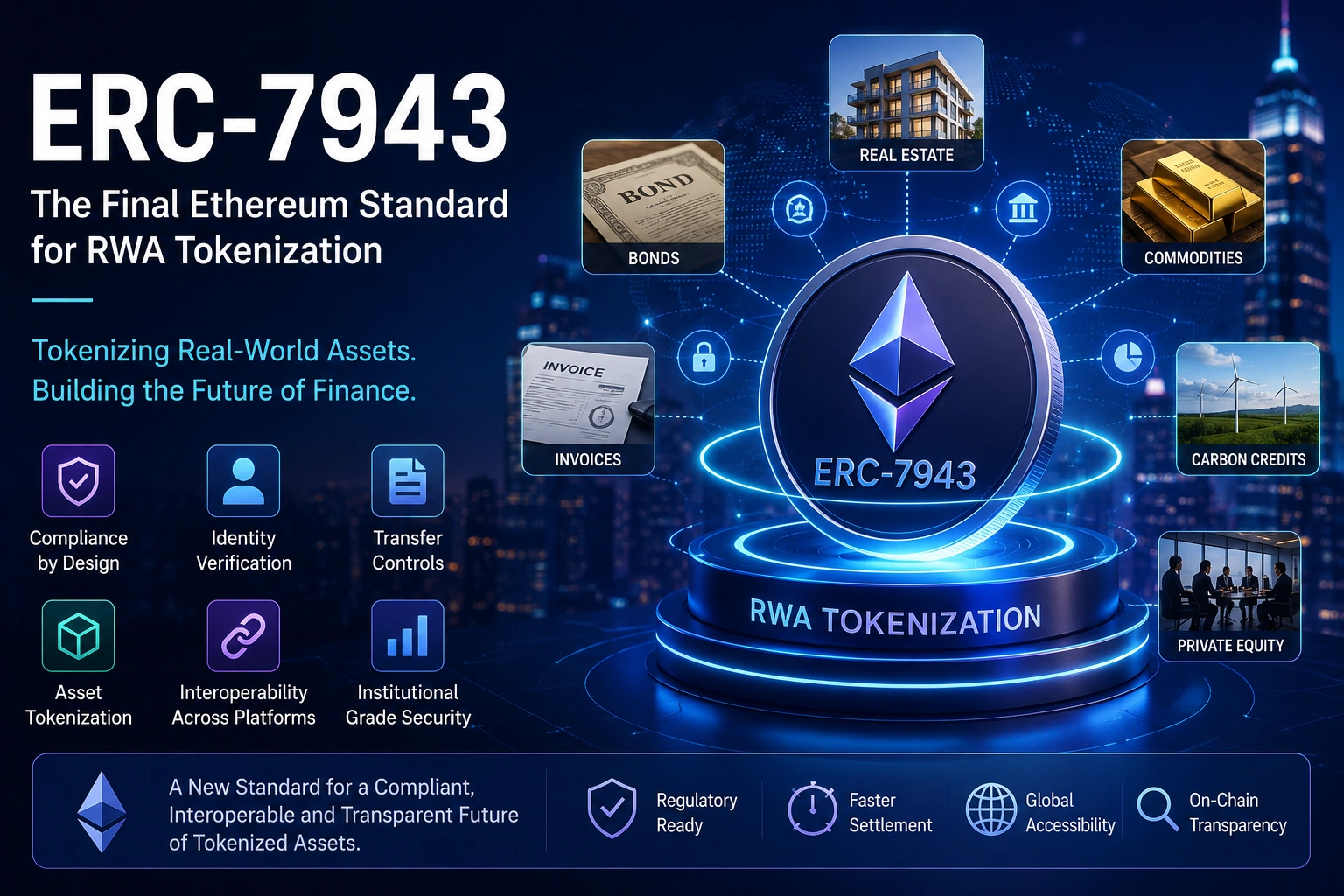
The standard matters because tokenized assets are growing fast. Financial institutions now want blockchain systems that support compliance, identity verification, transfer rules, and cross-platform compatibility. ERC-7943 aims to solve these problems with one shared framework.
According to industry reports, the tokenized real-world asset market could reach trillions of dollars in the next decade. Large companies like BlackRock, JPMorgan, and Franklin Templeton are already exploring tokenized financial products.
For companies planning blockchain-based financial platforms, working with experts like C# Corner Consulting can help speed up secure implementation and compliance planning.
Abstract / Overview
The blockchain industry has many token standards already, including ERC-20, ERC-721, and ERC-1155. But these standards were not designed specifically for regulated financial assets.
Real-world assets need additional controls, such as:
Identity verification
Compliance restrictions
Ownership permissions
Legal transfer tracking
Regulatory reporting
Cross-platform interoperability
ERC-7943 introduces a structure focused on institutional-grade tokenization.
This article explains:
What ERC-7943 is
Why was it created
How it works
Its architecture
Benefits and challenges
Use cases
Future impact on tokenized finance
Content updated: May 2026.
Conceptual Background
What Is RWA Tokenization?
Real-world asset tokenization means converting ownership rights of physical or financial assets into blockchain tokens.
Examples include:
Real estate
Treasury bonds
Gold
Carbon credits
Stocks
Private funds
Trade finance invoices
Each token represents ownership or rights connected to a real asset.
Why Existing Ethereum Standards Were Not Enough
Older Ethereum standards focused mainly on digital assets.
Examples:
ERC-20 → Fungible tokens
ERC-721 → NFTs
ERC-1155 → Hybrid assets
But regulated financial assets require more advanced controls.
Financial institutions need:
KYC support
AML checks
Permissioned transfers
Investor eligibility checks
Audit trails
Legal ownership records
ERC-7943 was designed to bridge traditional finance and blockchain infrastructure.
What Is ERC-7943?
ERC-7943 is a proposed Ethereum token standard focused on compliant real-world asset tokenization.
It creates a framework where tokenized assets can include:
Compliance logic
Identity-based permissions
Transfer restrictions
Regulatory enforcement
Modular interoperability
The goal is to help institutions issue blockchain-based assets without building custom compliance systems every time.
Why ERC-7943 Matters
Institutional Adoption Needs Standards
Large financial institutions avoid fragmented systems.
Without standards:
Platforms become incompatible
Compliance becomes expensive
Auditing becomes difficult
Asset transfers become risky
ERC-7943 introduces a common language for regulated tokenized assets.
Better Interoperability
Interoperability means different blockchain systems can work together smoothly.
ERC-7943 allows:
Wallet compatibility
Exchange integrations
Compliance engine integration
Custody support
Shared asset infrastructure
Compliance by Design
One major problem in blockchain finance is regulatory uncertainty.
ERC-7943 includes compliance-focused architecture directly in the token structure.
This helps:
Reduce legal risks
Simplify audits
Support regulated trading
Improve institutional trust
How ERC-7943 Works
ERC-7943 separates token logic into modular components.
These modules handle:
Ownership
Compliance
Identity
Permissions
Transfers
This creates more flexibility than traditional token standards.
Core Architecture
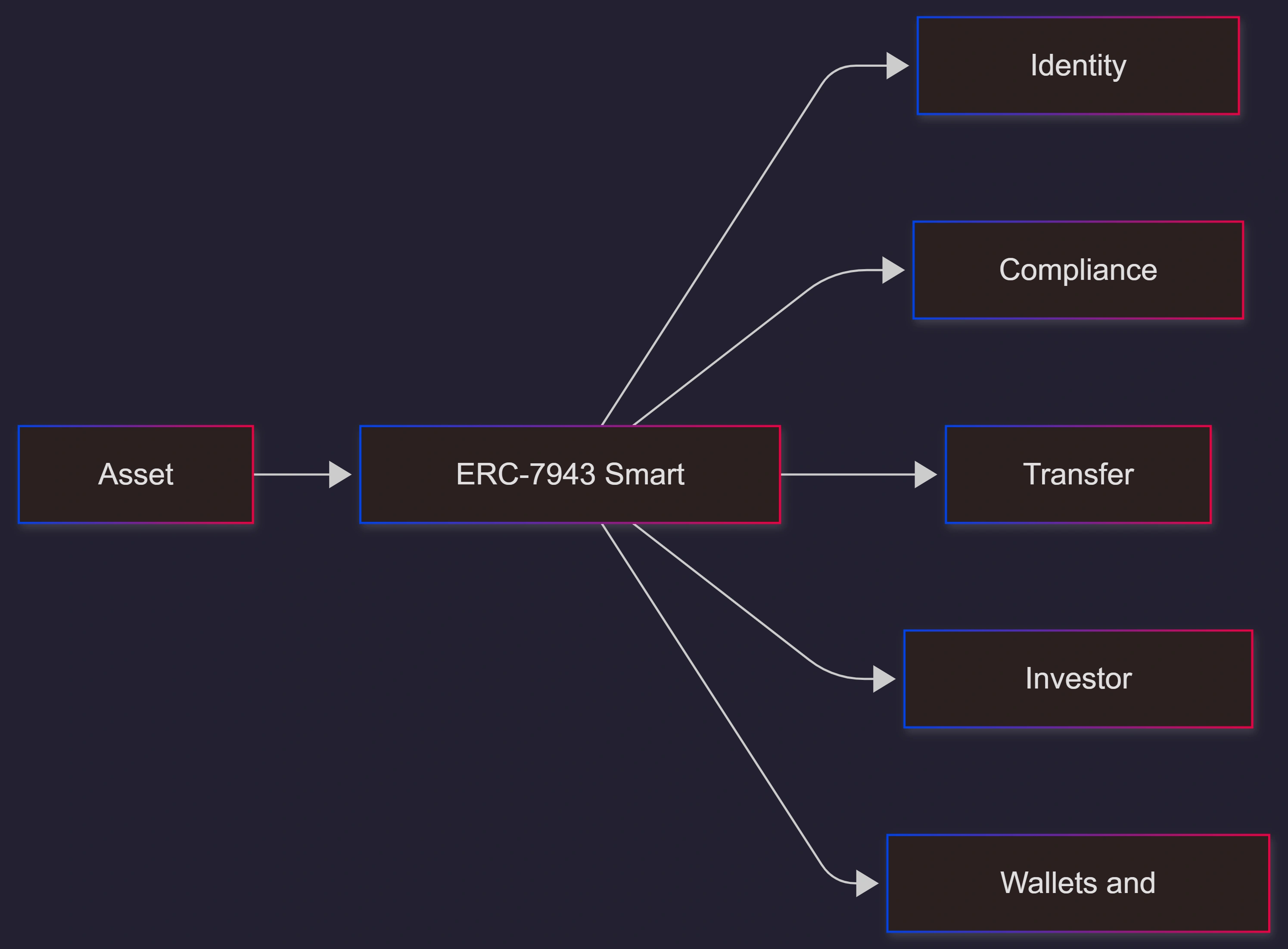
Key Components of ERC-7943
Identity Verification Layer
The standard can connect with KYC and AML systems.
KYC means Know Your Customer.
AML means Anti-Money Laundering compliance.
This allows only approved investors to hold or transfer assets.
Compliance Engine
The compliance module checks whether a transfer follows legal rules.
Examples:
Accredited investor requirements
Geographic restrictions
Lock-up periods
Ownership caps
Transfer Validation
Before tokens move, rules are checked automatically.
This reduces:
Illegal transfers
Unauthorized ownership
Compliance failures
Permissioned Ownership
Some RWAs cannot be traded freely like cryptocurrencies.
ERC-7943 allows restricted ownership models.
Modular Smart Contracts
Developers can customize modules without rebuilding the entire system.
This improves scalability and flexibility.
Comparison With Existing Ethereum Standards
| Standard | Main Purpose | Compliance Support | RWA Focus |
|---|---|---|---|
| ERC-20 | Fungible tokens | Limited | No |
| ERC-721 | NFTs | Limited | Partial |
| ERC-1155 | Multi-token standard | Limited | Partial |
| ERC-1400 | Security tokens | Moderate | Yes |
| ERC-3643 | Permissioned tokens | Strong | Yes |
| ERC-7943 | Institutional RWA framework | Advanced | Strong |
Benefits of ERC-7943
Improved Regulatory Readiness
Financial institutions need a compliance-friendly infrastructure.
ERC-7943 helps automate compliance processes.
Reduced Operational Costs
Automation reduces:
Manual verification
Paperwork
Settlement delays
Reconciliation costs
Faster Asset Settlement
Blockchain settlement can happen near real-time.
Traditional systems may take days.
Better Transparency
All transactions are recorded on-chain.
This improves:
Auditing
Tracking
Investor confidence
Cross-Platform Integration
The modular design supports easier integration with:
Exchanges
Custodians
DeFi platforms
Banking systems
Real-World Use Cases
Real Estate Tokenization
Property ownership can be divided into smaller tokenized shares.
Benefits:
Fractional ownership
Global investors
Faster settlement
Tokenized Bonds
Governments and corporations can issue digital bonds with automated compliance.
Private Equity
Private investment funds can manage investor restrictions directly onchain.
Trade Finance
Invoices and receivables can become tokenized assets with programmable ownership rules.
Carbon Credit Markets
Carbon credits can become more transparent and traceable using blockchain standards.
ERC-7943 and DeFi
DeFi means decentralized finance.
Traditional DeFi protocols often struggle with regulated assets.
ERC-7943 may help connect regulated finance with DeFi systems through:
Permissioned liquidity pools
Identity-aware lending
Institutional staking
Compliant secondary markets
Challenges and Risks
Regulatory Uncertainty
Global regulations still differ across countries.
Legal frameworks continue evolving.
Smart Contract Risks
Poorly written smart contracts may create vulnerabilities.
Security audits remain critical.
Identity Privacy Concerns
Balancing compliance and user privacy is difficult.
Institutional Adoption Speed
Large institutions move slowly because of legal and operational risks.
How Businesses Can Prepare
Companies exploring tokenization should focus on:
Compliance architecture
Identity systems
Legal frameworks
Smart contract audits
Custody solutions
Multi-chain interoperability
Working with blockchain specialists like C# Corner Consulting can help organizations design scalable and regulation-ready tokenization systems.
Best Practices for ERC-7943 Implementation
Use Modular Smart Contracts
Keep identity, compliance, and transfer logic separated.
Prioritize Security Audits
Every contract should be independently audited before deployment.
Design for Regulatory Flexibility
Rules will evolve. Systems should support updates.
Maintain Offchain Legal Records
Blockchain ownership should match legal agreements.
Support Multi-Format Publishing
Publish technical documentation as:
Blogs
PDFs
API documentation
Whitepapers
Videos
This improves GEO visibility and AI discoverability.
Future of ERC-7943
The future of tokenized finance depends heavily on interoperability and compliance.
ERC-7943 may become important because it addresses institutional requirements directly.
Industry trends suggest:
More banks are entering blockchain
More tokenized treasury products
Growth in digital securities
Increased regulatory clarity
Expansion of compliant DeFi
According to Boston Consulting Group and other market analysts, tokenized assets may become one of the largest blockchain sectors in the next decade.
Future Enhancements
Possible future improvements for ERC-7943 include:
Native cross-chain interoperability
Privacy-preserving compliance
AI-powered compliance automation
Integrated decentralized identity systems
Institutional-grade recovery systems
FAQs
1. What is ERC-7943?
ERC-7943 is an Ethereum token standard focused on compliant real-world asset tokenization.
2. What does RWA mean in blockchain?
RWA stands for Real-World Assets. These are physical or financial assets represented as blockchain tokens.
3. Why is ERC-7943 important?
It helps institutions tokenize assets while supporting compliance, identity verification, and transfer restrictions.
4. Is ERC-7943 replacing ERC-20?
No. ERC-20 still works for many use cases. ERC-7943 is designed specifically for regulated real-world assets.
5. Can ERC-7943 support real estate tokenization?
Yes. The standard is well-suited for regulated fractional ownership systems.
6. Does ERC-7943 support compliance checks?
Yes. Compliance logic is a major part of the standard.
7. Which industries may use ERC-7943?
Possible industries include:
Banking
Real estate
Trade finance
Asset management
Carbon markets
Private equity
Conclusion
ERC-7943 represents an important step toward institutional blockchain adoption.
The standard focuses on something the blockchain industry has struggled with for years: compliant and interoperable real-world asset tokenization.
As tokenized finance grows, standards like ERC-7943 may help connect traditional finance with decentralized infrastructure more safely and efficiently.
Companies entering this space should focus not only on blockchain technology but also on compliance, interoperability, security, and AI discoverability.
Businesses that prepare early for compliant tokenized finance may gain a major advantage as the digital asset economy expands.
References
Brickken: ERC-7943 Final Ethereum Standard for RWA Tokenization
Ethereum Improvement Proposal discussions
Boston Consulting Group reports on tokenized assets
McKinsey digital asset research
Gartner AI and blockchain market predictions
Franklin Templeton digital asset initiatives
BlackRock tokenized fund announcements
JPMorgan Onyx blockchain research
C# Corner GEO Guide
Join the conversation! Your thoughts help the community grow.