

Events and Delegates in C# are undoubtedly among the most confusing topics. Let us explore more about these. The code used in this article can be downloaded from GitHub.
Delegates
Delegates are function pointers. Let’s write some code using delegates to understand delegates.
I have created a sample console application. When a user registers, an email and SMS verification is sent.
- class Program {
- static void Main() {
- var registerUser = new RegisterUser();
- var emailVerification = new EmailVerification();
- var smsVerification = new SMSVerification();
- registerUser.registerUserDelegateInstance += emailVerification.OnUserRegistered;
- registerUser.registerUserDelegateInstance += smsVerification.OnUserRegistered;
- registerUser.RegisterAUser(); // Call delegate
- Console.ReadLine();
- }
- }
- public class RegisterUser {
- public delegate void registerUserDelegate(); // declare a delegate
- public registerUserDelegate registerUserDelegateInstance; // create a delegate instance
- public void RegisterAUser() {
- Console.WriteLine("User registered");
- if (registerUserDelegateInstance != null) {
- registerUserDelegateInstance(); // Call the delegate
- }
- }
- }
- public class EmailVerification {
- public void OnUserRegistered() {
- Console.WriteLine("Sent Email for Verification");
- }
- }
- public class SMSVerification {
- public void OnUserRegistered() {
- Console.WriteLine("Sent SMS for Verification");
- }
- }
We have created a delegate instance ‘registerUserDelegateInstance‘ which points to OnUserRegistered methods of EmailVerification & SMSVerification classes. When a delegate instance is called in the RegisterAUser method, all the methods it points to are executed.
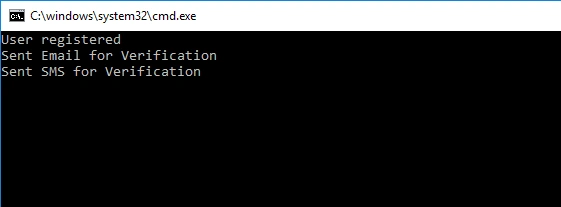
If we run the application, we get an output as below.
Advantages of using Delegates
- LINQ uses Func & Action delegates.
- Events are nothing but encapsulated delegates. (More on this later)
- Methods cannot be passed as parameters to other methods. But delegates can be passed as method parameters.
- Delegate help us reduce coupling. In the future, if we want an address verification, we simply have to add a new class for address verification and point a method of this class to the delegate instance. If we had not used delegates here, we would have simply called the email verification & SMS verification methods in RegisterAUser method. In this case, every time we add a new verification, RegisterUser class gets modified increasing coupling.
Disadvantages of using Delegates
You can make a delegate instance null as below.
- registerUser.registerUserDelegateInstance = null;
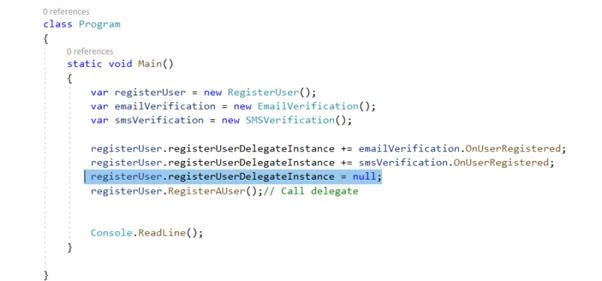
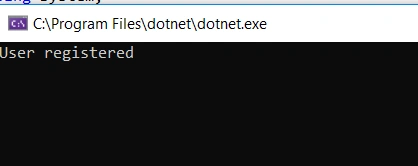
The email verification and SMS verification methods are not called as the delegate becomes null.
Let’s have a look at how events help us solve this issue.
Events
Let’s have a look at how we can use events help provide delegate encapsulation.
I have modified the above code as below.
- class Program {
- static void Main() {
- var registerUser = new RegisterUser();
- var emailVerification = new EmailVerification();
- var smsVerification = new SMSVerification();
- registerUser.registerUserEvent += emailVerification.OnUserRegistered; //subscribe to an event
- registerUser.registerUserEvent += smsVerification.OnUserRegistered; //subscribe to an event
- registerUser.RegisterAUser(); // publisher
- Console.ReadLine();
- }
- }
- public class RegisterUser {
- public delegate void registerUserEventHandler(object source, EventArgs Args); //define a delegate
- public event registerUserEventHandler registerUserEvent; // define an event
- public void RegisterAUser() {
- Console.WriteLine("User registered");
- if (registerUserEvent != null) {
- registerUserEvent(this, EventArgs.Empty); // call event
- }
- }
- }
- public class EmailVerification {
- public void OnUserRegistered(object source, EventArgs e) {
- Console.WriteLine("Sent Email for Verification");
- }
- }
- public class SMSVerification {
- public void OnUserRegistered(object source, EventArgs e) {
- Console.WriteLine("Sent SMS for Verification");
- }
- }
I have then created an EmailVerification which will contain a method ‘OnUserRegistered’ that will receive parameters sent by an event.
In our Main class, the EmailVerification & SMSVerification will subscribe to the event.
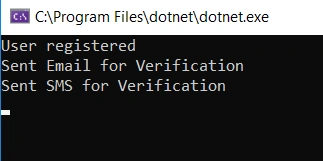
Let’s run the code.
The output is as below.
So, the summarised steps are,
- Declare a delegate (registerUserEventHandler)
- Declare an event based on that delegate (registerUserEvent)
- Create an event (registerUserEvent(this, EventArgs.Empty);)
- Subscribe methods to that event(registerUser.registerUserEvent += emailVerification.OnUserRegistered;)
- Fire that event (RegisterAUser)
Every time you declare an event, you do not have to declare a delegate too. Dotnet provides an inbuilt delegate called EventHandler which can be used directly while calling an event as below.
- public event EventHandler registerUserEvent;
- class Program
- {
- static void Main()
- {
- var registerUser = new RegisterUser();
- var emailVerification = new EmailVerification();
- var smsVerification = new SMSVerification();
- registerUser.registerUserEvent += emailVerification.OnUserRegistered; //subscribe to an event
- registerUser.registerUserEvent += smsVerification.OnUserRegistered; //subscribe to an event
- registerUser.RegisterAUser(); // publisher
- Console.ReadLine();
- }
- }
- public class RegisterUser
- {
- public event EventHandler registerUserEvent;
- public void RegisterAUser()
- {
- Console.WriteLine("User registered");
- if (registerUserEvent != null)
- {
- registerUserEvent(this, EventArgs.Empty);// call event
- }
- }
- }
- public class EmailVerification
- {
- public void OnUserRegistered(object source, EventArgs e)
- {
- Console.WriteLine("Sent Email for Verification");
- }
- }
- public class SMSVerification
- {
- public void OnUserRegistered(object source, EventArgs e)
- {
- Console.WriteLine("Sent SMS for Verification");
- }
- }
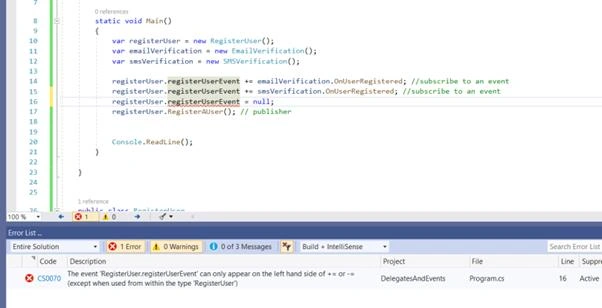
So, events are encapsulated delegates that provide an extra layer of security. This is the reason why we prefer using events over delegates.
I hope this article brings you one step closer to understanding events and delegates.
Here is a great video by Mosh to understand the same.
More articles,
- https://csharpindepth.com/articles/Events
- https://docs.microsoft.com/en-us/dotnet/csharp/delegates-events
This article was originally published on my website taagung.
Madhukar KrishnaPosted Apr 26, 2019, 7:17 AM
Well you see the events and delegates are two different things. So don't confuse them with one preference over other. I am not satisfied with this article. Please correct it.