

Introduction
This is the Advanced JavaScript article series. In this series, we are talking about JavaScript. Already we have explained various important concepts of JavaScript. You can read them here.
- Advance JavaScript: History and role of JavaScript behind modern web
- Advance JavaScript: play with object in JavaScript
- Advance JavaScript: Function Definition Style in JavaScript
- Advance JavaScript: Understand undefined in JavaScript
- Advance JavaScript: Understand "class"-ical concept of JavaScript
- Advance JavaScript: Implement inheritance in JavaScript
- Advance JavaScript: Callback design pattern and callback function in JavaScript
- Advance JavaScript: Exception handling in JavaScript
- Advance JavaScrip: Scope of Variable in JavaScript
- Advance JavaScript: closure in JavaScript
In this article, we will learn exception handling in JavaScript. We know that exception handling is a very important concept of any programming language, and JavaScript is not an exceptional case. We can implement our well-known try-catch block to catch exceptions in JavaScript.
Raise our own exception
Like C# and other languages, we can raise our own exception using the throw new Error() statement. Try to understand the following code.
- <%@ Page Language="C#" AutoEventWireup="true" CodeBehind="JavaScript.aspx.cs" Inherits="JavaScript.JavaScript" %>
- <!DOCTYPE html>
- <html xmlns="http://www.w3.org/1999/xhtml">
- <head runat="server">
- </head>
- <body>
- <form id="form1" runat="server">
- <script>
- function fun() {
- throw new Error("This is error");
- }
- try {
- fun();
- }
- catch (Error) {
- alert(Error.message);
- }
- </script>
- </form>
- </body>
- </html>
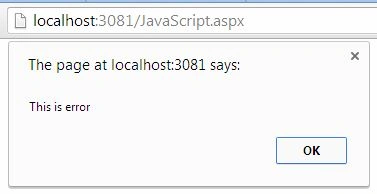
Catch exception in normal operation
In the example above we have seen how to throw our own exception. Just as in any other function, we can trap an exception in normal function execution. Here we are trying to trap an exception in JSON parsing.
- <%@ Page Language="C#" AutoEventWireup="true" CodeBehind="JavaScript.aspx.cs" Inherits="JavaScript.JavaScript" %>
- <!DOCTYPE html>
- <html xmlns="http://www.w3.org/1999/xhtml">
- <head runat="server">
- </head>
- <body>
- <form id="form1" runat="server">
- <script>
- function fun() {
- try{
- JSON.parse("Thsi is not JSON");
- }
- catch (Exception) {
- alert(Exception.message);
- }
- }
- //Call to function
- fun();
- </script>
- </form>
- </body>
- </html>
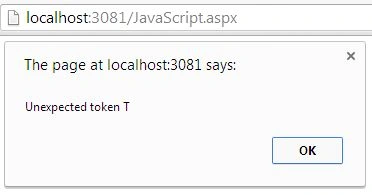
The error type is due to an unexpected token. This is due to a bad format of JSON data.
Checking various type of Error in JavaScript
In this section we will check various types of error types that JavaScript supports. We are seeing that it supports various types, like EvalError, MediaError, PositionError and many more.
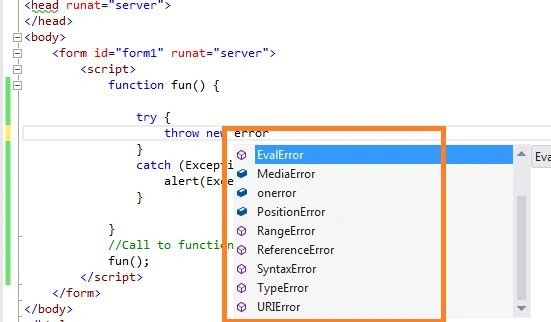
Detect error type in JavaScript
In a catch block, we can check which type of error has been thrown and depending on that we can make a decision. In this example, we are throwing a SyntaxError and within the catch block, we are trying to detect it.
- <%@ Page Language="C#" AutoEventWireup="true" CodeBehind="JavaScript.aspx.cs" Inherits="JavaScript.JavaScript" %>
- <!DOCTYPE html>
- <html xmlns="http://www.w3.org/1999/xhtml">
- <head runat="server">
- </head>
- <body>
- <form id="form1" runat="server">
- <script>
- function fun() {
- try {
- throw new SyntaxError();
- }
- catch (Exception) {
- alert(Exception.name);
- }
- }
- //Call to function
- fun();
- </script>
- </form>
- </body>
- </html>
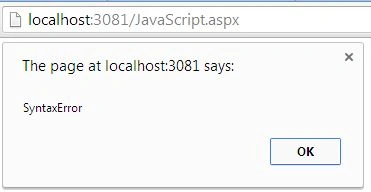
Finally block of try-catch
Generally we implement a finally block to perform additional work at the time of exception processing; the same is true in JavaScript. We can implement a finally block to take some action. Have a look at the following example:
- <%@ Page Language="C#" AutoEventWireup="true" CodeBehind="JavaScript.aspx.cs" Inherits="JavaScript.JavaScript" %>
- <!DOCTYPE html>
- <html xmlns="http://www.w3.org/1999/xhtml">
- <head runat="server">
- </head>
- <body>
- <form id="form1" runat="server">
- <script>
- function fun() {
- try {
- throw new URIError();
- }
- catch (Exception) {
- document.write("Error type:- " + Exception.name);
- }
- finally {
- alert("program close");
- }
- }
- //Call to function
- fun();
- </script>
- </form>
- </body>
- </html>
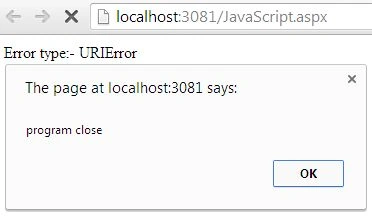
Conclusion
In this article, we have learned to implement exception handling in JavaScript applications. I hope you have understood the concept. In a future article, we will learn more about JavaScript.
Comments
Join the conversation! Your thoughts help the community grow.