

Introduction
AI is rapidly reshaping how we work, operate, and make decisions, and teams are becoming increasingly reliant on it in their day-to-day workflows. Yet across successive waves of enterprise AI from BI dashboards and data lakes to predictive analytics, and now generative AI and autonomous agents the approach has remained largely unchanged: gather more data, deploy more tools, and rely on models to piece together business context from fragmented semantics spread across disparate systems.
At Microsoft Ignite, Fabric IQ, a new semantic foundation within Microsoft Fabric. Rather than replacing your existing data estate, Fabric IQ amplifies the value of every investment you’ve already made. By unifying data, context, and actions into a single semantic layer, it empowers AI agents and business users to reason intelligently, automate workflows, and act with confidence.
Ontology in Fabric IQ
At the heart of Fabric IQ is the new Ontology item, now available in public preview.
Ontology provides the semantic foundation that unifies people, processes, systems, actions, rules, and data into a single, coherent model. By grounding real-world data in this ontology, raw tables and events are transformed into meaningful business entities and relationships giving both people and AI a structured, higher-level view of the business to reason, analyze, and act with confidence.
With shared definitions, lineage, and policies embedded directly into these entities and relationships, organizations operate on a consistent semantic layer that eliminates semantic drift and conflicting interpretations. This ensures every application and AI agent works from a single source of truth enabling real-time reasoning and action, powering business-aligned dashboards, and driving decisions you can trust.
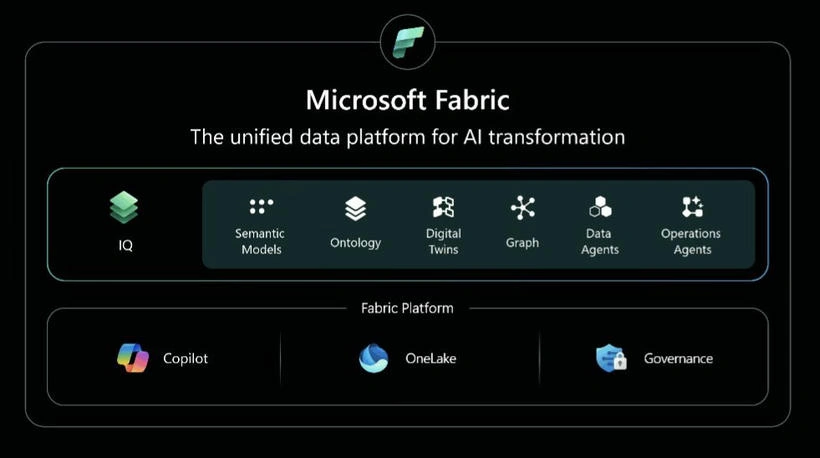
Image Source: Microsoft Ignite 2025
Key Benefits
Semantic foundation: Establish a shared understanding where business users, engineers, and AI agents can model what matters, how entities relate, the rules that govern them, and the actions they enable.
Reuse your semantic investments: New analytics and AI experiences don’t need to rediscover business meaning—existing Power BI semantic models can be reused so core concepts are defined once and applied everywhere.
Enterprise-grade AI grounding: Ontology provides AI with a precise semantic backbone, ensuring responses are consistent, explainable, and aligned with your business reality.
Decision-ready AI actions: With business rules and constraints embedded in the ontology, AI agents can go beyond insights to perform safe, auditable actions.
Governance and trust: Clear semantics reduce duplication and semantic drift, while built-in constraints improve data quality and reliability.
Cross-domain reasoning: Graph-based relationships and rules enable traversal across domains—such as Order → Shipment → Temperature Sensor → Cold Chain Breach to explain outcomes and root causes.
Key Elements of Fabric IQ
Ontology (preview): A foundational item for enterprise vocabulary and semantics that unifies meaning across domains and OneLake data sources. It defines entity types, relationships, properties, as well as rules and constraints, and connects them to real data so all downstream tools and experiences operate with a shared language.
Fabric data agent: Enables you to build custom conversational Q&A experiences powered by generative AI, allowing users to interact naturally with data.
Graph in Microsoft Fabric: Provides native graph storage and compute for managing nodes, edges, and traversals across connected data—ideal for scenarios such as pathfinding, dependency analysis, and graph-based analytics.
Operations agent: Allows you to create AI agents that monitor real-time data, detect conditions, and recommend or trigger business actions.
Power BI semantic model: A curated analytics layer optimized for reporting and interactive analysis, featuring measures, hierarchies, relationships, and DAX logic to power visuals, dashboards, and scorecards.
How Fabric IQ is redefining data intelligence?
Fabric IQ serves as an interactive intelligence layer between humans and AI, enabling clearer interpretation of requirements across existing datasets and delivering intelligent business insights driven by strong business logic.
Powered by AI-enabled intelligence, it introduces a new category of capabilities called operational agents. While traditional AI agents are adept at recognizing patterns within individual datasets, they often fall short when it comes to interpreting those patterns in meaningful business terms.
Microsoft Fabric IQ bridges this gap by enabling AI agents to move beyond identifying statistical or regressive patterns. Instead, they gain a deeper understanding of business operations, allowing them to deliver more specialized, context-aware analytics and actionable insights tailored to end users.
Extending Intelligent Insights Across the Microsoft Ecosystem
Fabric IQ does not operate in isolation. Its value multiplies when combined with Foundry IQ in Microsoft Foundry and Work IQ in Microsoft 365, creating a shared intelligence layer that spans business data, documents, communications, and enterprise knowledge.
Microsoft Foundry empowers developers to build sophisticated, orchestrated AI agents capable of planning, reasoning, and acting across systems. Rather than starting from scratch, these agents inherit live business context from Fabric IQ through Foundry IQ—including the enterprise ontology and the real-time state of the business.
Summary
Fabric IQ represents a significant step forward in how organizations move from fragmented data to unified intelligence. By establishing a strong semantic foundation through ontology, enabling operational agents, and integrating seamlessly across the Microsoft ecosystem, Fabric IQ empowers both humans and AI to reason, collaborate, and act with confidence. It transforms raw data into meaningful business context, driving trusted insights, intelligent automation, and better decision-making at scale.
Join the conversation! Your thoughts help the community grow.