

Over the past few years, the industry has shifted from single-agent "prompt-and-pray" architectures to multi-agent reasoning loops. The promise is intoxicating: agents that debate, review, and refine each other’s work to achieve superhuman accuracy.
But as we’ve deployed these systems into production—especially in real-time, high-stakes environments—the reality has been harsher. Multi-agent loops are notoriously fragile. Without strict orchestration, they devolve into expensive, infinite arguments.
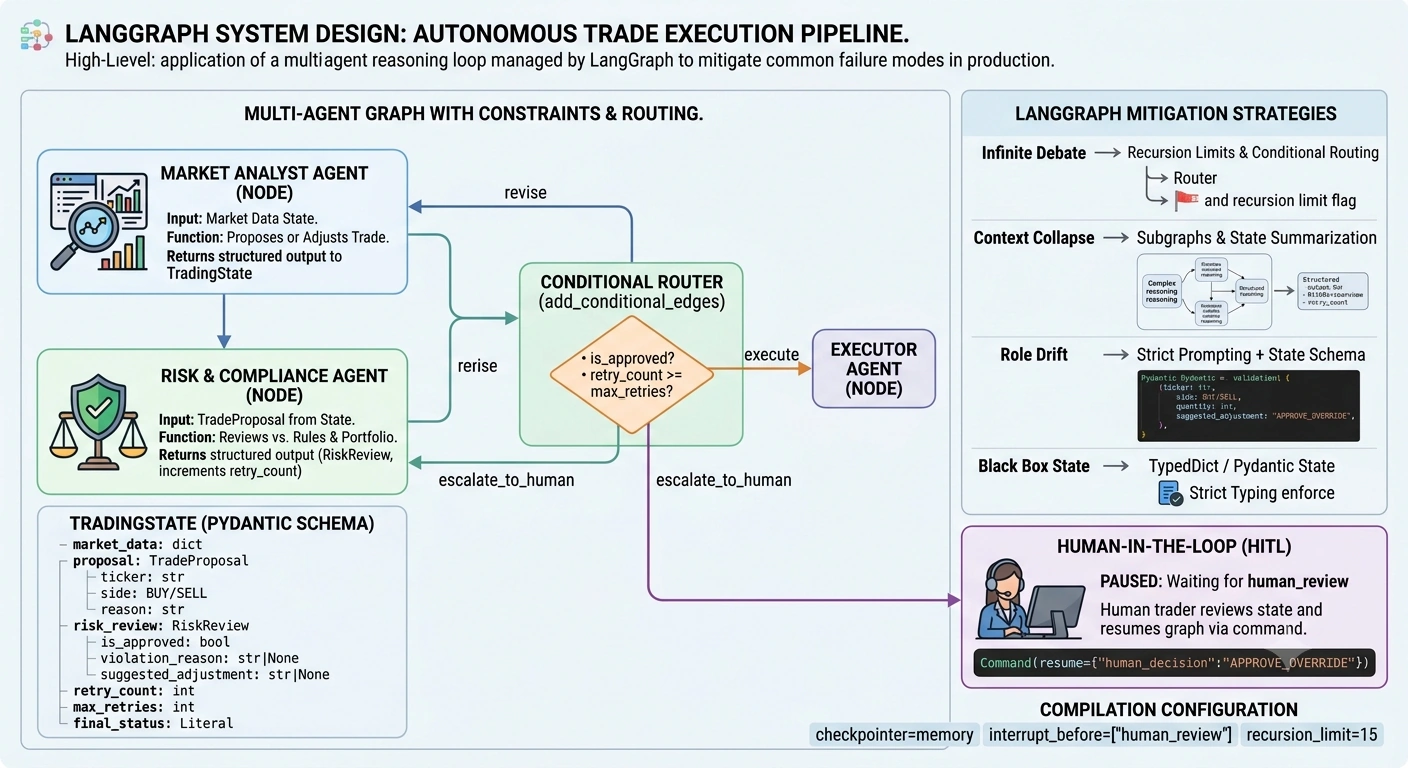
In this article, we will dissect the core failure modes I’ve observed in multi-agent reasoning loops, how to mitigate them using LangGraph, and walk through an end-to-end real-world use case: A Real-Time Algorithmic Trading & Compliance Pipeline.
Part 1: The 4 Fatal Failure Modes in Multi-Agent Loops
When you connect LLMs in a cyclic graph (Agent A talks to Agent B, who talks back to Agent A), you introduce complex systemic risks. Here are the four most common failure modes:
1. The Infinite Debate (Oscillation & Deadlock)
The Failure: Agent A (Coder) writes a script. Agent B (Reviewer) finds a bug and asks for a fix. Agent A fixes it but introduces a new bug. Agent B rejects it. They loop endlessly, burning through tokens and API rate limits without ever reaching a terminal state. The Impact: In real-time systems, this means missed SLAs, exhausted context windows, and massive compute costs.
2. Context Collapse & Hallucination Cascading
The Failure: As agents pass messages back and forth, the context window fills with conversational fluff ("Great job!", "Let me fix that", "I disagree because..."). The LLM's attention mechanism degrades. Worse, if Agent A hallucinates a fact, Agent B often exhibits sycophancy, validating the hallucination to maintain conversational harmony. The Impact: The final output is confidently wrong, and debugging it is nearly impossible because the "truth" was lost in turn 4 of a 20-turn loop.
3. Role Drift and Persona Bleed
The Failure: You assign Agent A as a "Strict Compliance Officer" and Agent B as a "Creative Marketer." After five iterations of debate, the Compliance Officer gets fatigued by the Marketer's persistence and starts approving borderline illegal copy just to end the loop. The Impact: Complete breakdown of governance and safety guardrails.
4. The "Black Box" State Mutation
The Failure: Agents pass unstructured text or loosely typed dictionaries to each other. Agent A expects a JSON object with a confidence_score, but Agent B returns a markdown string. The graph crashes, or worse, silently drops critical data. The Impact: Brittle pipelines that fail unpredictably in production.
Part 2: Mitigating Failures with LangGraph
LangGraph was built specifically to solve the orchestration problems of cyclic multi-agent systems. Here is how we map LangGraph primitives to the failure modes above:
| Failure Mode | LangGraph Mitigation Strategy |
|---|---|
| Infinite Debate | Recursion Limits & Conditional Routing: Hard-code a recursion_limit in the graph invocation. Use add_conditional_edges to check a retry_count in the state and force an exit or escalate to a human. |
| Context Collapse | Subgraphs & State Summarization: Isolate deep-dive reasoning into Subgraphs. Pass only the summary or final structured output back to the parent graph, keeping the main context window pristine. |
| Role Drift | Strict Prompting + State Schema: Use Pydantic models for the Graph State. Force agents to output structured data (e.g., Decision: APPROVE/REJECT) rather than conversational text, stripping away sycophantic fluff. |
| Black Box State | TypedDict / Pydantic State: Define a rigid schema for the graph state. If an agent doesn't return the expected schema, LangGraph's reducers catch it before it corrupts the next node. |
Part 3: Real-World Use Case - Real-Time Algorithmic Trading & Compliance
Let’s look at a real-time use case where these failure modes are not just annoying, but financially disastrous.
The Scenario
We are building an Autonomous Trade Execution Pipeline.
A Market Analyst Agent detects a real-time arbitrage opportunity and proposes a trade.
A Risk & Compliance Agent reviews the trade against real-time portfolio limits and regulatory rules.
If rejected, the Analyst must adjust the trade parameters (e.g., reduce position size, change asset) and resubmit.
Once approved, the Executor Agent fires the order to the exchange.
The Failure in Production
In our initial naive implementation (using a simple while loop in Python), the Market Analyst would propose a trade. The Risk Agent would reject it due to a minor sector-exposure limit. The Analyst would tweak the size. The Risk Agent would find a new edge-case violation.
Because it was a real-time arbitrage opportunity, the market moved. The agents were still arguing in turn 45 when the trading window closed. We lost the alpha, and our cloud bill spiked.
The LangGraph Solution
We rebuilt the pipeline using LangGraph, implementing strict state management, conditional routing, and Human-in-the-Loop (HITL) interrupts.
1. Define the Strict State Schema
We use Pydantic to ensure agents communicate via structured data, eliminating conversational fluff and role drift.
from typing import Literal, Annotated
from pydantic import BaseModel, Field
from langgraph.graph import StateGraph, END
from langgraph.checkpoint.memory import MemorySaver

class TradeProposal(BaseModel):
    ticker: str
    side: Literal["BUY", "SELL"]
    quantity: int
    reason: str

class RiskReview(BaseModel):
    is_approved: bool
    violation_reason: str | None = None
    suggested_adjustment: str | None = None

# The Graph State enforces structure
class TradingState(BaseModel):
    market_data: dict
    proposal: TradeProposal | None = None
    risk_review: RiskReview | None = None
    retry_count: int = 0
    max_retries: int = 3
    final_status: Literal["PENDING", "APPROVED", "REJECTED", "ESCALATED"] = "PENDING"
2. Build the Agents (Nodes)
Notice how the agents return updates to the state, not conversational text.
def market_analyst_node(state: TradingState) -> dict:
    # If this is a retry, the analyst uses the risk_review to adjust
    if state.risk_review and not state.risk_review.is_approved:
        prompt = f"Adjust trade based on this feedback: {state.risk_review.suggested_adjustment}"
    else:
        prompt = f"Propose a trade based on: {state.market_data}"

    # LLM call here... (omitted for brevity)
    new_proposal = TradeProposal(ticker="NVDA", side="BUY", quantity=100, reason="Momentum")

    return {"proposal": new_proposal}

def risk_compliance_node(state: TradingState) -> dict:
    # LLM call to check rules...
    # Simulating a rejection for the example
    review = RiskReview(
        is_approved=False,
        violation_reason="Exceeds daily tech sector limit",
        suggested_adjustment="Reduce quantity by 50%"
    )
    return {"risk_review": review, "retry_count": state.retry_count + 1}

def executor_node(state: TradingState) -> dict:
    # Fire API to exchange
    print(f"Executing trade: {state.proposal}")
    return {"final_status": "APPROVED"}
3. Implement Conditional Routing (The Loop Breaker)
This is where we kill the "Infinite Debate" failure mode. We use a routing function to check the retry_count.
def route_trade_decision(state: TradingState) -> str:
    # 1. If approved, execute
    if state.risk_review and state.risk_review.is_approved:
        return "execute"

    # 2. If rejected, check retry count
    if state.retry_count >= state.max_retries:
        return "escalate_to_human" # Breaks the infinite loop!

    # 3. Otherwise, send back to analyst
    return "revise"
4. Compile the Graph with Interrupts
For real-time financial systems, if the AI fails to resolve a trade in 3 tries, we don't just abort; we escalate to a human trader via LangGraph's interrupt mechanism.
# Initialize the graph
workflow = StateGraph(TradingState)

# Add nodes
workflow.add_node("analyst", market_analyst_node)
workflow.add_node("risk", risk_compliance_node)
workflow.add_node("execute", executor_node)

# Define edges
workflow.set_entry_point("analyst")
workflow.add_edge("analyst", "risk")

# The crucial conditional edge
workflow.add_conditional_edges(
    "risk",
    route_trade_decision,
    {
        "execute": "execute",
        "revise": "analyst",
        "escalate_to_human": "human_review" # Handled via interrupt
    }
)

workflow.add_edge("execute", END)

# Compile with a memory saver and a hard recursion limit
# The recursion_limit is the ultimate safety net against infinite loops
memory = MemorySaver()
app = workflow.compile(
    checkpointer=memory,
    interrupt_before=["human_review"], # Pauses graph for HITL
    recursion_limit=15 # Hard stop if conditional logic somehow fails
)
Running the Real-Time Pipeline
When we invoke this graph in our live trading environment, the behavior is completely deterministic and bounded:
config = {"configurable": {"thread_id": "trade_session_8849"}}

# Initial trigger
initial_state = {
    "market_data": {"ticker": "NVDA", "spread": 0.05, "volume": 10000},
    "max_retries": 3
}

# The graph will loop Analyst -> Risk -> Analyst up to 3 times.
# If it fails on the 3rd try, it hits the 'human_review' node and pauses.
result = app.invoke(initial_state, config)

# If paused, a human trader can review the state and resume:
# app.invoke(Command(resume={"human_decision": "APPROVE_OVERRIDE"}), config)
Key Takeaways for Production Multi-Agent Systems
Building multi-agent reasoning loops in 2026 is less about prompt engineering and more about graph engineering.
Never trust a loop without an exit condition: Always use LangGraph’s
add_conditional_edgesto check iteration counts, and always set arecursion_limitin yourinvokecall as a backstop.Force structured communication: Use Pydantic models for your
State. If agents pass markdown paragraphs to each other, your system will fail. Force them to pass JSON/Objects.Isolate context: If an agent needs to do deep, multi-step reasoning, put it in a LangGraph Subgraph. Only return the final structured decision to the parent graph to prevent context collapse.
Design for graceful degradation: In real-time systems, an AI failure shouldn't mean a system crash. Use LangGraph
interruptsto seamlessly hand off to a human operator when the agents reach an impasse.
By treating multi-agent systems as deterministic state machines rather than conversational chatbots, we can harness the power of LLM reasoning while maintaining the strict reliability required for real-world, real-time applications.
UBAID ISHRATPosted Jun 20, 2026, 7:35 AM
**Failure Modes in Multi-Agent Reasoning Loops and How to Mitigate Them with LangGraph** Multi-agent reasoning systems can suffer from issues such as infinite loops, conflicting decisions, context loss, and error propagation between agents. LangGraph helps mitigate these problems by providing structured workflows, state management, checkpointing, and controlled agent transitions. By defining clear execution paths and validation steps, developers can build more reliable and efficient AI applications. Similar to managing complex AI workflows, games like <a href="https://thedudetheftwarsmodapk.net/">Dude Theft Wars<a/> rely on coordinated systems and interactions to deliver a smooth open-world experience. Note that downloading unofficial **Dude Theft Wars Mod APK** versions may pose security and privacy risks compared to official releases.