

Introduction
In this article, we will be discussing an algorithm that returns possible (no. of pairs) digit pairs that are equal to a given number (6) using Tuple class.
Prerequisite
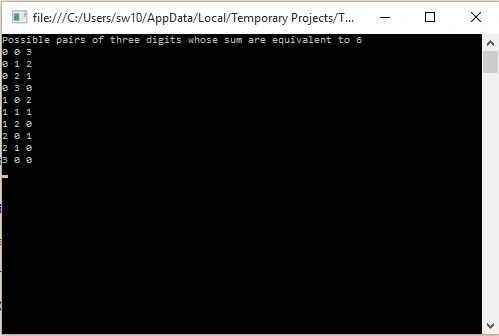
Suppose we pass a list of numbers List<int> { 1 , 2 , 3 , 4 , 5 , 6 } with 6 as a sum, The possible pairs should be :
- 0 0 3 ( 1 + 1 + 4 ) = 6
- 0 1 2 ( 1 + 2 + 3 ) = 6
- 0 2 1 ( 1 + 3 + 2 ) = 6
- 0 3 0 ( 1 + 4 + 1 ) = 6
- 1 0 2 ( 2 + 1 + 3 ) = 6
- 1 1 1 ( 2 + 2 + 2 ) = 6
- 1 2 0 ( 2 + 3 + 1 ) = 6
- 2 0 1 ( 3 + 1 + 2 ) = 6
- 2 1 0 ( 3 + 2 + 1 ) = 6
- 3 0 0 ( 4 + 1 + 1 ) = 6
How?
- The following is the basic function which we will implement in this article.
- public static List<Tuple<int,int,int>> PairsOfThreeDigitSum(IList<int> lstInt, int sum)
- {
- // Implementation
- }
- The above function which is the return wist of Tuple<int,int,int> actually will contain three-digit pairs that are equal to a given sum.
- We will iterate through for loop and check if the sum of the list is equal to the sum we gave.
- for (int i=0;i<lstInt.Count;i++)
- {
- for (int i=0;i<lstInt.Count;i++)
- {
- for (int i=0;i<lstInt.Count;i++)
- {
- if (sum == (lstInt[i] + lstInt[j] + lstInt[k]))
- {
- pairs.Add(Tuple.Create<int,int,int>>(I , j, k);
- }
- }
- }
- }
- If condition becomes true it means this is the pair in which sum is equal to the sum we gave. I will store that pair index into our List of Tuples by Add() method
- if (sum == (lstInt[i] + lstInt[j] + lstInt[k]))
- {
- pairs.Add(Tuple.Create<int,int,int>>(I , j, k);
- }
- Loop iterates until the count of elements in the list; and finally, it will return the pairs which hold three digits pairs as with,
- return pairs;
Join the conversation! Your thoughts help the community grow.