

Introduction
In the high-stakes world of fintech credit scoring, the margin between profit and loss is often defined by the ability to see what others miss. For decades, financial institutions have relied on Traditional Feature-Based Machine Learning (ML) pipelines. These systems ingest tabular data credit scores, income, debt-to-income ratios and output a probability of default. While efficient, these models treat every applicant as an isolated island, ignoring the complex web of relationships that define modern financial behavior.
Enter Graph RAG (Retrieval-Augmented Generation). By combining the structural power of Knowledge Graphs with the semantic reasoning of Large Language Models (LLMs), Graph RAG allows us to score not just the individual, but their position within a network of entities. This article explores how this paradigm shift transforms credit scoring from a static calculation into a dynamic, context-aware investigation, and provides a complete Proof of Concept (POC) using an Enterprise Multi-Agent LangGraph system.
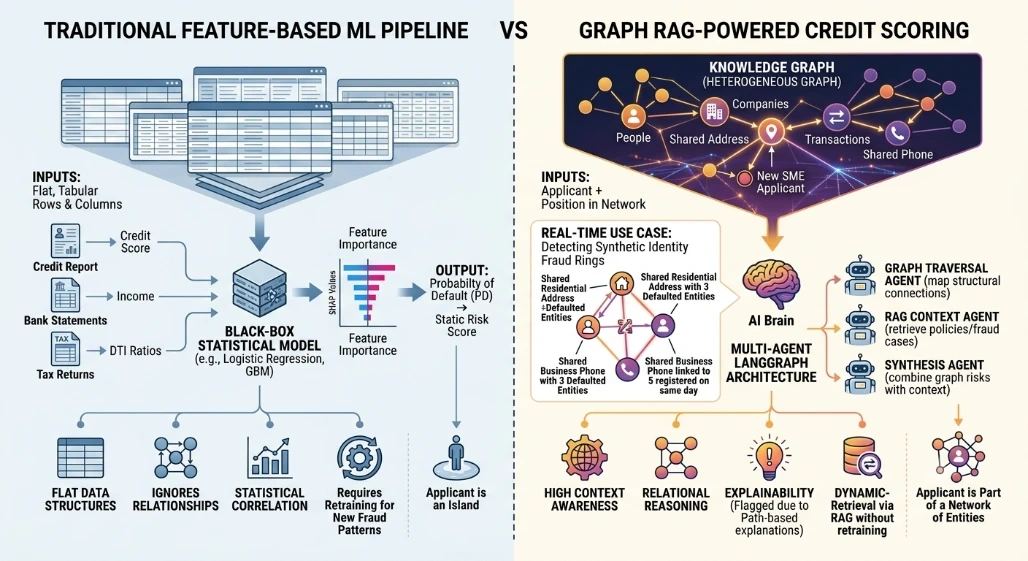
Traditional Feature-Based ML vs. Graph RAG-Powered Credit Scoring
The difference between these two approaches is fundamental: one looks at attributes, while the other looks at connections.
Feature | Traditional Feature-Based ML Pipeline | Graph RAG-Powered Credit Scoring |
|---|---|---|
Data Structure | Flat, tabular rows and columns. | Heterogeneous graphs (Nodes: People, Companies; Edges: Transactions, Shared Addresses). |
Context Awareness | None. A shared phone number is just a string value. | High. Recognizes that 50 applicants sharing one phone number indicates a fraud ring. |
Reasoning Type | Statistical correlation (e.g., "Low income correlates with default"). | Relational reasoning (e.g., "This applicant is 2 hops away from a known defaulter via a shared director"). |
Explainability | Black-box feature importance (SHAP values). | Path-based explanations (e.g., "Flagged due to connection to Entity X via Shared Address Y"). |
Adaptability | Requires retraining for new fraud patterns. | Dynamically retrieves new graph paths and policy contexts via RAG without retraining. |
Real-Time Use Case: Detecting Synthetic Identity Fraud in SME Lending
The Scenario: A new Small and Medium Enterprise (SME) applies for a $50,000 line of credit.
Traditional ML View: The business has a valid EIN, a clean credit history (thin file), and reported revenue of $100k. The model approves it with a moderate risk score.
Graph RAG View: The system constructs a local subgraph around the applicant. It discovers that the "CEO" shares a residential address with three other recently defaulted businesses, and the "Business Phone Number" is linked to five other entities registered on the same day.
The Workflow: The Graph RAG agent traverses these connections, retrieves historical fraud cases involving similar network structures from a vector database, and synthesizes a warning: "High Risk: Applicant is part of a dense cluster of synthetic identities sharing key infrastructure nodes."
Enterprise Multi-Agent LangGraph Architecture
Our architecture uses LangGraph to orchestrate agents that traverse both structured graphs and unstructured knowledge bases:
Graph Traversal Agent: Queries a mock Knowledge Graph to find direct and indirect connections (hops) to known risky entities.
RAG Context Agent: Retrieves institutional policies and historical fraud case studies related to the identified graph patterns.
Synthesis Agent: Combines the structural risk signals from the graph with the contextual insights from RAG to produce a final, explainable credit decision.
Step-by-Step POC Implementation
Step 1: Defining State, Memory, and Graph Schema
We define the state to carry graph traversal results and RAG context, utilizing LangGraph’s MemorySaver for audit trails.
# backend/graph_state.py
from typing import TypedDict, List, Annotated, Literal, Optional
from langgraph.graph import StateGraph, END
from langgraph.checkpoint.memory import MemorySaver

class GraphCreditState(TypedDict):
    applicant_id: str
    graph_connections: List[str]  # e.g., ["Shared Address with Defaulted Entity X"]
    retrieved_policies: List[str]
    structural_risk_score: float
    final_decision: Literal["APPROVE", "REVIEW", "DECLINE"]
    explanation: str
    agent_trace: Annotated[List[str], "Audit trail of graph reasoning"]

memory = MemorySaver()
Step 2: Building the Multi-Agent Graph RAG Workflow
We simulate a Knowledge Graph and a Vector Database to demonstrate the retrieval logic.
# backend/agents.py
from .graph_state import GraphCreditState, memory

# Mock Knowledge Graph (Adjacency List style)
MOCK_KNOWLEDGE_GRAPH = {
    "APP-992": {
        "shared_address": ["ENT-501", "ENT-502"],
        "shared_phone": ["ENT-503"],
        "director_link": []
    },
    "APP-104": {
        "shared_address": [],
        "shared_phone": [],
        "director_link": ["ENT-888"] # Clean entity
    }
}

# Mock Entity Status DB
ENTITY_STATUS = {
    "ENT-501": "DEFAULTED_2025",
    "ENT-502": "ACTIVE",
    "ENT-503": "FRAUD_FLAGGED",
    "ENT-888": "ACTIVE"
}

# Mock Vector DB for Policies
MOCK_POLICY_DB = [
    "Policy GRAPH-01: Any applicant sharing infrastructure (phone/address) with >2 flagged entities requires manual review.",
    "Policy GRAPH-02: Direct director links to active entities are considered neutral unless flagged."
]

def graph_traversal_agent(state: GraphCreditState):
    """Traverses the Knowledge Graph to find risky connections."""
    app_id = state["applicant_id"]
    connections = MOCK_KNOWLEDGE_GRAPH.get(app_id, {})

    findings = []
    risk_score = 0.0

    # Check shared addresses
    for ent_id in connections.get("shared_address", []):
        status = ENTITY_STATUS.get(ent_id, "UNKNOWN")
        if "DEFAULTED" in status or "FRAUD" in status:
            findings.append(f"Critical Link: Shares address with {ent_id} ({status})")
            risk_score += 0.4

    # Check shared phones
    for ent_id in connections.get("shared_phone", []):
        status = ENTITY_STATUS.get(ent_id, "UNKNOWN")
        if "FRAUD" in status:
            findings.append(f"Critical Link: Shares phone with {ent_id} ({status})")
            risk_score += 0.5

    state["agent_trace"].append(f"Graph Agent: Traversed 2-hop neighborhood. Found {len(findings)} critical links.")
    return {"graph_connections": findings, "structural_risk_score": min(risk_score, 1.0)}

def rag_policy_agent(state: GraphCreditState):
    """Retrieves policies relevant to the found graph patterns."""
    # In a real system, this would embed the 'graph_connections' and search vector DB
    policies = MOCK_POLICY_DB
    state["agent_trace"].append(f"RAG Agent: Retrieved {len(policies)} relevant underwriting policies.")
    return {"retrieved_policies": policies}

def synthesis_agent(state: GraphCreditState):
    """Synthesizes graph risks and policies into a decision."""
    risk_score = state["structural_risk_score"]
    connections = state["graph_connections"]
    policies = state["retrieved_policies"]

    # Simple decision logic based on graph risk
    if risk_score > 0.6:
        decision = "DECLINE"
    elif risk_score > 0.2:
        decision = "REVIEW"
    else:
        decision = "APPROVE"

    explanation = f"Structural Risk Score: {risk_score:.2f}\n"
    explanation += f"Key Graph Findings:\n"
    for conn in connections:
        explanation += f"- {conn}\n"
    explanation += f"Applied Policy: {policies[0]}"

    state["agent_trace"].append(f"Synthesis Agent: Final decision {decision} based on graph topology.")
    return {"final_decision": decision, "explanation": explanation}

# Build the Graph
workflow = StateGraph(GraphCreditState)
workflow.add_node("traverse", graph_traversal_agent)
workflow.add_node("rag", rag_policy_agent)
workflow.add_node("synthesis", synthesis_agent)

workflow.set_entry_point("traverse")
workflow.add_edge("traverse", "rag")
workflow.add_edge("rag", "synthesis")
workflow.add_edge("synthesis", END)

app = workflow.compile(checkpointer=memory)
Step 3: The FastAPI Backend
# backend/main.py
from fastapi import FastAPI
from pydantic import BaseModel
from .agents import app

app_api = FastAPI(title="Graph RAG Credit Scoring POC")

class GraphCreditRequest(BaseModel):
    applicant_id: str
    thread_id: str = "graph_audit_01"

@app_api.post("/score-graph-applicant")
async def score_graph_applicant(req: GraphCreditRequest):
    config = {"configurable": {"thread_id": req.thread_id}}
    initial_state = {
        "applicant_id": req.applicant_id,
        "graph_connections": [],
        "retrieved_policies": [],
        "structural_risk_score": 0.0,
        "final_decision": "",
        "explanation": "",
        "agent_trace": []
    }
    final_state = app.invoke(initial_state, config)
    return {
        "decision": final_state["final_decision"],
        "risk_score": final_state["structural_risk_score"],
        "explanation": final_state["explanation"],
        "agent_trace": final_state["agent_trace"]
    }
Step 4: The Streamlit Frontend
# frontend/app.py
import streamlit as st
import requests

st.set_page_config(page_title="Graph RAG Credit Scoring", layout="wide")
st.title("🕸️ Graph RAG-Powered Credit Scoring")
st.markdown("*Detecting Fraud Rings via Multi-Agent Knowledge Graph Traversal*")

st.sidebar.header("Applicant Details")
app_id = st.sidebar.text_input("Applicant ID", "APP-992")
thread_id = st.sidebar.text_input("Audit Thread ID", "audit_graph_01")

if st.sidebar.button("Run Graph Analysis"):
    with st.spinner("Traversing Knowledge Graph and Retrieving Context..."):
        response = requests.post(
            "http://localhost:8000/score-graph-applicant",
            json={"applicant_id": app_id, "thread_id": thread_id}
        )

        if response.status_code == 200:
            data = response.json()

            col1, col2 = st.columns(2)
            with col1:
                st.subheader("Decision & Risk")
                if data["decision"] == "APPROVE":
                    st.success(data["decision"])
                elif data["decision"] == "REVIEW":
                    st.warning(data["decision"])
                else:
                    st.error(data["decision"])
                st.metric("Structural Risk Score", f"{data['risk_score']:.2f}")

            with col2:
                st.subheader("Graph-Based Explanation")
                st.info(data["explanation"])

            st.subheader("Agent Reasoning Trace")
            for trace in data["agent_trace"]:
                st.write(f"  {trace}")
        else:
            st.error("Error connecting to the graph engine.")
Conclusion
The transition from traditional feature-based ML to Graph RAG-powered credit scoring represents a leap forward in financial risk management. While traditional models are blind to the relational context of an applicant, Graph RAG illuminates the hidden networks of fraud and risk.
By leveraging LangGraph, we created a system where the Graph Traversal Agent maps the structural landscape, the RAG Agent provides the regulatory and historical context, and the Synthesis Agent delivers a decision that is both mathematically grounded in graph theory and explainable through natural language. This architecture ensures that enterprises can detect sophisticated synthetic identity fraud rings that would otherwise slip through the cracks of flat, tabular data pipelines.
Join the conversation! Your thoughts help the community grow.