

Chapter 01 — System Design Foundation | Topic 05
A feature can work perfectly and still create a poor system.
Sounds strange, right?
Let's take a simple example:
Customer should be able to place an order.
We can implement this feature successfully.
But is that enough?
What if the API takes 10 seconds to respond?
What if an unauthorized user can place an order?
What if the system crashes when thousands of customers place orders together?
The feature works.
But the system doesn't work well.
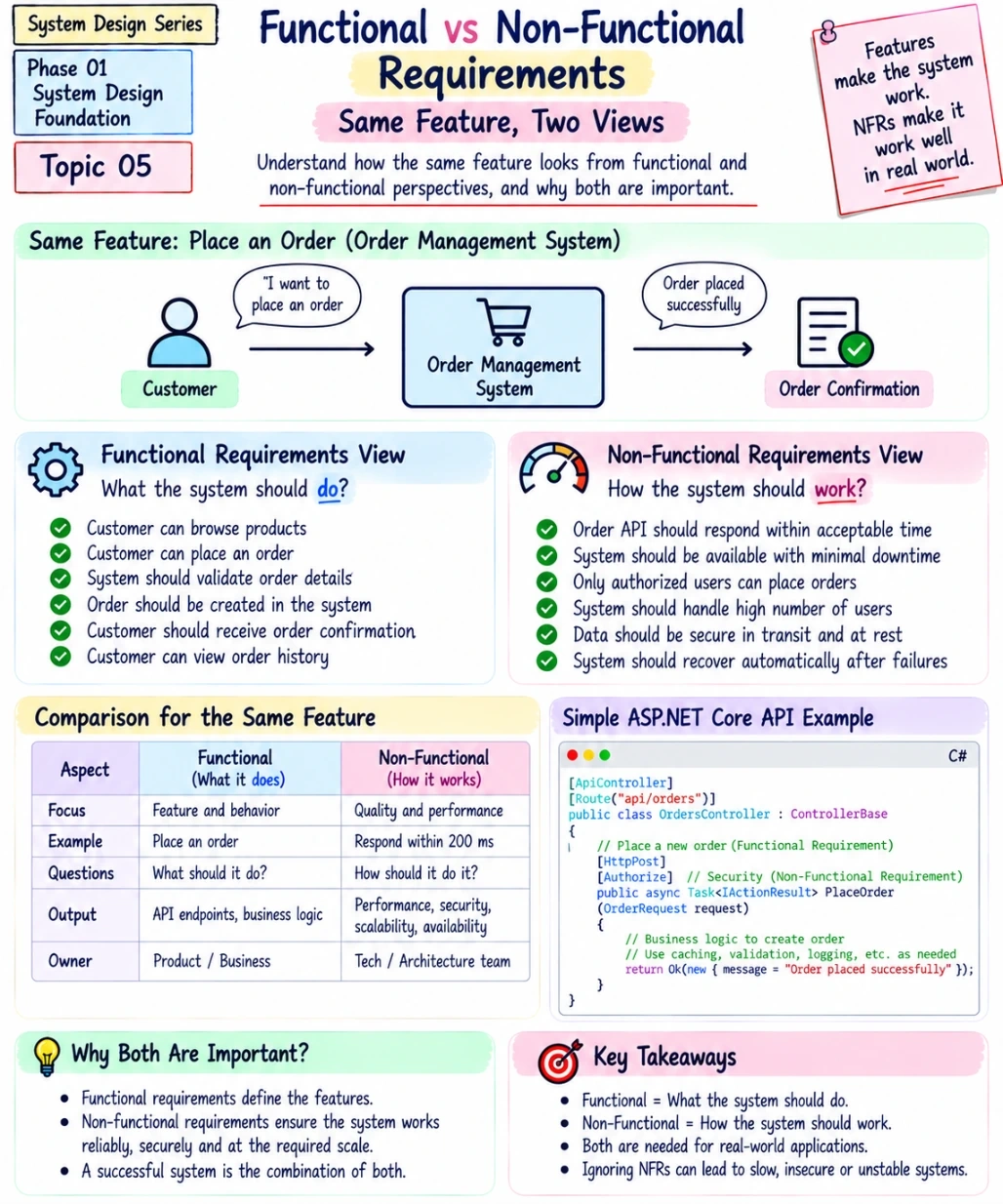
This is why we need to understand the difference between Functional Requirements and Non-Functional Requirements.
The Simple Difference
The easiest way to remember it is:
Functional Requirement
What should the system do?
Non-Functional Requirement
How should the system work?
Both are important for building a real-world application.
Let's Take One Feature
Consider an Order Management System.
One requirement is:
Customer should be able to place an order.
Now let's look at this requirement from two different views.
Functional View — What Should Happen?
From the functional perspective, we ask:
What should the system do when a customer places an order?
For example:
Customer selects products
Customer submits the order
System validates the order
System creates the order
Order details are stored
Customer receives confirmation
These describe the actual behavior and functionality of the system.
So we can create an API such as:
POST /api/ordersThe API may receive:
{
  "customerId": 101,
  "productId": 25,
  "quantity": 2
}
The requirement is about the feature:
Customer can place an order.
Non-Functional View — How Should It Work?
Now ask different questions.
Performance
How quickly should the order API respond?
For example:
95% of requests should respond within an acceptable response time.
Security
Who is allowed to place an order?
For example:
Only authenticated customers can place orders.
Scalability
What happens when the number of customers increases?
For example:
The system should support significantly higher traffic during peak periods.
Availability
What happens if one application instance fails?
For example:
The application should remain available with minimal interruption.
These are not new features.
They describe how well the feature should work.
Same Feature, Two Views
Let's put everything together.
Feature: Place an Order
Functional Requirements
Customer can place an order
System validates order details
System creates the order
System stores order information
Customer receives confirmation
Non-Functional Requirements
API should respond quickly
Only authorized users can place orders
System should handle increased traffic
Order data should be secure
System should remain available
Notice something important:
The feature is the same.
Only the perspective is different.
Why Does This Matter for System Design?
Suppose the functional requirement is:
Customer can place an order.
If we only think about functionality, we may create:
Controller
    ↓
Service
    ↓
Database
And the feature may work.
But now suppose the business says:
“During a sale, thousands of customers may place orders at the same time.”
Now the Non-Functional Requirements change our design thinking.
We may need to consider:
Database optimization
Indexes
Caching
Load balancing
Multiple application instances
Background processing
Message queues
Monitoring
The requirement didn't change the feature.
It changed how the system needs to support that feature.
Simple ASP.NET Core Example
Let's look at a small API:
[ApiController]
[Route("api/orders")]
public class OrdersController : ControllerBase
{
    [Authorize]
    [HttpPost]
    public async Task<IActionResult> PlaceOrder(
        OrderRequest request)
    {
        // Validate the incoming request
        // Apply business rules
        // Save the order
        // Return the result

        return Ok(new
        {
            Message = "Order placed successfully"
        });
    }
}
This small example represents both perspectives.
Functional Requirement
The API allows an authorized customer to place an order.
Non-Functional Requirement
[Authorize] helps enforce a security requirement.
But security is only one part.
For a production system, we may also need to think about:
Response time
Database performance
Scalability
Availability
Logging
Error handling
Monitoring
This is where System Design goes beyond simply creating an endpoint.
A Quick Comparison
Functional | Non-Functional |
|---|---|
What the system should do | How the system should work |
Features and behavior | Quality and constraints |
Place an order | Respond quickly |
Cancel an order | Remain available |
View order history | Protect user data |
Update order status | Handle high traffic |
Send notification | Recover from failures |
A simple memory trick:
Functional = What
Non-Functional = How
Why Both Matter
Imagine an application with excellent functionality but:
Very slow APIs
Frequent downtime
Weak security
Poor scalability
Users will still have a bad experience.
Now imagine an application that is:
Fast
Secure
Highly available
Scalable
But customers cannot place orders.
That system is also useless.
So a successful system needs both:
Correct functionality + Good system behavior
How Should a Developer Think?
When you receive a new feature, don't stop after asking:
“What should I build?”
Also ask:
“How should this feature behave in the real world?”
For every important feature, think about:
What?
→ Functional Requirement
How fast?
→ Performance
Who can access it?
→ Security
How much traffic?
→ Scalability
What happens when something fails?
→ Reliability / Availability
This mindset helps you move from simply implementing features to designing systems.
IMPORTANT Takeaway
Functional and Non-Functional Requirements are not competing requirements.
They complement each other.
Functional Requirements define what the system does.
Non-Functional Requirements define how well the system should do it.
A good system is not just one where the features work.
It is a system where those features work securely, reliably, efficiently, and at the required scale.
What's Next?
Now that we understand:
Requirements
Functional Requirements
Non-Functional Requirements
The difference between them
The next step is to understand another important part of System Design:
Chapter 01 — System Design Foundation | Topic 06 — Constraints: The Rules Behind Your Design
Because real-world systems are never designed with unlimited time, money, infrastructure, traffic capacity, or resources.
Join the conversation! Your thoughts help the community grow.