

by John Godel: AI Researcher and Mathematician
Abstract
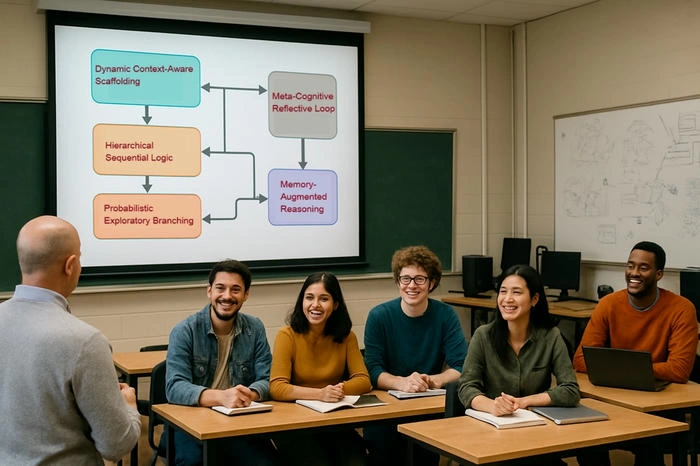
I present Godel's Scaffolded Cognitive Prompting (GSCP), a novel and sophisticated prompting architecture for the enhancement of the reasoning ability of large language models via recursive, meta-cognitive, and adaptive processes. GSCP unifies dynamic exemplar scaffolding, hierarchical sequential logic, probabilistic exploratory branching, and a reflective meta-cognitive loop into one framework. The architecture supports context-aware, transparent, and flexible reasoning beyond constraints of linear, branching, or exemplar-based prompting approaches.
I outline the theoretical underpinnings, compositional characteristics, operational process flow, and empirical domains in which GSCP stands out. Additionally, I briefly discuss extensions such as hierarchical levels of reasoning, uncertainty modeling, memory extension, and continuous learning, which place GSCP as a viable cognitive architecture for next-generation AI reasoning systems.
1. Introduction
Recent large language models (LLMs) have shown impressive linguistic and reasoning abilities, prompting the development of varied prompting methods to elicit and direct these abilities. Prominent strategies involve linear stepwise breakdown, branch-and-bound search of competing hypotheses, and exemplar-based conditioning through few-shot learning. Yet each strategy in isolation is subject to inherent vulnerabilities: linear strategies converge too quickly, branching is afflicted with combinatorial explosion in the absence of systematic testing, and exemplar conditioning overfits surface regularities at the expense of flexibility.
I introduce Godel's Scaffolded Cognitive Prompting (GSCP), a new and sophisticated prompting method that seeks to transcend these constraints by recursive, self-referential meta-cognition and adaptive scaffolding. Based on mathematical foundations of stratified reasoning and reflexive consistency, GSCP integrates dynamic scaffolding, disciplined sequential logic, strategic branching, and a meta-cognitive loop for continuous evaluation and tuning. The integration provides for clear, firm, and context-dependent reasoning capable of handling tough, open-ended issues.
2. Related Work
Previous prompting approaches have given us valuable insights:
- Linear Reasoning (e.g., chain-of-thought) provides step-by-step, comprehensible logic but is limited in the breadth of hypothesis consideration.
- Branching Reasoning (tree-of-thought, for instance) allows parallel consideration but does not typically provide means of managing exponential path expansion.
- Exemplar Conditioning (few-shot prompting) accelerates adaptation but risks brittle generalization.
GSCP moves these paradigms one step further by adding meta-cognition, dynamic adaptability, and hierarchical reasoning into a unified prompting framework.
3. The GSCP Framework
3.1 Dynamic Context-Aware Scaffolding
GSCP starts with scaffolding that adaptively modulates exemplar retrieval or template creation according to problem context and inference state during development. Adaptive scaffolding decreases uncertainty, grounds inference, and enhances generalization beyond strict few-shot cases.
3.2 Hierarchical Sequential Logic
The system imposes hierarchical, disciplined lines of thinking from micro- to macro-granularities. The reasoning across multiple levels facilitates communication between nitty-gritty design and high-level strategy, adding coherence and depth.
3.3 Probabilistic Exploratory Branching
GSCP provides branching mechanisms that are informed by quantifying uncertainty, allowing probabilistic testing of competing hypotheses. This trades off exploration and exploitation, avoiding premature commitment or combinatorial explosion.
3.4 Meta-Cognitive Layer (The Godelian Loop)
One of its most important innovations is a meta-cognitive loop that recursively filters and reviews reasoning pathways. This self-referential process detects contradictions, measures confidence, and prunes or adjusts hypotheses, allowing for iterative refinement and robustness.
3.5 Memory-Augmented Reasoning and Resource Allocation
GSCP also employs long-term, structured memory to record intermediate results and previous reasoning for effective retrieval and reuse. It also allocates computational effort dynamically in direct relation to problem uncertainty and difficulty.
3.6 Learning-to-Reason and Interactive Explanation
The architecture also accommodates ongoing learning through internal simulation or self-play for heuristic adjustment and pruning strategies. GSCP also generates comprehensible, human-interpretable explanations, which enable trust and collaborative refinement.
4. Workflow
- Contextual scaffolding also performs dynamic reasoning with applicable exemplars or templates.
- Hierarchical sequential logic builds clear inferential chains.
- Probabilistic branching is triggered to pursue rival hypotheses.
- The meta-cognitive cycle is constantly assessing, revising, and pruning lines of reasoning.
- Memory modules retain and retrieve important observations for efficient continuity.
- Continuous learning mechanisms evolve scaffolding and reasoning heuristics over time.
- Interactive explanations accompany final outputs, supporting interpretability.
5. Use Cases
GSCP is most appropriately applied to areas that call for sophisticated, adaptive, and clear-thinking:
- Clinical Diagnostics: Layered symptom analysis and treatment choice.
- Legal Reasoning: Sophisticated argument relying on precedent and complex statutes.
- Scientific Research: Dynamic integration and testing of competing hypotheses.
- Strategic Planning: Adaptive policy design under uncertainty and changing objectives.
- Creative Problem Solving: Balancing innovation with logical consistency.
- Autonomous Reflective AI: Self-supervising systems with the ability for continuous self-improvement and self-correction.
6. Comparative Advantages
Godel's Scaffolded Cognitive Prompting (GSCP) goes beyond the shortcomings of the reigning prompting paradigms by integrating their advantages and inverting their respective weaknesses. Here, I compare the relative strengths of GSCP to the three most dominant approaches:
6.1 Advantages Over Linear Stepwise Reasoning (Chain-of-Thought)
- Large Exploratory Capacity: Unlike pure linear thinking that examines a single inference sequence at a time, GSCP employs probabilistic branching to explore multiple hypotheses simultaneously. This prevents the risk of premature convergence to suboptimal solutions.
- Hierarchical Depth: The multi-level thinking of GSCP enables fertile interaction between detailed minutiae and overall strategies, while linear approaches forfeit this hierarchical view.
- Dynamic Adaptation: GSCP adapts reasoning strategies dynamically in response to contextual cues and meta-cognitive feedback outside of the inflexibility of pre-defined sequential steps for linear thinking.
6.2 Advantages Over Branching Reasoning (Tree-of-Thought)
- Effective Pruning through Meta-Cognition: Branching approaches are prone to a combinatorial explosion while considering several possibilities. GSCP's meta-cognitive loop aggressively inspects and prunes undesirable branches, enhancing computational tractability without compromising completeness.
- Uncertainty-Aware Exploration: GSCP models confidence and uncertainty explicitly in making its branching choices, allowing for more informed and adaptive exploration compared to undirected branching.
- Memory-Augmented Continuity: GSCP employs structured memory to recall and remember essential findings between branches with no redundant reasoning and in a way that accumulates knowledge.
6.3 Advantages Over Static Exemplar Conditioning (Few-Shot Prompting)
- Contextual and Dynamic Scaffolding: In contrast to relying on static exemplars, GSCP instantiates scaffolding templates dynamically based on problem context and evolving reasoning states, enhancing generalization and reducing overfitting.
- Integrated Logical and Reflective Processes: GSCP combines exemplar conditioning with hierarchical logic and recursive self-monitoring under discipline, and offers more structural guidance than exemplar conditioning by itself.
- Continuous Learning and Refinement: GSCP has refinement and adaptation procedures that can be performed online, unlike fixed few-shot methods without feedback-driven refinement.
6.4 Other Benefits Specific to GSCP
- Recursive Self-Referential Reasoning: GSCP's meta-cognitive level allows for reflective review and revision of reasoning processes, enabling error detection and iterative refinement in ways not achievable through standalone prompting methods.
- Explainability and Transparency: GSCP produces explainable reasoning traces and human-comprehensible explanations at various levels of abstraction, thereby enabling trust and collaborative behavior.
- Scalable Resource Allocation: Through dynamic reallocation of computational effort in response to problem size and uncertainty, GSCP maximizes performance under resource constraints.
- Integration with Multi-Modal and Interactive Environments: The architecture of GSCP is crafted for integration with heterogeneous data modalities and human-in-the-loop feedback, thus rendering it suitable for real-world applications.
GSCP integrates the strengths of current prompting methods—linear coherence, exploratory range, and exemplar grounding—while adding adaptive meta-cognition, dynamic scaffolding, and memory augmentation. The result is a robust, flexible, and explainable cognitive architecture that advances AI reasoning beyond current state-of-the-art prompting paradigms.
7. Discussion and Future Directions
GSCP is an ethical step towards AI systems that integrate flexible, context-dependent reasoning and reflective self-regulation with ongoing learning. Future directions involve empirical benchmarking, formal studies of meta-cognitive scalability, and extensions of GSCP to multi-modal and interactive environments.
8. Conclusion
Godel's Scaffolded Cognitive Prompting is a coherent, adaptive reasoning framework incorporating dynamic scaffolding, hierarchical logic, probabilistic branching, and reflective meta-cognition. The architecture supports open, strong, and contextual AI reasoning and is a step towards more intelligent, self-enhancing cognitive agents.
Join the conversation! Your thoughts help the community grow.