

Introduction
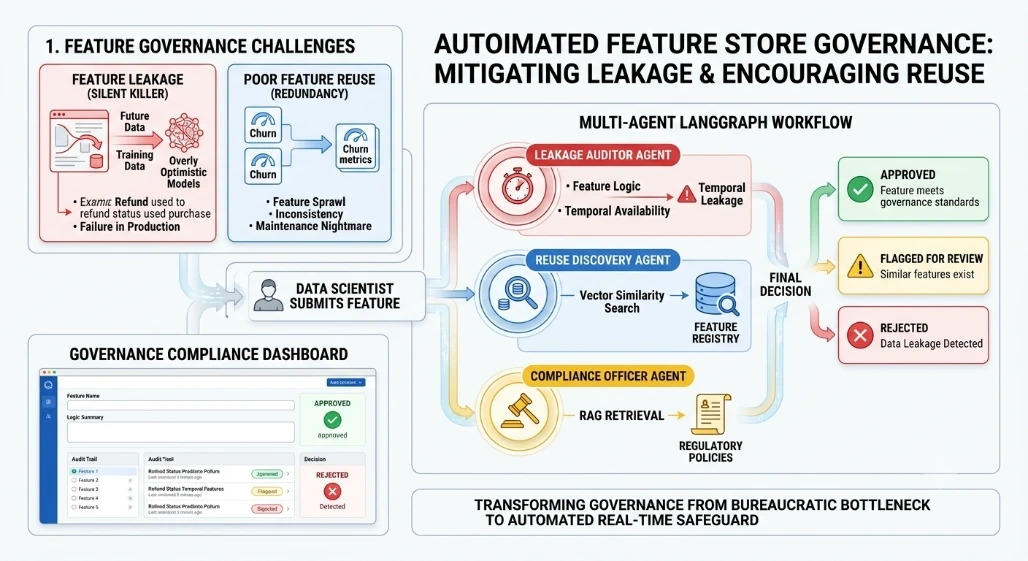
In enterprise machine learning, a feature store is more than just a data repository; it is a critical asset that requires strict governance. Two primary risks threaten the integrity of this asset: Feature Leakage and Poor Feature Reuse. Leakage occurs when future information inadvertently influences historical training data, leading to overly optimistic models that fail in production. Poor reuse results in "feature sprawl," where dozens of engineers create redundant, slightly different versions of the same metric, causing inconsistency and maintenance nightmares.
This article explores how to implement robust governance controls using an enterprise-grade Multi-Agent Retrieval-Augmented Generation (RAG) system built on LangGraph. By automating the auditing process through intelligent agents, we can ensure that every feature used in a model is both legally compliant and technically sound. This approach transforms governance from a bureaucratic bottleneck into an automated, real-time safeguard.
The Governance Challenge: Leakage vs. Reuse
Feature Leakage: This is the silent killer of ML models. It happens when a feature contains information that would not be available at the time of prediction. For example, using a "refund_status" feature to predict "initial_purchase_success" is leakage because the refund happens after the purchase. Detecting this requires deep semantic understanding of business logic and temporal constraints.
Feature Reuse: Without governance, teams often recreate features from scratch. This leads to inconsistent definitions (e.g., two different ways to calculate "churn") and wasted computational resources. Effective governance requires a searchable, well-documented registry that encourages engineers to find and use existing, validated features.
Key Governance Controls: Lineage, Validation, and Access
To mitigate these risks, enterprises implement several layers of control:
Temporal Lineage Tracking: Every feature must have a clear "created_at" timestamp and a definition of its "availability window." This allows systems to verify point-in-time correctness during training.
Semantic Validation Agents: AI agents that analyze feature descriptions and code logic to flag potential leakage or redundancy before a feature is registered.
Access Control Lists (ACLs): Strict permissions ensuring that only authorized models or users can access sensitive features (e.g., PII-derived metrics).
Automated Documentation: Using RAG to generate and maintain up-to-date documentation for every feature, making them easier to discover and reuse.
Real-Time Use Case: Regulated Credit Scoring Engine
Scenario: "FinTrust Bank" operates a credit scoring AI subject to strict regulatory audits (e.g., GDPR, Fair Lending laws). The bank maintains a feature store with thousands of metrics. Data scientists frequently request new features for their models.
Problem: A data scientist creates a new feature, avg_balance_next_7_days, to predict loan default. This is a classic leakage error because future balance data is being used to predict a current event. Additionally, another team has already created a similar feature, projected_weekly_balance, leading to redundancy.
Objective: Build a Multi-Agent LangGraph system that:
Intercepts new feature registration requests.
Uses an Auditor Agent to check for semantic leakage and temporal validity.
Uses a Discovery Agent to search for existing similar features (Reuse).
Uses a Compliance Agent to retrieve regulatory policies via RAG.
Approves, rejects, or flags the feature for review based on stateful reasoning.
Architecture Overview: Governance-Aware Multi-Agent RAG
We use LangGraph to orchestrate the governance workflow. The state object holds the feature metadata, audit results, and compliance context.
Registry Agent: Manages the feature store metadata.
Leakage Auditor Agent: Analyzes feature logic for temporal inconsistencies.
Reuse Discovery Agent: Performs vector similarity search against existing features.
Compliance Officer Agent: Retrieves regulatory rules and makes final decisions.
State Management: LangGraph’s checkpointer ensures that all audit trails are preserved for regulatory reporting.
Step-by-Step POC Implementation
Backend: Feature Registry and Governance Rules Engine
We simulate a feature registry and a set of governance rules.
# backend/governance_store.py
from pydantic import BaseModel
from typing import List, Optional
import uuid

class FeatureDefinition(BaseModel):
    id: str = str(uuid.uuid4())
    name: str
    description: str
    logic_summary: str
    temporal_availability: str  # e.g., "at_prediction_time", "post_event"
    status: str = "pending"

class GovernanceStore:
    def __init__(self):
        self.features = []

    def register_feature(self, feature: FeatureDefinition):
        self.features.append(feature)

    def get_all_features(self) -> List[FeatureDefinition]:
        return self.features

governance_store = GovernanceStore()
# Seed with an existing feature to test reuse
governance_store.register_feature(FeatureDefinition(
    name="projected_weekly_balance",
    description="Estimated average balance for the upcoming week",
    logic_summary="Uses ARIMA model on past 30 days",
    temporal_availability="at_prediction_time",
    status="approved"
))
Multi-Agent Graph: Auditor, Validator, and State Management
The graph orchestrates the governance checks.
# backend/graph.py
from typing import TypedDict, Annotated, List
from langgraph.graph import StateGraph, END
from langchain_core.messages import HumanMessage, AIMessage
import operator
from .governance_store import governance_store, FeatureDefinition

class GovernanceState(TypedDict):
    new_feature: FeatureDefinition
    leakage_risk: bool
    similar_features: List[str]
    compliance_rules: List[str]
    final_decision: str
    messages: Annotated[List, operator.add]

def audit_for_leakage(state: GovernanceState):
    """Agent 1: Checks for temporal leakage"""
    feature = state["new_feature"]
    risk = False
    # Simple heuristic: if description mentions 'future' or 'next' but availability is 'at_prediction_time'
    if ("next" in feature.logic_summary.lower() or "future" in feature.description.lower()) and \
       feature.temporal_availability == "at_prediction_time":
        risk = True
    return {"leakage_risk": risk, "messages": [AIMessage(content=f"Leakage Risk Detected: {risk}")]}

def check_for_reuse(state: GovernanceState):
    """Agent 2: Searches for similar existing features"""
    existing = governance_store.get_all_features()
    similar = []
    # Mock similarity check
    for f in existing:
        if "balance" in f.name.lower() and "balance" in state["new_feature"].name.lower():
            similar.append(f.name)
    return {"similar_features": similar, "messages": [AIMessage(content=f"Found {len(similar)} similar features")]}

def apply_compliance_rules(state: GovernanceState):
    """Agent 3: RAG retrieval of regulatory policies"""
    # Mock RAG retrieval
    rules = [
        "Rule 101: No future-looking features allowed in real-time scoring.",
        "Rule 102: Must reuse existing features if similarity > 80%."
    ]
    return {"compliance_rules": rules, "messages": [AIMessage(content="Compliance rules retrieved")]}

def make_governance_decision(state: GovernanceState):
    """Agent 4: Final approval or rejection"""
    if state["leakage_risk"]:
        decision = "REJECTED: Potential Data Leakage Detected"
    elif len(state["similar_features"]) > 0:
        decision = f"FLAGGED_FOR_REVIEW: Similar features exist ({', '.join(state['similar_features'])})"
    else:
        decision = "APPROVED: Feature meets governance standards"

    return {"final_decision": decision, "messages": [AIMessage(content=decision)]}

# Build Graph
workflow = StateGraph(GovernanceState)
workflow.add_node("audit", audit_for_leakage)
workflow.add_node("reuse_check", check_for_reuse)
workflow.add_node("compliance", apply_compliance_rules)
workflow.add_node("decide", make_governance_decision)

workflow.set_entry_point("audit")
workflow.add_edge("audit", "reuse_check")
workflow.add_edge("reuse_check", "compliance")
workflow.add_edge("compliance", "decide")
workflow.add_edge("decide", END)

app = workflow.compile()
Frontend: Governance Compliance Dashboard
A React dashboard allows data scientists to submit features and view audit results.
// frontend/src/components/GovernanceDashboard.jsx
import { useState } from 'react';

export default function GovernanceDashboard() {
  const [featureName, setFeatureName] = useState('');
  const [logic, setLogic] = useState('');
  const [result, setResult] = useState(null);

  const handleSubmit = async () => {
    const payload = {
      name: featureName,
      description: "User submitted feature",
      logic_summary: logic,
      temporal_availability: "at_prediction_time"
    };
    const response = await fetch('/api/governance/check', {
      method: 'POST',
      headers: { 'Content-Type': 'application/json' },
      body: JSON.stringify(payload)
    });
    const data = await response.json();
    setResult(data);
  };

  return (
    <div className="p-6 max-w-3xl mx-auto">
      <h2 className="text-2xl font-bold mb-4">Feature Governance Portal</h2>
      <div className="space-y-4 mb-6">
        <input
          type="text"
          placeholder="Feature Name"
          value={featureName}
          onChange={(e) => setFeatureName(e.target.value)}
          className="border p-2 w-full"
        />
        <textarea
          placeholder="Logic Summary"
          value={logic}
          onChange={(e) => setLogic(e.target.value)}
          className="border p-2 w-full h-24"
        />
        <button onClick={handleSubmit} className="bg-blue-600 text-white p-2 rounded w-full">
          Submit for Governance Check
        </button>
      </div>

      {result && (
        <div className="mt-6 space-y-4">
          <div className={`p-4 rounded border-l-4 ${result.final_decision.includes('REJECTED') ? 'bg-red-100 border-red-500' : result.final_decision.includes('FLAGGED') ? 'bg-yellow-100 border-yellow-500' : 'bg-green-100 border-green-500'}`}>
            <h3 className="font-semibold">Governance Decision</h3>
            <p className="text-lg">{result.final_decision}</p>
          </div>

          <details className="bg-white p-4 rounded shadow">
            <summary className="cursor-pointer font-medium">View Audit Trail</summary>
            <ul className="mt-2 list-disc pl-5">
              {result.messages.map((m, i) => (
                <li key={i} className="text-sm text-gray-700">{m.content}</li>
              ))}
            </ul>
          </details>
        </div>
      )}
    </div>
  );
}
Conclusion
Governance in a feature store is not about restricting innovation; it is about ensuring sustainability and reliability. By automating the detection of feature leakage and encouraging reuse through intelligent multi-agent systems, enterprises can protect their ML investments from technical debt and regulatory risk. The LangGraph-based approach demonstrated here provides a flexible, stateful framework for embedding governance directly into the development lifecycle. As AI models become more integral to core business operations, such automated governance will transition from a best practice to a mandatory requirement for operational excellence.
Join the conversation! Your thoughts help the community grow.