

Abstract / Overview
OpenAI’s GPT-5.6 family has three main capability levels:
Sol is the flagship model for difficult reasoning, coding, research, cybersecurity, science, design, and long-running agent tasks.
Terra is the balanced model. It aims to provide strong performance at half the API price of Sol.
Luna is the fastest and lowest-cost model in the family. It is designed for high-volume work and tasks that do not need the deepest reasoning.
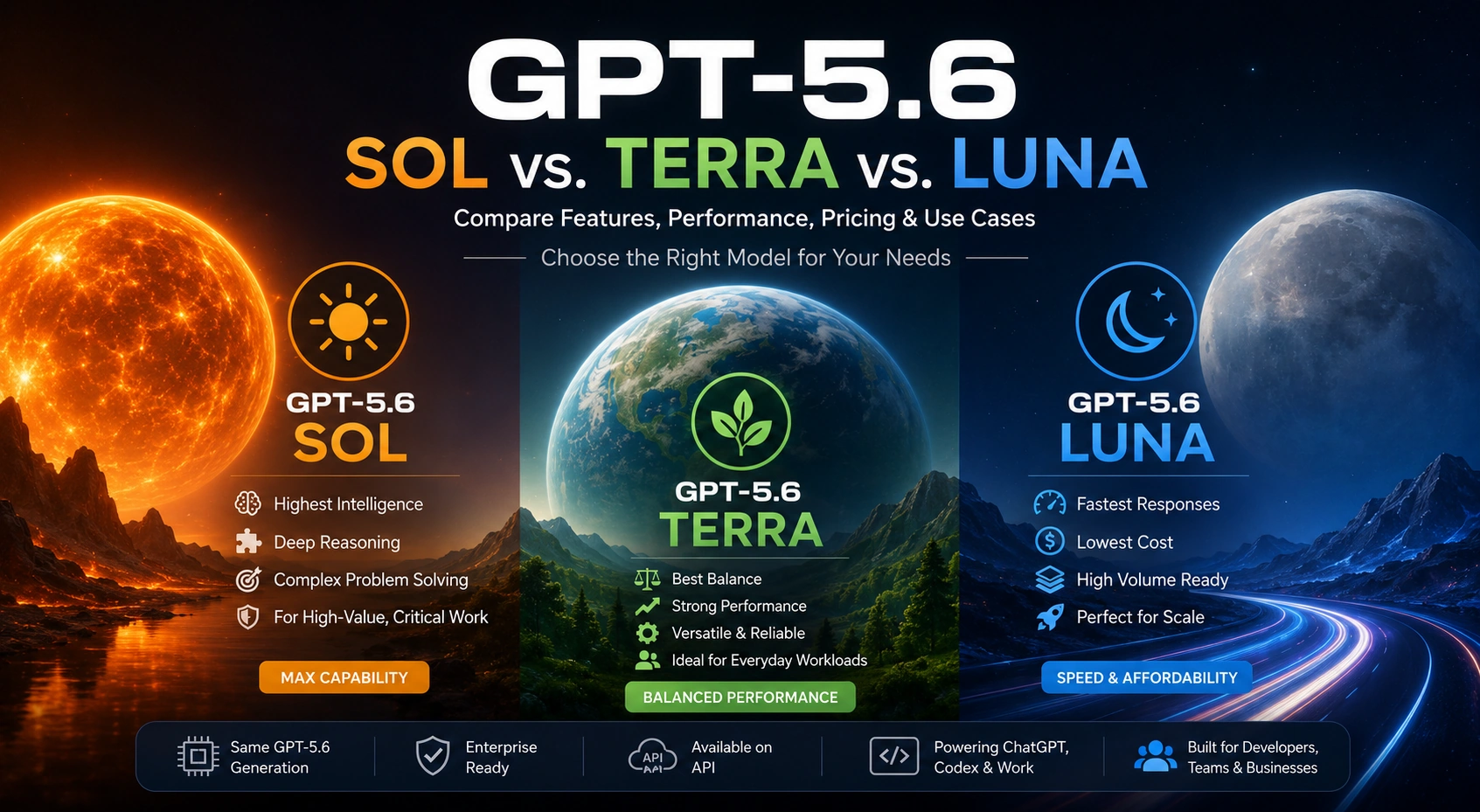
All three models belong to the same GPT-5.6 generation. Their names describe lasting capability tiers rather than temporary product labels. OpenAI may improve each tier over time without changing the general role it plays.
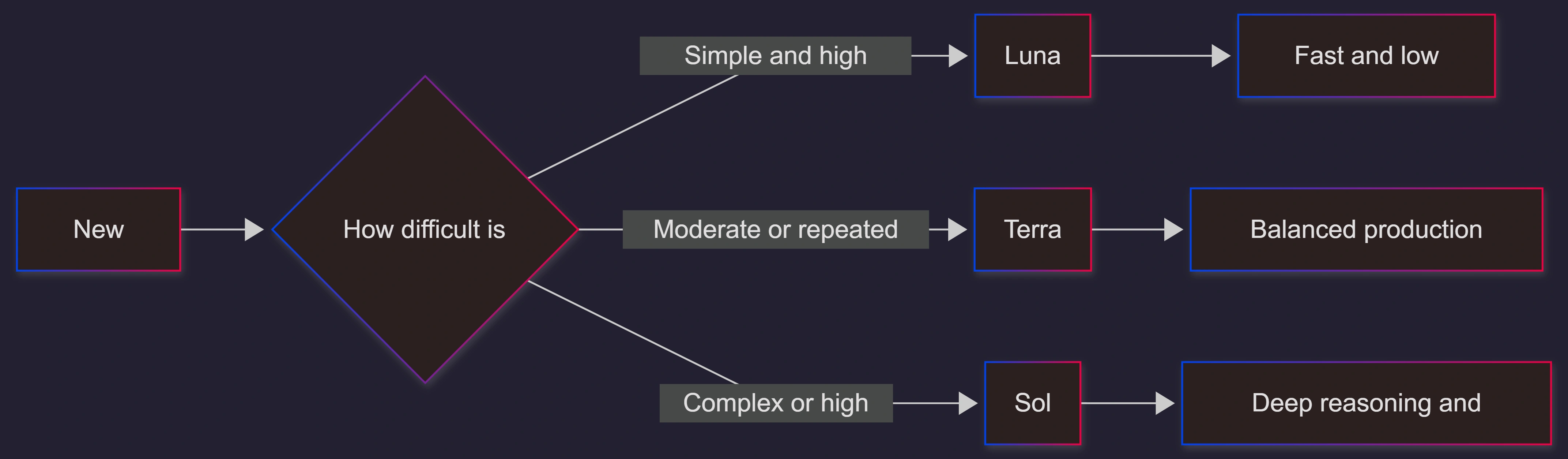
The simple decision is:
Choose Sol when accuracy and deep reasoning are worth the extra cost.
Choose Terra when you need dependable results at scale.
Choose Luna when speed, volume, and cost are the main concerns.
GPT-5.6 Sol, Terra, and Luna at a Glance
| Area | GPT-5.6 Sol | GPT-5.6 Terra | GPT-5.6 Luna |
|---|---|---|---|
| Position | Flagship | Balanced | Fast and affordable |
| Main strength | Maximum capability | Capability-to-cost balance | Speed and low cost |
| Best for | Complex, high-value work | Everyday production workloads | Simple, high-volume tasks |
| Reasoning depth | Highest | Strong | Lighter |
| Expected speed | Slowest of the three on deep tasks | Faster balance | Fastest |
| API input price | $5 per 1 million tokens | $2.50 per 1 million tokens | $1 per 1 million tokens |
| API output price | $30 per 1 million tokens | $15 per 1 million tokens | $6 per 1 million tokens |
| Standard ChatGPT selection | Available on eligible paid plans | Not directly selectable | Not directly selectable |
| OpenAI API | Available | Available | Available |
| Codex and ChatGPT Work | Available on eligible plans | Available on eligible plans | Available on eligible plans |
Prices and availability can change. The figures above reflect OpenAI’s published information as of July 17, 2026.
Conceptual Background
Why OpenAI Uses Three Model Tiers
One AI model cannot be the perfect choice for every task.
A model that spends more time reasoning may solve a hard problem more reliably. However, it can also take longer and cost more. A smaller or faster model may handle routine work at a much lower cost.
The GPT-5.6 family separates these needs into three levels:
Sol focuses on maximum intelligence.
Terra focuses on practical balance.
Luna focuses on speed and affordability.
This structure lets developers match the model to the value and difficulty of each request.
For example, a legal research agent may need Sol for its final analysis. The same system could use Luna to classify documents and Terra to summarize the relevant files.
What “Reasoning” Means
Reasoning is the model’s ability to work through a problem before giving an answer.
More reasoning can help with:
Multi-step coding problems
Complex calculations
Research across several sources
Planning and decision-making
Tool use
Long-running agent workflows
Finding mistakes and checking results
More reasoning does not automatically improve every task. A customer support label such as “billing,” “technical,” or “shipping” usually does not need a flagship model.
How the Three Models Fit Together
GPT-5.6 Sol: The Flagship Model
GPT-5.6 Sol is OpenAI’s most capable model in the family. It is designed for work where a better answer can save significant time, reduce risk, or create more value.
Key Strengths
Sol is best suited to:
Complex software engineering
Debugging large codebases
Long-running coding agents
Professional research
Detailed financial analysis
Scientific workflows
Cybersecurity defense
Computer-use tasks
Interface and presentation design
Multi-stage planning
Difficult document analysis
OpenAI also provides higher reasoning settings for Sol. The max setting gives the model more time to explore options, run checks, and revise its approach. The ultra setting can coordinate multiple agents working in parallel on demanding tasks.
Reported Performance
OpenAI reports the following results for the standard Sol configuration:
52.7% on Agents’ Last Exam, compared with 50.4% for Terra and 50.3% for Luna.
88.8% on Terminal-Bench 2.1, compared with 87.4% for Terra and 84.7% for Luna.
90.4% on BrowseComp, compared with 87.5% for Terra and 83.3% for Luna.
These results show that the performance gaps can be small on some tasks and larger on others.
Benchmarks are controlled tests. They do not guarantee the same result in every real application. Your prompts, tools, data, reasoning settings, and evaluation method can change the outcome.
Where Sol Provides the Most Value
Sol makes sense when a wrong or incomplete result would be expensive.
Examples include:
Reviewing a major software architecture
Investigating a serious production failure
Creating an investment research report
Analyzing a large contract set
Planning a company-wide migration
Running a complex security review
Building an agent that must work for hours
Producing a polished client deliverable
Main Trade-Offs
Sol costs more than Terra and Luna.
Its API output price is five times Luna’s price. It may also use more time and reasoning tokens on difficult tasks.
Using Sol for every request can increase costs without improving simple outputs. It is often better to reserve Sol for the stages that need judgment, deep reasoning, or final verification.
GPT-5.6 Terra: The Balanced Model
GPT-5.6 Terra sits between Sol and Luna.
OpenAI describes Terra as a balanced model for everyday work. It is designed to offer strong capability while lowering cost.
Key Strengths
Terra is a good fit for:
Production coding agents
Code generation
Pull request reviews
Document analysis
Business research
Report drafting
Data extraction
Customer support automation
Workflow agents
Content transformation
Tool-based applications
Large batches of moderately difficult tasks
Terra is especially useful when your system handles many requests but still needs strong reasoning.
Why Terra May Be the Default Choice for Businesses
Terra costs half as much as Sol at published API rates:
Sol: $5 input and $30 output per 1 million tokens
Terra: $2.50 input and $15 output per 1 million tokens
Its reported benchmark results are also close to Sol in several areas.
For example:
Terra scored 50.4% on Agents’ Last Exam, while Sol scored 52.7%.
Terra scored 87.4% on Terminal-Bench 2.1, while Sol scored 88.8%.
Terra scored 63.4% on SWE-Bench Pro, while Sol scored 64.6%.
That does not mean Terra will always match Sol. It means teams should test whether Sol’s extra capability produces enough business value to justify its higher cost.
Where Terra Provides the Most Value
Terra is often the strongest starting point for a new production system.
It can handle the main workflow while Sol is used only for difficult cases.
Examples include:
A coding assistant that sends failed tasks to Sol
A research tool that uses Terra for summaries and Sol for final conclusions
A support system that uses Luna for classification and Terra for replies
A content platform that uses Terra for first drafts and Sol for important client work
An early user quoted by OpenAI said Terra and Luna “punch well above their price.”
Main Trade-Offs
Terra may miss details that Sol catches in long, difficult, or unusual tasks.
It can also be more expensive than needed for simple work such as tagging, routing, formatting, or extracting a few fields.
GPT-5.6 Luna: The Fastest and Most Affordable Model
GPT-5.6 Luna is the fastest and lowest-cost model in the family.
It is built for applications that need quick responses, predictable costs, and high throughput.
Throughput means the number of requests a system can process during a set period.
Key Strengths
Luna is best suited to:
Classification
Tagging
Data extraction
Text cleanup
Short summaries
Intent detection
Search-query rewriting
Product description generation
Basic customer support
Simple code changes
Content moderation support
High-volume background tasks
First-pass document processing
Luna can also serve as the first stage of a larger AI workflow.
Cost Advantage
Luna’s published API price is:
$1 per 1 million input tokens
$6 per 1 million output tokens
Compared with Sol, that is an 80% lower listed token price for both input and output.
Compared with Terra, Luna costs 60% less at the listed rates.
For large applications, this difference can be significant.
Suppose an application generates 100 million output tokens each month, before caching and other charges:
Sol output cost: about $3,000
Terra output cost: about $1,500
Luna output cost: about $600
This example only applies the published output-token rates. A real invoice may include input tokens, cached tokens, tools, priority processing, and other services.
Where Luna Provides the Most Value
Luna is valuable when the task is easy to check or easy to retry.
Examples include:
Assigning a support ticket to a department
Extracting names and dates from a standard form
Rewriting a title in a fixed format
Generating search keywords
Summarizing a short message
Creating several draft variations
Filtering a long list before deeper analysis
Main Trade-Offs
Luna has less reasoning power than Sol and Terra.
It may be less reliable for:
Ambiguous instructions
Large architectural decisions
Complex debugging
Advanced research
Difficult calculations
Long chains of tool use
High-risk recommendations
Tasks that require careful judgment
The lower price only creates value when the output is good enough for the job.
Sol vs. Terra vs. Luna: Detailed Comparison
Capability
Winner: Sol
Sol should be the first choice when maximum reasoning and problem-solving ability matter.
Terra remains strong and may provide similar results on many standard business tasks. Luna is capable, but its main advantage is efficiency rather than maximum depth.
Speed
Winner: Luna
Luna is designed as the fastest model.
Terra offers a middle ground. Sol may take longer when higher reasoning settings are enabled.
Actual speed can also depend on traffic, prompt length, tools, reasoning level, service tier, and output size.
Cost
Winner: Luna
Luna has the lowest published API token rates.
Terra offers a useful price-to-performance balance. Sol is the most expensive of the three, but it may reduce retries or human review on difficult tasks.
Coding
Best maximum capability: Sol
Best production balance: Terra
Best for simple coding volume: Luna
OpenAI reports coding-agent index scores of:
Sol: 80
Terra: 77.4
Luna: 74.6
For a difficult repository migration, choose Sol. For a production coding assistant serving many developers, start by testing Terra. For formatting, simple tests, comments, or small edits, Luna may be enough.
Research and Knowledge Work
Best for deep research: Sol
Sol is the strongest choice for multi-source research, financial analysis, scientific work, and complicated document sets.
Terra is suitable for routine research, summarization, and repeated report generation.
Luna works best for early-stage filtering, extraction, or short summaries.
AI Agents and Tool Use
Best for long and complex agents: Sol
An AI agent is a system that can plan tasks, use tools, observe results, and decide what to do next.
Sol is designed for demanding, long-running workflows. Terra can power cost-aware production agents. Luna can perform small steps inside a larger system.
A strong agent may use all three rather than selecting only one.
High-Volume Applications
Winner: Luna
Luna is the natural choice for millions of short or simple requests.
Terra is better when those requests require stronger reasoning. Sol should normally be reserved for escalations or high-value requests.
Step-by-Step Walkthrough: How to Choose the Right Model
Define the Task
Write down what the model must produce.
Avoid broad goals such as “help with coding.” Use a clear task such as:
Fix a failing unit test
Review a pull request
Design a system architecture
Extract invoice fields
Summarize a research paper
Classify support tickets
Measure the Cost of a Wrong Answer
Ask what happens when the model makes a mistake.
Use Sol when an error could cause:
Major rework
Financial loss
Security risk
Legal risk
A failed customer delivery
A damaging business decision
Use Terra or Luna when mistakes are easy to detect, retry, or correct.
Estimate Request Volume
A model price difference may look small for one request but become large across millions of tokens.
Estimate:
Monthly input tokens
Monthly output tokens
Average number of retries
Tool costs
Human review time
The value of successful completion
Build a Test Set
Create a set of real tasks from your business.
Include:
Easy cases
Normal cases
Difficult cases
Unusual cases
Past failures
Long-context requests
Tool-use requests
Do not select a model using public benchmarks alone.
Score the Results
Measure factors that matter to your application:
Accuracy
Completeness
Response time
Token use
Cost per successful task
Retry rate
Human editing time
Safety
Format compliance
Start With Terra
For many business systems, Terra is a practical starting point.
Move down to Luna when quality remains acceptable. Move up to Sol when difficult cases need better reasoning.
Add Automatic Routing
A production system can route work based on difficulty:
Luna handles simple requests.
Terra handles normal requests.
Sol handles difficult requests and failed attempts.
This approach can provide strong quality without paying Sol prices for every task.
Use Cases and Recommended Models
| Use case | Recommended model | Reason |
|---|---|---|
| Complex software architecture | Sol | Needs deep reasoning and trade-off analysis |
| Large codebase debugging | Sol | Requires persistence and tool coordination |
| Routine code generation | Terra | Strong coding at a lower cost |
| Simple code formatting | Luna | Fast and easy to verify |
| Deep financial research | Sol | High-value, multi-step analysis |
| Regular business reports | Terra | Good balance for repeated work |
| Ticket classification | Luna | Simple and high volume |
| Customer support replies | Terra | Needs quality without flagship cost |
| Support intent detection | Luna | Short and structured task |
| Contract portfolio analysis | Sol | Complex document reasoning |
| Standard document extraction | Luna | Clear fields and predictable format |
| Marketing first drafts | Terra | Strong writing with manageable cost |
| Headline variations | Luna | Fast generation of many options |
| Final executive presentation | Sol | Better judgment and polish |
| Research-document filtering | Luna | Efficient first-stage processing |
| Scientific workflow | Sol | Advanced reasoning and long tasks |
| Production AI agent | Terra | Strong default for repeated agent work |
| Agent escalation | Sol | Handles the most difficult cases |
A Practical Multi-Model Architecture
A company does not need to choose one GPT-5.6 model for everything.
A better design may look like this:
Luna receives the request.
It detects the intent.
It extracts key fields.
It estimates task difficulty.
Terra performs the main work.
It creates the draft.
It uses standard tools.
It checks the requested format.
Sol handles escalations.
It reviews uncertain cases.
It solves difficult failures.
It produces the final answer for high-value work.
This design can reduce cost while protecting quality.
Common Selection Mistakes
Using Sol for Every Request
Sol is powerful, but many tasks do not need flagship reasoning.
Fix this by testing Luna and Terra on simple and normal requests.
Choosing Luna Only Because It Is Cheaper
A low token price does not help when the model requires repeated retries or heavy human correction.
Measure cost per successful task, not only cost per token.
Depending Only on Public Benchmarks
Benchmarks provide useful signals, but they may not reflect your prompts, tools, data, or users.
Build a private evaluation set based on real work.
Ignoring Output Length
Output tokens cost more than input tokens across all three models.
Clear instructions, structured output, and sensible response limits can reduce unnecessary cost.
Ignoring Product Availability
Terra and Luna are not directly selectable in standard ChatGPT conversations as of this update. They are available through supported versions of ChatGPT Work, Codex, and the OpenAI API.
Failing to Route Difficult Cases
A Luna or Terra workflow should know when to escalate.
Useful escalation signals include:
Low confidence
Tool failure
Repeated attempts
Conflicting evidence
High-risk subject matter
A request marked as business-critical
Availability in ChatGPT, Codex, Work, and the API
As of July 17, 2026, GPT-5.6 is still rolling out gradually to eligible accounts.
Standard ChatGPT Conversations
GPT-5.6 Sol powers Medium, High, and Extra High reasoning options on eligible plans.
GPT-5.6 Sol Pro is available for difficult and longer-running workflows on supported higher-tier plans.
Terra and Luna cannot currently be selected directly in a standard ChatGPT conversation.
ChatGPT Work
Eligible paid plans can use Sol, Terra, and Luna in ChatGPT Work.
Availability can depend on the plan, workspace settings, and rollout status.
Codex
Free and Go users can access Terra in Codex.
Eligible Plus, Pro, Business, and Enterprise users can select Sol, Terra, and Luna.
OpenAI API
Developers can access all three models through the OpenAI API.
This is the main option for teams that want to build automatic routing, cost controls, agent systems, and custom evaluations.
Pricing Comparison
OpenAI publishes the following regular API prices per 1 million tokens:
| Model | Input | Output |
|---|---|---|
| GPT-5.6 Sol | $5 | $30 |
| GPT-5.6 Terra | $2.50 | $15 |
| GPT-5.6 Luna | $1 | $6 |
OpenAI also offers prompt caching.
A cache stores reusable prompt content, so it does not need to be processed at the full uncached rate each time. For GPT-5.6, OpenAI states that cache reads receive a 90% cached-input discount, while cache writes are charged at 1.25 times the uncached input rate.
Your real cost can differ based on:
Prompt length
Output length
Reasoning effort
Cache use
Tool calls
Multi-agent work
Retries
Priority processing
Application design
Simple Recommendations by User Type
Individual ChatGPT User
Choose Sol through the available reasoning controls when you are working on:
Difficult coding
Research
Data analysis
Long documents
Important decisions
Complex planning
Continue using the faster default experience for simple questions.
Startup
Begin with Terra for the main product experience.
Use Luna for classification, extraction, routing, and background jobs. Escalate difficult or high-value tasks to Sol.
Large Enterprise
Use all three models.
Apply policy-based routing based on task type, risk, department, customer value, and required service level.
Developer Tool Company
Test Terra as the production default.
Use Sol for difficult repository tasks, major refactoring, architecture work, and failed attempts. Use Luna for small edits and supporting steps.
Research Team
Use Sol for final analysis and complex investigation.
Use Terra for repeated summaries and data work. Use Luna for filtering, cleaning, and document preparation.
Future Enhancements to Consider
Add automatic model routing based on task difficulty.
Build a private benchmark using real company requests.
Track cost per successful result rather than token cost alone.
Add fallback rules when Luna or Terra cannot complete a task.
Publish monthly benchmark updates as OpenAI improves each capability tier.
FAQs
1. What is the main difference between GPT-5.6 Sol, Terra, and Luna?
Sol provides the highest capability. Terra balances quality, speed, and cost. Luna provides the fastest and lowest-cost option.
2. Which GPT-5.6 model is best?
Sol is the most capable, but it is not the best economic choice for every task. Terra may be the best default for production work. Luna may be best for simple, high-volume requests.
3. Which model is cheapest?
Luna has the lowest published API price at $1 per 1 million input tokens and $6 per 1 million output tokens.
4. Is Terra half the price of Sol?
Yes, based on the published regular API token rates. Terra’s input and output prices are half of Sol’s prices.
5. Can I select Terra or Luna in a normal ChatGPT conversation?
Not currently. OpenAI states that Terra and Luna are not selectable in standard ChatGPT conversations. They are available in supported versions of ChatGPT Work, Codex, and the API.
6. Is Sol always more accurate than Terra?
Sol is the flagship model and generally provides greater capability. However, Terra’s results are close to Sol’s on some published benchmarks. The difference for your application must be tested with real tasks.
7. Is Luna suitable for coding?
Yes, Luna can handle coding tasks, especially simple and high-volume work. Sol is better for the hardest coding problems, while Terra provides a strong middle option.
8. Which model should a startup use?
A startup can begin with Terra as the main model, Luna for simple background tasks, and Sol for difficult or high-value cases.
9. Should I route every failed task to Sol?
Not automatically. First check whether the failure came from an unclear prompt, missing data, a broken tool, or a model limitation. Route to Sol when stronger reasoning is likely to solve the problem.
10. Do the three models share the same generation?
Yes. Sol, Terra, and Luna are capability tiers within the GPT-5.6 generation.
11. What is Sol Max and Ultra?
max gives Sol more time to reason, check alternatives, and revise its work. ultra coordinates multiple agents in parallel for demanding tasks.
12. Can pricing change?
Yes. Prices, plans, limits, and availability can change. Check the official OpenAI pricing and help pages before making a purchase or production decision.
References
[1] OpenAI. “GPT-5.6: Frontier Intelligence That Scales with Your Ambition.” Published July 9, 2026.
https://openai.com/index/gpt-5-6/
Official source for model roles, API prices, benchmarks, reasoning settings, caching, availability, and product positioning.
[2] OpenAI Help Center. “GPT-5.6 in ChatGPT.” Updated July 2026.
https://help.openai.com/en/articles/20001354-gpt-56-in-chatgpt
Official source for ChatGPT plan access, model selection, Codex availability, standard-chat restrictions, usage information, and rollout status.
Conclusion
GPT-5.6 Sol, Terra, and Luna solve different business problems.
Sol is the right choice for the hardest tasks, where quality and deep reasoning matter more than token price. Terra is the practical middle option and may be the strongest default for many production applications. Luna is ideal for fast, simple, and high-volume work.
Do not choose a model based only on its position in the lineup. Test all three against real tasks. Measure accuracy, speed, retries, human review, and total cost.
The strongest GPT-5.6 system may not use one model. It may use Luna for simple work, Terra for the main workflow, and Sol for the moments that require the best available reasoning.
Join the conversation! Your thoughts help the community grow.