

The arrival of OpenAI’s GPT-6 architecture—spearheaded by the flagship GPT-6 Astra and its streamlined counterpart GPT-6 Sol marks a massive leap in raw artificial intelligence capabilities. With a 1.05-million token context window, native computer-use automation, and advanced recurrent depth reasoning, the technology presents an unprecedented opportunity for enterprise automation.
However, raw intelligence does not equal operational safety. Deploying GPT-6 out-of-the-box introduces significant financial, operational, and compliance risks.
To bridge this gap, organizations are deploying GSCP-15 (Gödel's Scaffolded Cognitive Prompting, Version 15)—a 15-stage structured control plane that wraps around the model to enforce strict constraints, tool routing, and auditability.
The following breakdown illustrates the stark operational difference between deploying a raw GPT-6 model versus governing it with a GSCP-15 scaffolded pipeline.
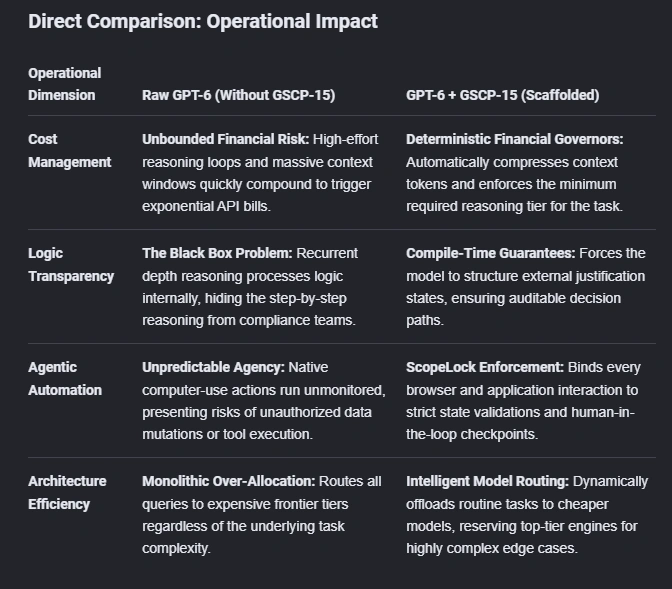
Core Areas of Transformation
1. Cost Containment Against the "Context and Effort Tax"
GPT-6 Astra introduces a powerful reasoning engine, but it comes at a steep premium: $10 per million input tokens and $50 per million output tokens, paired with a 2x input penalty for prompts exceeding 272K tokens.
Without GSCP-15: An unmonitored agent can easily fall into repetitive processing loops. By continuously maximizing reasoning depth or bloating the context window, a single run can deplete thousands of dollars in budget.
With GSCP-15: Stage 4 (Context Compression) and Stage 5 (Reasoning Mode Selection) act as literal financial firewalls. The pipeline strips redundant data before hitting the API and locks the model into the exact reasoning effort level required—dropping from "Astra Max" to a more economical "Sol Medium" whenever possible.
2. Penetrating the "Recurrent Depth" Black Box
GPT-6 relies heavily on internal recurrent reasoning. While this improves accuracy, it means the model calculates its logic steps hidden from view before outputting text, obscuring the traditional Chain-of-Thought (CoT).
Without GSCP-15: Enterprises in heavily regulated sectors (such as healthcare, banking, and legal tech) cannot prove why the model made a specific critical decision, failing core compliance and audit standards.
With GSCP-15: Stage 9 (Self-Critique) and Stage 10 (Safety & Compliance Review) wrap the execution. The model is barred from returning a final response until it maps its conclusions against an explicit ScopeLock execution contract, translating the black-box processing into verifiable, structured evidence.
3. Guardrails for Autonomous Computer Use
GPT-6 excels at OSWorld automation, enabling the AI to control screens, move cursors, open applications, and navigate web browsers directly.
Without GSCP-15: Giving a raw LLM unmitigated control over desktop environments presents immense operational risk. A minor hallucination could lead to unauthorized API expenditures, accidental data deletion, or compliance breaches.
With GSCP-15: Stage 7 (Tool Planning) sequences and locks down every machine-level action. High-impact operations, like database updates or form submissions, are automatically halted at Stage 12 (Approval & Escalation) until validated by clear automated rules or human authorization.
4. Strategic Model Routing
Maximizing efficiency requires balancing OpenAI's flagship Astra with its 5x cheaper, faster counterpart, GPT-6 Sol.
Without GSCP-15: System architectures struggle to cleanly delegate workloads, either overpaying for simple text transformations on Astra or experiencing logical failures by forcing Sol to handle highly complex edge cases.
With GSCP-15: The system evaluates incoming data payloads immediately during Stage 1 (Structured Intake). Standard processing, basic programming tasks, and routine classification are safely routed to GPT-6 Sol, ensuring that expensive GPT-6 Astra compute cycles are reserved solely for scenarios that trigger high-uncertainty flags during Stage 6 (Option Mapping).
Conclusion
As AI models become increasingly powerful, the primary focus of enterprise AI engineering shifts from capability to governance. GPT-6 provides the raw cognitive engine, but GSCP-15 provides the steering wheel, brakes, and dashboard. By implementing this scaffolded control layer, companies can deploy next-generation autonomous workflows with total predictability, absolute cost transparency, and ironclad regulatory compliance.
Join the conversation! Your thoughts help the community grow.