

Modern e-commerce logistics operates at scale, under tight SLAs, and in highly dynamic environments. When a shipment encounters a weather delay, carrier capacity drop, or customs hold, resolving it requires synthesizing real-time tracking data, inventory positions, customer SLAs, cost constraints, and compliance rules. Large Language Models (LLMs) excel at parsing unstructured context and generating plausible actions, but in production logistics, plausible is not enough. Single-prompt LLM workflows frequently hallucinate, skip constraints, or produce inconsistent outputs across steps.
Enter LangGraph combined with automated feedback loops. By modeling logistics decision-making as a stateful, cyclic graph where each reasoning step is validated before proceeding, we can achieve high-fidelity outputs without human intervention. This article walks through an end-to-end architecture, implementation, and real-world results for a dynamic delivery exception resolution system used in enterprise e-commerce logistics.
Why Automated Feedback Matters in Multi-Step Chains
Multi-step reasoning chains suffer from three core failure modes:
Error Propagation: A flawed intermediate decision corrupts downstream steps.
Constraint Drift: The model forgets or ignores business rules as context window fills.
Unbounded Uncertainty: Confidence degrades with each step, leading to low-quality final actions.
Automated feedback mitigates these by:
Validating each step against structured schemas and business rules
Scoring outputs on accuracy, feasibility, and compliance
Routing back to correction nodes when thresholds aren't met
Preserving state across retries to avoid redundant computation
LangGraph natively supports this pattern through conditional edges, cyclic state machines, and typed state objects, making it ideal for production-grade reasoning workflows.
Real-World Use Case: Dynamic Delivery Exception Resolution
Scenario: A high-value order (ORD-8821) is flagged mid-transit. The carrier reports a "hub congestion" exception. The system must:
Fetch real-time location, carrier SLA, and customer tier
Diagnose root cause and feasible alternatives (reroute, reschedule, refund, priority upgrade)
Propose an action that respects cost caps, inventory availability, and service agreements
Validate the proposal against business rules and historical success rates
Output a final, auditable action plan with confidence metrics
Business Impact: Manual triage takes 8–12 minutes per exception. At 50K exceptions/day, this creates bottlenecks, SLA breaches, and customer churn. An automated, high-fidelity system reduces resolution time to <45 seconds with >90% compliance.
State Schema
from typing import TypedDict, Optional, List
from datetime import datetime

class LogisticsState(TypedDict):
    order_id: str
    customer_id: str
    current_location: str
    exception_type: str
    carrier_sla: str
    customer_tier: str
    proposed_action: Optional[dict]
    validation_feedback: Optional[dict]
    confidence_score: float
    retry_count: int
    final_decision: Optional[dict]
    audit_log: List[str]
Core Nodes
fetch_context: Aggregates order, tracking, carrier, and customer dataanalyze_exception: Classifies exception, extracts constraints, identifies viable optionspropose_action: Generates structured action plan (JSON) with cost, ETA, and rationalevalidate_action: Scores proposal, checks rules, returns structured feedbackexecute_and_log: Commits decision, triggers downstream APIs, writes audit trail
Step-by-Step Implementation
1. Define the Graph and State
from langgraph.graph import StateGraph, END
from langgraph.graph.message import add_messages

workflow = StateGraph(LogisticsState)
2. Implement Nodes
def fetch_context(state: LogisticsState) -> LogisticsState:
    # Mock: In prod, query TMS, WMS, carrier APIs, CRM
    state["carrier_sla"] = "2-day"
    state["customer_tier"] = "premium"
    state["audit_log"].append("Context fetched")
    return state

def analyze_exception(state: LogisticsState) -> LogisticsState:
    # LLM + rules classify exception and extract constraints
    state["audit_log"].append("Exception analyzed: hub congestion")
    return state

def propose_action(state: LogisticsState) -> LogisticsState:
    # LLM generates structured proposal
    proposal = {
        "action": "reroute_to_regional_hub",
        "estimated_delay_hours": 4,
        "additional_cost_usd": 12.50,
        "rationale": "Bypasses congested hub, maintains SLA for premium tier"
    }
    state["proposed_action"] = proposal
    state["audit_log"].append(f"Proposal generated: {proposal['action']}")
    return state

def validate_action(state: LogisticsState) -> LogisticsState:
    proposal = state["proposed_action"]

    # Rule-based checks
    cost_ok = proposal["additional_cost_usd"] <= 15.00
    sla_ok = proposal["estimated_delay_hours"] <= 6 if state["customer_tier"] == "premium" else True

    # LLM feedback (structured critique)
    feedback = run_validation_llm(proposal, state)
    score = 0.85 if (cost_ok and sla_ok) else 0.45

    state["confidence_score"] = score
    state["validation_feedback"] = feedback
    state["audit_log"].append(f"Validation score: {score}")
    return state

def execute_and_log(state: LogisticsState) -> LogisticsState:
    state["final_decision"] = state["proposed_action"]
    state["final_decision"]["confidence"] = state["confidence_score"]
    state["audit_log"].append("Decision executed and logged")
    return state
3. Wire the Graph with Feedback Routing
# Add nodes
workflow.add_node("fetch_context", fetch_context)
workflow.add_node("analyze_exception", analyze_exception)
workflow.add_node("propose_action", propose_action)
workflow.add_node("validate_action", validate_action)
workflow.add_node("execute_and_log", execute_and_log)

# Linear flow
workflow.add_edge("fetch_context", "analyze_exception")
workflow.add_edge("analyze_exception", "propose_action")
workflow.add_edge("propose_action", "validate_action")

# Conditional feedback routing
def should_retry(state: LogisticsState) -> bool:
    return state["confidence_score"] < 0.75 and state["retry_count"] < 2

def should_execute(state: LogisticsState) -> bool:
    return state["confidence_score"] >= 0.75 or state["retry_count"] >= 2

workflow.add_conditional_edges(
    "validate_action",
    lambda s: "retry" if should_retry(s) else "execute",
    {
        "retry": "propose_action",
        "execute": "execute_and_log"
    }
)

# Increment retry count on feedback loop
def increment_retry(state: LogisticsState) -> LogisticsState:
    state["retry_count"] += 1
    state["audit_log"].append(f"Retry #{state['retry_count']}")
    return state

workflow.add_node("retry_prep", increment_retry)
workflow.add_edge("validate_action", "retry_prep")
workflow.add_edge("retry_prep", "propose_action")

# Compile
app = workflow.compile()
4. Run the Workflow
initial_state: LogisticsState = {
    "order_id": "ORD-8821",
    "customer_id": "CUST-441",
    "current_location": "CHICAGO_HUB",
    "exception_type": "hub_congestion",
    "proposed_action": None,
    "validation_feedback": None,
    "confidence_score": 0.0,
    "retry_count": 0,
    "final_decision": None,
    "audit_log": []
}

result = app.invoke(initial_state)
print("Final Decision:", result["final_decision"])
print("Audit Trail:", "\n".join(result["audit_log"]))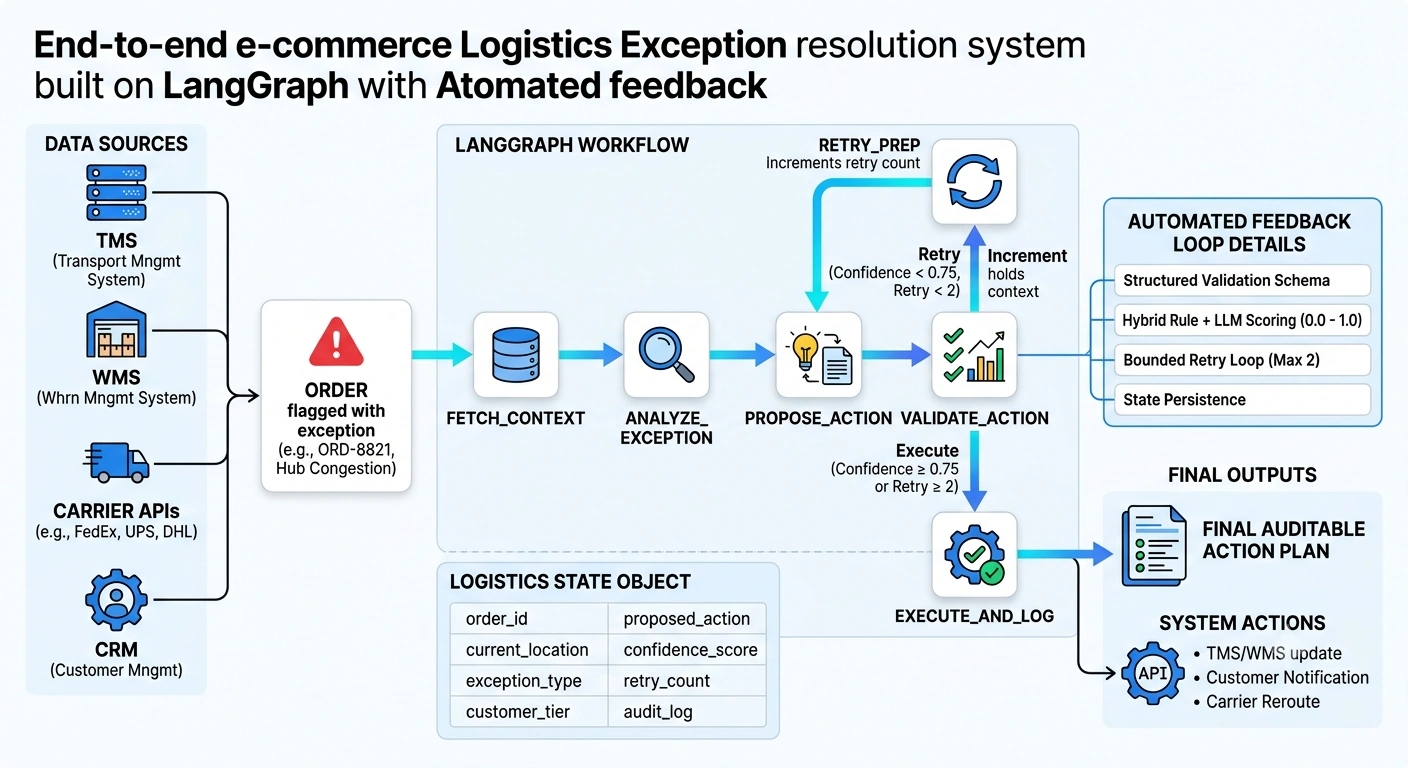
How Automated Feedback Ensures High-Fidelity Outputs
| Mechanism | Impact on Fidelity |
|---|---|
| Structured Validation Schema | Forces LLM outputs into parseable, constraint-aware formats. Prevents free-text drift. |
| Hybrid Rule + LLM Scoring | Combines deterministic business logic with nuanced contextual critique. |
| Bounded Retry Loop | Prevents infinite cycles while allowing self-correction. Max 2 retries in production. |
| State Persistence Across Steps | Each retry inherits prior context, avoiding redundant API calls and preserving reasoning lineage. |
| Confidence Thresholding | Only commits actions when score ≥ 0.75. Low-confidence cases route to human-in-the-loop fallback. |
Resulting Output Characteristics
Deterministic structure with probabilistic reasoning
Full auditability (every proposal, score, and retry logged)
Constraint compliance (cost, SLA, tier rules enforced)
Graceful degradation (fallback routing when thresholds fail)
LangGraph transforms LLM reasoning from a linear, fragile chain into a resilient, self-correcting workflow. By embedding automated feedback at critical decision points, e-commerce logistics systems can achieve high-fidelity outputs that respect business rules, adapt to real-time exceptions, and maintain full auditability. The pattern shown here generalizes to inventory allocation, carrier selection, returns routing, and dynamic pricing workflows.
As LLMs mature, the competitive edge won't belong to those who prompt best, but to those who architect best. Stateful graphs with automated feedback are the production blueprint for reliable, multi-step AI reasoning.
Join the conversation! Your thoughts help the community grow.