

In the span of just a few years, artificial intelligence has transformed from a promising technology with limited applications to a ubiquitous force reshaping entire industries. This acceleration is not merely a continuation of previous technological trends but represents a fundamental shift in both the pace and nature of innovation. To effectively manage this change, we must first understand its distinctive characteristics and driving forces.
Unlike previous technological revolutions that followed relatively predictable linear progressions, AI development is characterized by exponential growth curves. This acceleration is evident across multiple dimensions:
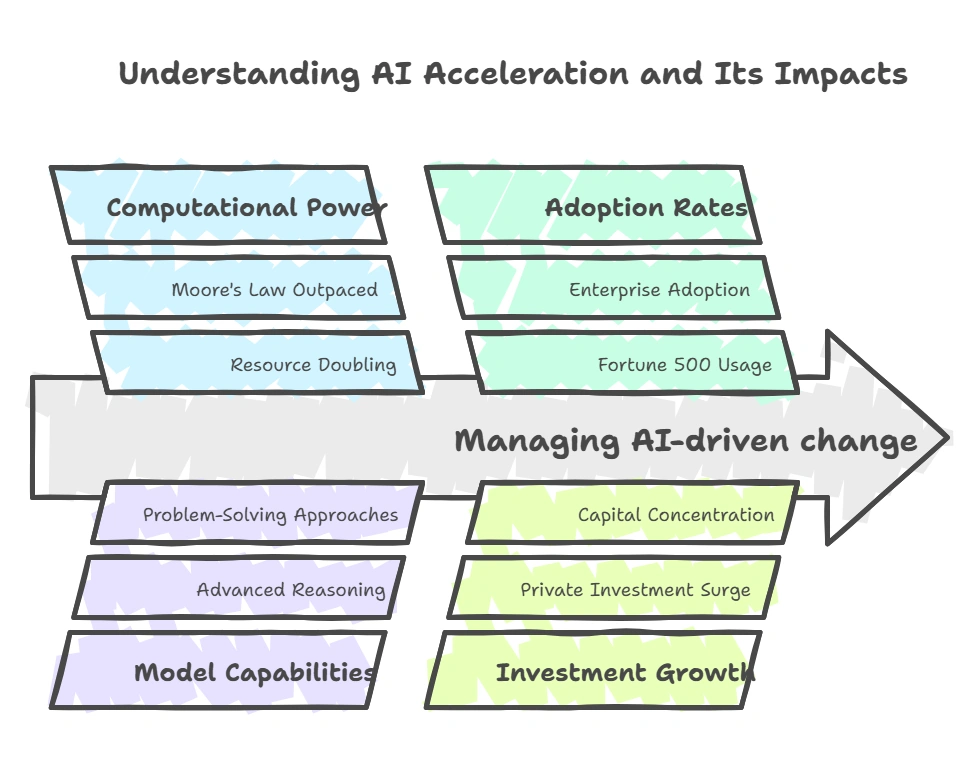
Computational Power: The computational resources available for AI training have doubled approximately every 3.4 months since 2012, representing a 10-million-fold increase in less than a decade. This vastly outpaces Moore's Law, which predicted a doubling of computing power every two years.
Model Capabilities: The capabilities of AI systems have expanded dramatically. In 2025, models with advanced reasoning capabilities like OpenAI's o1 and o3 can solve complex problems with logical steps similar to human thinking. These models break down tricky problems into simpler ones and try alternative approaches when initial methods fail—capabilities that seemed distant just a few years ago.
Adoption Rates: Enterprise adoption of generative AI jumped from 55% to 75% among business leaders and AI decision-makers in a single year. Nearly 70% of Fortune 500 companies now use AI-powered tools for tasks ranging from content creation to complex decision-making.
Investment Growth: Global investment in AI has surged, with private investment in AI more than doubling in the past five years, reaching unprecedented levels of capital concentration in a single technology category.
This acceleration creates a challenging environment for organizations, as the window for adaptation continues to shrink while the potential impact of each new advancement grows larger.
Key Trends Driving AI Innovation in 2025
Several interconnected trends are currently shaping the AI landscape, each with significant implications for organizational change management:
1. AI Reasoning Capabilities
AI systems have evolved beyond pattern recognition to demonstrate sophisticated reasoning abilities. Models can now work through problems step by step, breaking down complex challenges into manageable components. This represents a significant shift from earlier AI systems that excelled at narrow tasks but struggled with multi-step reasoning.
Organizational Impact: These reasoning capabilities enable AI to address increasingly complex business problems, from legal contract analysis to scientific research. Organizations must now prepare for AI systems that can handle nuanced decision-making processes previously reserved for highly skilled knowledge workers.
2. Agentic AI
Perhaps the most significant trend of 2025 is the rise of agentic AI—autonomous systems that can perform tasks independently with minimal human intervention. These AI agents can operate collaboratively, with multiple specialized agents working together to accomplish complex goals.
Organizational Impact: Agentic AI fundamentally changes the human-machine relationship from one where humans direct AI tools to one where humans oversee AI systems that operate with increasing autonomy. This shift requires new governance structures, oversight mechanisms, and approaches to human-AI collaboration.
3. Specialized Models and Custom Silicon
The AI landscape is increasingly characterized by specialized models designed for specific tasks or industries, rather than one-size-fits-all approaches. This specialization extends to hardware, with custom silicon designed for particular AI workloads rather than general-purpose processing.
Organizational Impact: Organizations must develop strategies for selecting, integrating, and managing an ecosystem of specialized AI capabilities rather than implementing a single monolithic system. This requires new forms of technical expertise and governance approaches.
4. Multimodal Capabilities
AI systems increasingly work across multiple types of data—text, images, audio, and video—enabling more natural and comprehensive interactions. These multimodal capabilities allow AI to process information more like humans do, drawing connections across different forms of input.
Organizational Impact: Multimodal AI enables new forms of human-machine interaction and unlocks previously inaccessible data sources. Organizations must rethink processes and interfaces to leverage these capabilities effectively.
5. Measuring AI ROI
As AI moves from experimentation to mainstream implementation, organizations are increasingly focused on measuring and demonstrating business value. This shift reflects the maturation of AI from a speculative technology to a core business capability.
Organizational Impact: Organizations must develop robust methodologies for evaluating AI's impact beyond technical metrics, including productivity gains, cost savings, revenue growth, and competitive differentiation.
Industry-Specific Acceleration Patterns
While AI acceleration affects all sectors, the patterns of innovation and adoption vary significantly across industries:
Financial Services: AI adoption is particularly advanced in financial services, with applications ranging from algorithmic trading to fraud detection and personalized financial advice. The industry's data-rich environment and quantitative orientation have enabled rapid integration of AI capabilities.
Healthcare: In healthcare, AI is transforming diagnostics, drug discovery, and personalized medicine. The regulatory environment creates additional complexity for change management, but the potential impact on patient outcomes drives continued innovation.
Manufacturing: AI-powered robotics, predictive maintenance, and supply chain optimization are revolutionizing manufacturing. The integration of AI with physical systems creates unique change management challenges that span both digital and physical domains.
Retail: Customer experience personalization, inventory management, and demand forecasting represent key AI applications in retail. The direct consumer impact of these technologies creates both opportunities and risks for organizations.
The Changing Innovation Ecosystem
The acceleration of AI is not occurring in isolation but within a rapidly evolving innovation ecosystem:
Democratization of AI: The barriers to AI adoption continue to fall, with increasingly accessible tools and platforms enabling organizations of all sizes to implement AI capabilities. This democratization accelerates the diffusion of AI across the economy.
Ecosystem Collaboration: The complexity of AI development has led to new forms of collaboration across the value chain, with chip companies, cloud providers, model developers, and application builders forming intricate partnerships.
Regulatory Evolution: The regulatory landscape for AI is developing rapidly, with new frameworks emerging to address concerns around privacy, bias, safety, and competition. Organizations must navigate this evolving regulatory environment while pursuing innovation.
The current state of AI innovation represents a perfect storm of technological acceleration, with multiple reinforcing trends driving change at an unprecedented pace. This acceleration creates both extraordinary opportunities and formidable challenges for organizations seeking to harness AI's potential.
The unprecedented acceleration of AI innovation creates a unique set of challenges for organizations. Traditional approaches to change management—developed for more predictable and linear technological shifts—often prove inadequate in the face of AI's rapid evolution and profound implications. This section explores the distinctive challenges of managing AI-driven change and why conventional methods frequently fall short.
The Fundamental Challenges of AI-Driven Change
Speed Outpacing Organizational Capacity
Perhaps the most fundamental challenge is the sheer velocity of AI advancement. While technology evolves at an exponential rate, organizational adaptation typically follows a more linear trajectory. This growing gap between technological possibility and organizational readiness creates significant tension.
Compressed Decision Cycles: The accelerating pace of AI innovation compresses decision-making timeframes. Organizations accustomed to multi-year technology planning cycles now face a landscape where significant new capabilities emerge quarterly or even monthly.
Continuous vs. Episodic Change: Traditional change management approaches treat change as a discrete event with a clear beginning and end. AI-driven transformation, however, is continuous and open-ended, requiring perpetual adaptation rather than one-time transitions.
Capability Building Under Pressure: Organizations must develop new capabilities while simultaneously deploying them, creating a challenging "learn while doing" environment that tests conventional approaches to skill development.
Depth and Breadth of Organizational Impact
AI's impact extends far beyond technology systems to transform fundamental aspects of work, organizational structure, and business models.
Workforce Transformation: AI reshapes job roles, skill requirements, and career paths across all levels of the organization. According to research, 58% of work activities could be automated using current AI technologies, requiring significant workforce adaptation.
Business Model Disruption: AI enables entirely new business models and value propositions, potentially rendering existing approaches obsolete. Organizations must innovate their core offerings while maintaining current operations.
Cross-Functional Complexity: Effective AI implementation requires unprecedented collaboration across traditionally siloed functions—data science, IT, business units, legal, ethics, and human resources must work together in new ways.
The Human Dimension of AI Change
The human aspects of AI-driven change present particularly complex challenges that technical approaches alone cannot address.
Psychological Responses: AI triggers profound psychological responses, from fear of job displacement to concerns about loss of autonomy and meaning. The Kübler-Ross change curve—with its stages of denial, anger, bargaining, depression, and acceptance—plays out with particular intensity in AI transformations.
Trust and Explainability: The "black box" nature of many AI systems creates trust challenges. Employees and customers may resist systems whose decision-making processes they cannot understand or verify.
Power and Control Shifts: AI redistributes decision-making authority within organizations, challenging established power structures and creating resistance from those whose authority is diminished.
Ethical Complexities: AI raises novel ethical questions around bias, privacy, surveillance, and accountability that organizations must navigate without established playbooks or societal consensus.
Why Traditional Change Management Approaches Fall Short
Traditional change management frameworks, while valuable in many contexts, often prove insufficient for AI-driven transformation for several key reasons:
Linear vs. Exponential Thinking
Most established change management approaches assume relatively linear, predictable change trajectories. Models like Lewin's "Unfreeze-Change-Refreeze" presuppose a stable end state that can be defined in advance—a luxury rarely available in the rapidly evolving AI landscape.
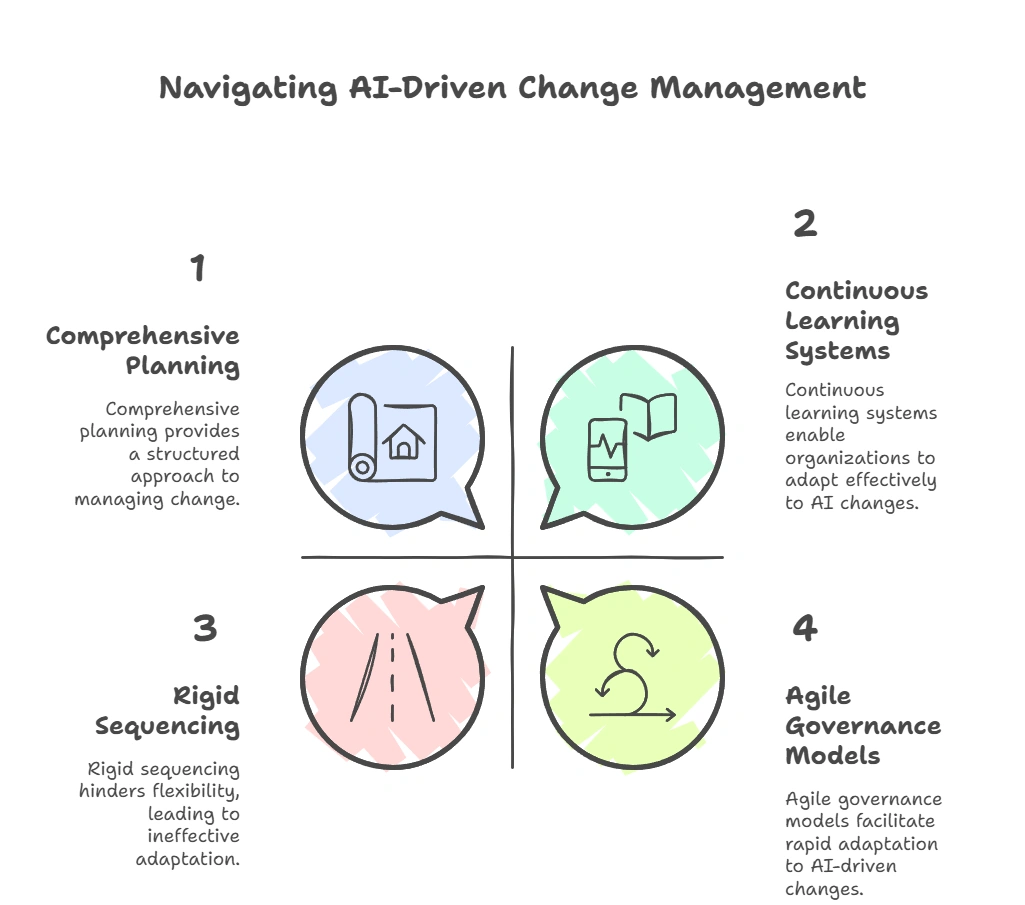
Planning Limitations: Traditional approaches emphasize comprehensive upfront planning, which becomes problematic when the technology itself is evolving during implementation.
Rigid Sequencing: Step-by-step methodologies struggle in environments where multiple interdependent changes must occur simultaneously and iteratively.
Insufficient Focus on Continuous Learning
While traditional frameworks acknowledge the importance of training, they rarely address the need for continuous learning systems that can keep pace with rapidly evolving technology.
Skills Half-Life: The accelerating pace of AI innovation shortens the useful life of specific technical skills, requiring new approaches to continuous reskilling.
Learning While Implementing: Organizations must build learning mechanisms that operate in parallel with implementation rather than as a preliminary phase.
Underestimation of Cultural Challenges
Many change management approaches treat culture as just one of many factors rather than a fundamental determinant of AI adoption success.
Data Culture Gaps: Successful AI implementation requires a strong data culture that many organizations lack. According to MIT Sloan Management Review, only 33% of organizations report having established a data- and AI-driven culture.
Decision-Making Norms: AI challenges established decision-making norms by introducing algorithmic inputs into processes previously dominated by human judgment and intuition.
Inadequate Governance Models
Traditional governance approaches struggle with the unique characteristics of AI systems.
Algorithmic Accountability: Organizations lack established frameworks for ensuring appropriate oversight and accountability for algorithmic decision-making.
Risk Management Challenges: AI introduces novel risks—from bias and privacy concerns to safety and security vulnerabilities—that traditional risk management approaches are ill-equipped to address.
Industry-Specific Change Management Challenges
Different sectors face unique challenges in managing AI-driven change:
Financial Services: Regulatory compliance, risk management, and the need to maintain customer trust create specific change management challenges for financial institutions implementing AI.
Healthcare: Patient safety concerns, clinical workflow integration, and professional autonomy issues complicate AI adoption in healthcare settings.
Manufacturing: The integration of AI with physical systems and operational technology creates unique change management requirements that span both digital and physical domains.
Retail: Customer-facing AI applications must navigate complex expectations around personalization, privacy, and service quality.
The Cost of Failed Change Management
The consequences of ineffective change management in AI initiatives are substantial:
Financial Losses: Failed AI implementations represent significant wasted investment, with the average large-scale AI project costing millions of dollars.
Missed Opportunities: Organizations that fail to effectively implement AI risk competitive disadvantage as rivals successfully leverage the technology.
Talent Implications: Unsuccessful AI initiatives can trigger talent flight, as skilled professionals seek organizations with more effective approaches.
Trust Erosion: Failed AI projects can damage trust in technology more broadly, creating resistance to future initiatives.
The challenges outlined above are not insurmountable, but they do require new approaches to change management specifically designed for the unique characteristics of AI-driven transformation. In the next section, we will explore frameworks and strategies that organizations can employ to navigate these challenges successfully.
Join the conversation! Your thoughts help the community grow.