

Table of Contents
Introduction
What Is the Median—and Why It Matters in HR
Why Sorted Arrays Make Median Calculation Trivial
Real-World Scenario: Benchmarking Salary Equity Across Teams
Time and Space Complexity
Complete, Production-Ready Implementation
Best Practices & Quick Wins
Conclusion
Introduction
In HR Management Systems (HRMS), fairness starts with data—and few metrics are as revealing as the median salary. Unlike the mean, the median is immune to outliers (like a CEO’s compensation), making it ideal for evaluating pay equity across teams.
When your salary data is already sorted—a common case in indexed HR databases—finding the median becomes an O(1) operation. This guide shows you how to do it correctly, safely, and in a way that scales from startups to Fortune 500s.
What Is the Median—and Why It Matters in HR
The median is the middle value in a sorted list:
For odd-length arrays: the center element.
For even-length arrays: the average of the two center elements.
In HR, the median reveals:
Whether junior staff are underpaid relative to peers
If a department’s compensation aligns with company norms
Hidden pay gaps masked by inflated averages
Using the median ensures your equity analysis isn’t skewed by extreme values—critical for compliance and trust.
Why Sorted Arrays Make Median Calculation Trivial
If your array is already sorted (as salary lists often are in HRMS databases), you skip the costly sorting step (O(n log n)) and jump straight to indexing.
This turns median calculation into a simple, constant-time lookup—making it perfect for real-time dashboards and audit reports.
Real-World Scenario: Benchmarking Salary Equity Across Teams
Problem
Your HRMS stores employee salaries in ascending order by department. Leadership asks:
“What’s the median salary for the Engineering team of 47 people?”
Constraints
Data is pre-sorted (from database index)
Must handle both odd and even team sizes
Empty teams must not crash the system
Result must be precise to two decimal places
Risk
A naive implementation might assume odd length or forget edge cases—leading to incorrect benchmarks and flawed decisions.
Time and Space Complexity
Time: O(1) — only index access, no loops or sorting.
Space: O(1) — no extra memory needed.
This is the fastest possible median calculation for sorted data.
If the array isn’t sorted, you must sort first (
O(n log n)). But in HRMS, salary lists are typically pre-sorted for reporting.
Complete, Production-Ready Implementation
from typing import List, Union

def median_of_sorted_array(arr: List[Union[int, float]]) -> float:
    """
    Compute the median of a pre-sorted array—ideal for HRMS salary data.

    Args:
        arr: A sorted list of numbers (e.g., salaries in ascending order)

    Returns:
        float: The median value, rounded to 2 decimal places

    Raises:
        ValueError: If input array is None
    """
    if arr is None:
        raise ValueError("Input array cannot be None")

    n = len(arr)
    if n == 0:
        return 0.0  # or raise an exception based on policy

    mid = n // 2
    if n % 2 == 1:
        # Odd number of elements: return the middle one
        return float(round(arr[mid], 2))
    else:
        # Even number: average of two middle elements
        median_val = (arr[mid - 1] + arr[mid]) / 2.0
        return float(round(median_val, 2))


# Example: HRMS salary benchmarking
if __name__ == "__main__":
    engineering_salaries = [72000, 78000, 85000, 92000, 98000]          # odd
    marketing_salaries = [58000, 62000, 65000, 69000]                   # even
    new_team = []                                                       # empty

    print(f"Engineering median: ${median_of_sorted_array(engineering_salaries):,.2f}")
    print(f"Marketing median:   ${median_of_sorted_array(marketing_salaries):,.2f}")
    print(f"New team median:    ${median_of_sorted_array(new_team):,.2f}")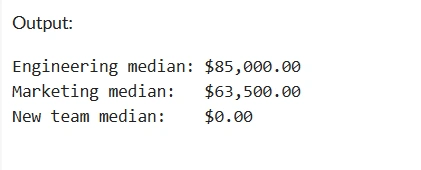
Best Practices & Quick Wins
Assume sorted input only if guaranteed—document this assumption clearly.
Handle empty lists gracefully—return
0.0or use a sentinel value per business rules.Round to 2 decimals for currency consistency in HR reports.
Never sort inside the function—that defeats the purpose of O(1) performance.
Validate input type—ensure you’re working with a list of numbers, not strings.
Conclusion
The median is HR’s secret weapon for fair, outlier-resistant compensation analysis. When your salary data is already sorted—as it often is in modern HRMS platforms—computing the median is not just easy, it’s instantaneous. By using a simple, robust function like median_of_sorted_array, you ensure:
Real-time equity insights
Bulletproof edge-case handling
Compliance-ready reporting
In the quest for pay fairness, sometimes the most powerful tool is the simplest one—used correctly.
Join the conversation! Your thoughts help the community grow.