

Let's specify some class named "Student
Class" in models folder has the Following Properties:
Student.cs
using System;
using System.Collections.Generic;
using System.Linq;
using System.Web;
using System.ComponentModel.DataAnnotations;
namespace MVC_Basic_Application.Models
{
public class Student
{
[Key]
public int StudentId
{ get; set; }
[Required(ErrorMessage
= "Please Enter FirstName")]
[StringLength(10, ErrorMessage = "FirstName
morethan 10 charcs")]
public string FirstName
{ get; set; }
[Required(ErrorMessage
= "Please Enter LastName")]
[StringLength(10, ErrorMessage = "LastName
morethan 10 charcs")]
public string LastName
{ get; set; }
[Range(5,
50, ErrorMessage = "Age Should Be Between 5 and 50")]
public int Age
{ get; set; }
[Required(ErrorMessage
= "Please Enter Location")]
[StringLength(10, ErrorMessage = "Location
morethan 10 charcs")]
public string Location
{ get; set; }
}
}
And My DataContext Class in models folder:
StudentStateEntities.cs is Specified
StudentStateEntities.cs
using System;
using System.Collections.Generic;
using System.Linq;
using System.Web;
using System.Data.Entity;
namespace MVC_Basic_Application.Models
{
public class StudentStateEntities:DbContext
{
public DbSet<Student>
Students { get; set;
}
}
}
And Now I will get chance to analyse what to do when My requirement changes and how to handle my application logic and database simultaneously. The Answer arises to this question which helps to another model class name "StudentStateIntializer" where we inherit from base class DropCreateDatabaseIfModelChanges<> , This Class help to drop and recreate the database if the requirement changes as per the application basis with necessary properties specified in Student class.
So the Fully Completed
StudentStateIntializer.cs looks like this:
StudentStateIntializer.cs
using System;
using System.Collections.Generic;
using System.Linq;
using System.Web;
using System.Data.Entity;
namespace MVC_Basic_Application.Models
{
public class StudentStateIntializer:DropCreateDatabaseIfModelChanges<StudentStateEntities>
{
protected override void Seed(StudentStateEntities context)
{
var stu = new List<Student>
{
new Student
{
StudentId=1,
FirstName="Vijay",
LastName="Prativadi",
Location="Banglore",
Age=25
},
new Student
{
StudentId=2,
FirstName="Uday",
LastName="Prativadi",
Location="Mumbai",
Age=28
}
};
stu.ForEach(p=>context.Students.Add(p));
}
}
}
Before you render changes to the webbroswer just go to global.asax.cs
Add this line in Application_Start() of global.asax.cs file:
Database.SetInitializer<StudentStateEntities>(new StudentStateIntializer());
The Completed Code of global.asax.cs looks
like this:
Global.asax.cs
using System;
using System.Collections.Generic;
using System.Linq;
using System.Web;
using System.Web.Mvc;
using System.Web.Routing;
using System.Data.Entity;
using MVC_Basic_Application.Models;
namespace MVC_Basic_Application
{
// Note: For instructions on enabling IIS6 or IIS7
classic mode,
// visit http://go.microsoft.com/?LinkId=9394801
public class MvcApplication :
System.Web.HttpApplication
{
public static void RegisterGlobalFilters(GlobalFilterCollection filters)
{
filters.Add(new HandleErrorAttribute());
}
public static void RegisterRoutes(RouteCollection routes)
{
routes.IgnoreRoute("{resource}.axd/{*pathInfo}");
routes.MapRoute(
"Default", //
Route name
"{controller}/{action}/{id}", //
URL with parameters
new { controller = "Student",
action = "Index", id = UrlParameter.Optional
} // Parameter defaults
);
}
protected void Application_Start()
{
Database.SetInitializer<StudentStateEntities>(new StudentStateIntializer());
AreaRegistration.RegisterAllAreas();
RegisterGlobalFilters(GlobalFilters.Filters);
RegisterRoutes(RouteTable.Routes);
}
}
}
So Now Everything should work Fine. So, lets do rebuild and take a look at
output which looks like this:
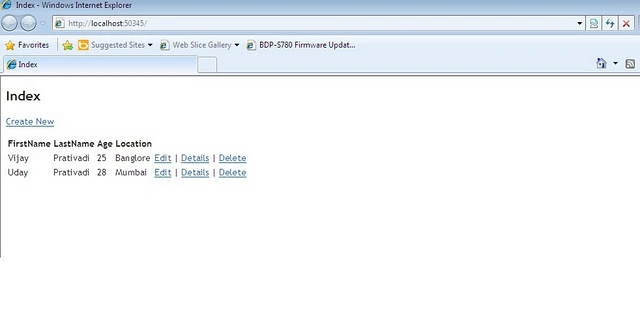
But think like, All of sudden my requirement is changed and I want to add an
other property where it should be affecting in my database and all other parts
of my application logic whereby rendering towards my output.
Let's See how to Handle this case
Let's Add New Property Named : "Email"
public string Email { get; set; }
The Completed Student.cs looks like this:
Student.cs with New Email Property
using System;
using System.Collections.Generic;
using System.Linq;
using System.Web;
using System.ComponentModel.DataAnnotations;
namespace MVC_Basic_Application.Models
{
public class Student
{
[Key]
public int StudentId
{ get; set; }
[Required(ErrorMessage
= "Please Enter FirstName")]
[StringLength(10, ErrorMessage = "FirstName
morethan 10 charcs")]
public string FirstName
{ get; set; }
[Required(ErrorMessage
= "Please Enter LastName")]
[StringLength(10, ErrorMessage = "LastName
morethan 10 charcs")]
public string LastName
{ get; set; }
[Range(5,
50, ErrorMessage = "Age Should Be Between 5 and 50")]
public int Age
{ get; set; }
[Required(ErrorMessage
= "Please Enter Location")]
[StringLength(10, ErrorMessage = "Location
morethan 10 charcs")]
public string Location
{ get; set; }
[Required(ErrorMessage
= "Email is required")]
[RegularExpression(@"^([a-zA-Z0-9_\-\.]+)@((\[[0-9]{1,3}" +
@"\.[0-9]{1,3}\.[0-9]{1,3}\.)|(([a-zA-Z0-9\-]+\" +
@".)+))([a-zA-Z]{2,4}|[0-9]{1,3})(\]?)$",
ErrorMessage = "Email
appears to be invalid.")]
public string Email
{ get; set; }
}
}
Simultaneously, we make necessary changes in
StudentStateIntializer.cs as well
StudentStateIntializer.cs
using System;
using System.Collections.Generic;
using System.Linq;
using System.Web;
using System.Data.Entity;
namespace MVC_Basic_Application.Models
{
public class StudentStateIntializer:DropCreateDatabaseIfModelChanges<StudentStateEntities>
{
protected override void Seed(StudentStateEntities context)
{
var stu = new List<Student>
{
new Student
{
StudentId=1,
FirstName="Vijay",
LastName="Prativadi",
Location="Banglore",
Age=25,
Email="[email protected]"
},
new Student
{
StudentId=2,
FirstName="Uday",
LastName="Prativadi",
Location="Mumbai",
Age=28,
Email="[email protected]"
}
};
stu.ForEach(d=>context.Students.Add(d));
}
}
}
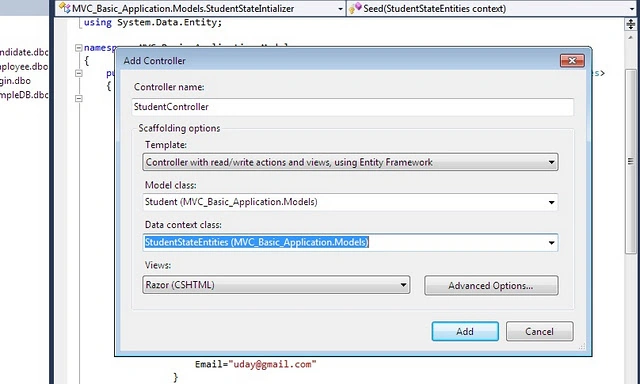
The Controller Should Accept Student.cs as
Model Class and StudentStateEntities.cs as DataContext Class Which Looks like
this:
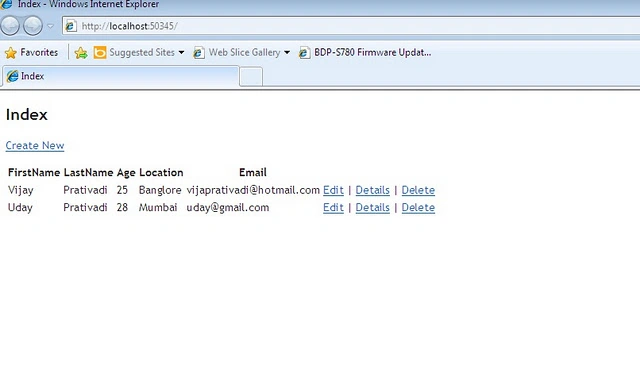
So When you rebuild and run the application you will find the new field added to your output and database aswell.
The output looks like this:
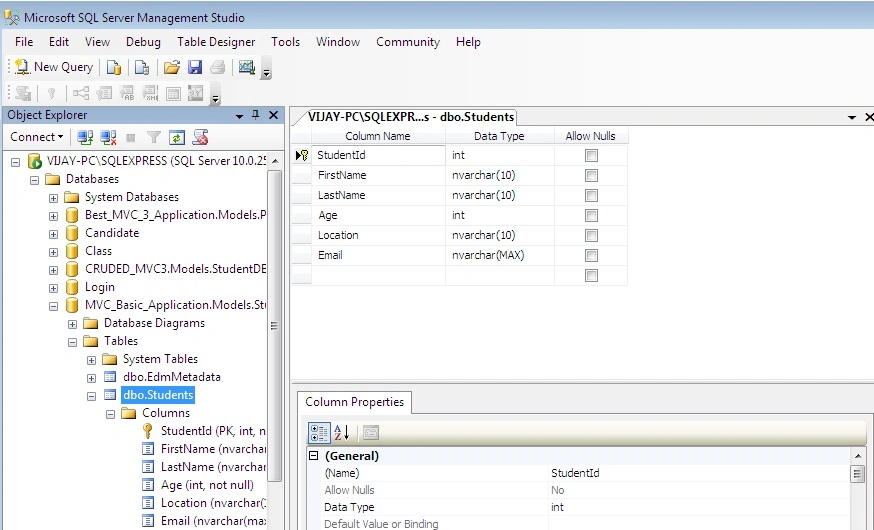
The Changes Made to database with DropCreateDatabaseIfModelChanges<> base class
will look this(Design Mode):
I
hope this article is useful to you.
Join the conversation! Your thoughts help the community grow.