

Introduction
Most developers treat Retrieval-Augmented Generation (RAG) as a "lookup" tool for Large Language Models (LLMs). You ask a question, it fetches a document, and the LLM summarizes it. This is a QA (Question-Answering) Workflow.
However, in high-stakes enterprise environments like FinTech, Supply Chain, or Healthcare, we need more than just answers; we need predictions. We need to know what will happen next based on retrieved context.
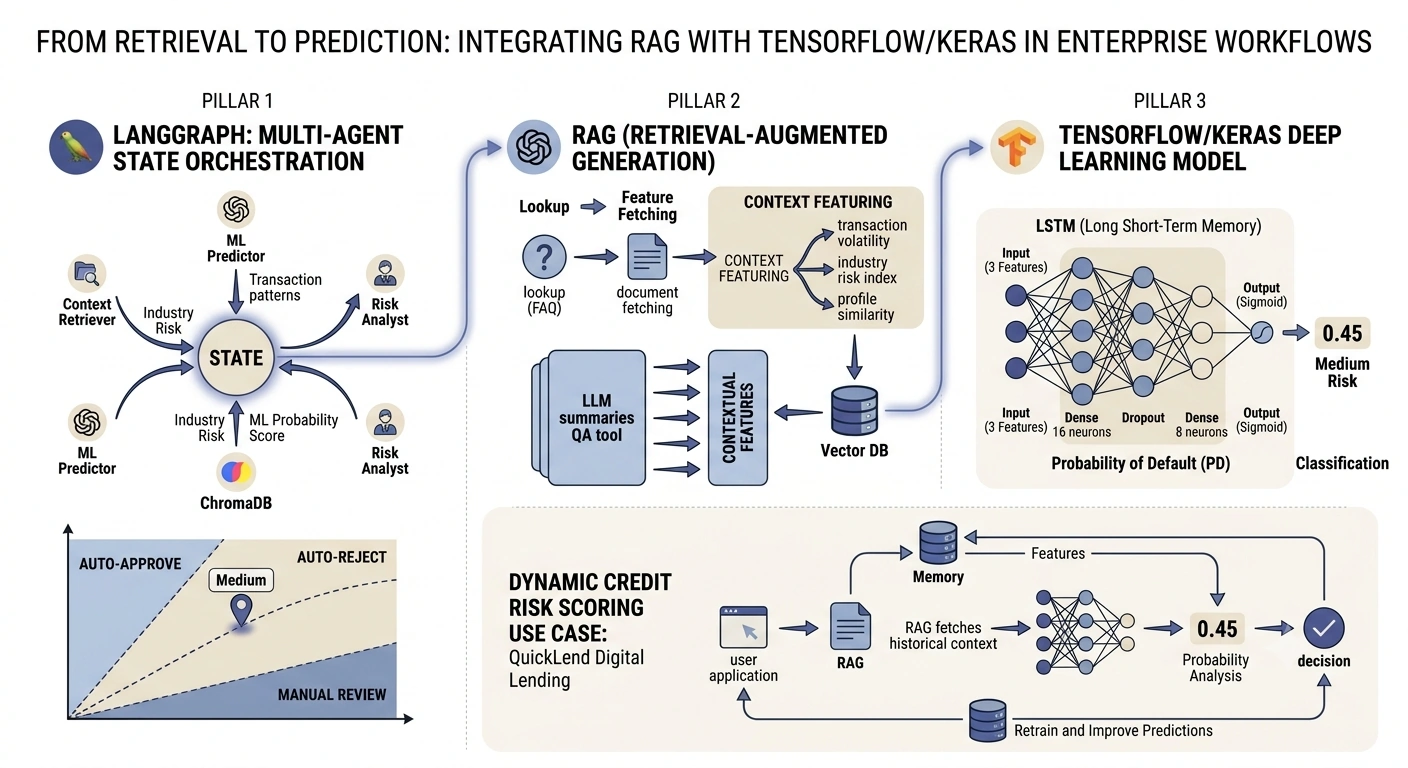
This article demonstrates how to integrate RAG into a Predictive Intelligence Workflow by combining:
LangGraph: For orchestrating multi-agent state.
RAG: To retrieve historical patterns and contextual features that static models miss.
TensorFlow/Keras: To run deep learning models (LSTMs/Transformers) that consume these retrieved features to generate numerical forecasts or classification probabilities.
Real-Time Use Case: Dynamic Credit Risk Scoring for Digital Lending
Scenario
Platform: "QuickLend," a digital lending platform offering instant personal loans. User: A freelancer applying for a ₹50,000 loan. Problem: Traditional credit scores (CIBIL) are lagging indicators. They don't capture recent behavior, such as a sudden spike in gig-income or a recent late payment on a utility bill that hasn't hit the bureau yet.
The Predictive RAG Solution
Instead of just asking "What is this user's credit score?", the system:
Retrieves (RAG): Fetches the user's last 6 months of transaction embeddings, recent industry risk reports for freelancers, and similar user profiles from a vector database.
Features Engineering: Converts these unstructured retrievals into structured numerical features (e.g., "Volatility Score," "Industry Risk Index").
Predicts (TensorFlow/Keras): Feeds these features into a pre-trained LSTM (Long Short-Term Memory) model to predict the Probability of Default (PD) for the next 90 days.
Decides (LangGraph): The agent combines the ML prediction with LLM-based reasoning to approve, reject, or flag for manual review.
System Architecture
Prerequisites
pip install langgraph langchain langchain-openai chromadb tensorflow pandas numpy psycopg2-binary redis pydantic scikit-learn
Step-by-Step Implementation
Step 1: Define State Schema
We need a state that holds both the raw data, the retrieved context, and the ML model's output.
from typing import TypedDict, List, Optional, Dict, Any
from pydantic import BaseModel, Field
import uuid

class LoanApplication(BaseModel):
    app_id: str = Field(default_factory=lambda: str(uuid.uuid4()))
    user_id: str
    amount: float
    tenure_months: int
    occupation: str

class RetrievedContext(BaseModel):
    transaction_volatility_score: float
    industry_risk_index: float
    similar_profile_default_rate: float
    recent_negative_events: List[str]

class MLPrediction(BaseModel):
    probability_of_default: float
    risk_category: str  # "Low", "Medium", "High"
    confidence_score: float

class RiskState(TypedDict):
    application: LoanApplication
    retrieved_context: Optional[RetrievedContext]
    ml_prediction: Optional[MLPrediction]
    final_decision: Optional[str]  # "Approve", "Reject", "Review"
    reasoning: str
    conversation_history: List[Dict[str, str]]
Step 2: Context Retriever Agent (RAG)
This agent retrieves semantic patterns from a vector store. In a real scenario, this would involve embedding transaction histories.
from langchain_chroma import Chroma
from langchain_openai import OpenAIEmbeddings
from langchain_core.documents import Document

class ContextRetrieverAgent:
    def __init__(self, vector_db_path: str = "./risk_db"):
        self.embeddings = OpenAIEmbeddings(model="text-embedding-3-small")
        self.vector_db = Chroma(
            persist_directory=vector_db_path,
            embedding_function=self.embeddings,
            collection_name="user_patterns"
        )
        self._seed_data()

    def _seed_data(self):
        if self.vector_db._collection.count() == 0:
            # Simulating embedded transaction patterns
            docs = [
                Document(
                    page_content="Freelancer with high income volatility but consistent savings.",
                    metadata={"volatility": 0.7, "industry_risk": 0.4, "default_rate": 0.05}
                ),
                Document(
                    page_content="Retail worker with stable income but high debt-to-income ratio.",
                    metadata={"volatility": 0.2, "industry_risk": 0.3, "default_rate": 0.08}
                )
            ]
            self.vector_db.add_documents(docs)

    def retrieve_features(self, user_id: str, occupation: str) -> RetrievedContext:
        """Retrieve semantic features for ML input."""
        query = f"user profile {occupation} financial behavior"
        results = self.vector_db.similarity_search(query, k=1)

        if results:
            meta = results[0].metadata
            return RetrievedContext(
                transaction_volatility_score=meta.get("volatility", 0.5),
                industry_risk_index=meta.get("industry_risk", 0.5),
                similar_profile_default_rate=meta.get("default_rate", 0.1),
                recent_negative_events=[]
            )
        else:
            # Fallback defaults
            return RetrievedContext(
                transaction_volatility_score=0.5,
                industry_risk_index=0.5,
                similar_profile_default_rate=0.1,
                recent_negative_events=["No historical data"]
            )

    def run(self, state: RiskState) -> RiskState:
        app = state['application']
        state['retrieved_context'] = self.retrieve_features(app.user_id, app.occupation)
        return state
Step 3: ML Predictor Agent (TensorFlow/Keras)
This is the core differentiator. We use Keras to build a simple neural network that takes the retrieved features and predicts risk.
import tensorflow as tf
from tensorflow import keras
from tensorflow.keras import layers
import numpy as np

class MLPredictorAgent:
    def __init__(self):
        # Build a simple Sequential Model
        # Input: 3 features (Volatility, Industry Risk, Similar Default Rate)
        self.model = keras.Sequential([
            layers.Input(shape=(3,)),
            layers.Dense(16, activation='relu'),
            layers.Dropout(0.2),
            layers.Dense(8, activation='relu'),
            layers.Dense(1, activation='sigmoid')  # Output: Probability of Default
        ])

        # Compile model
        self.model.compile(optimizer='adam', loss='binary_crossentropy', metrics=['accuracy'])

        # Note: In production, you would load a pre-trained model:
        # self.model = keras.models.load_model('path/to/risk_model.h5')
        self._train_dummy_model()

    def _train_dummy_model(self):
        """Train on dummy data for demonstration purposes."""
        X_train = np.array([
            [0.8, 0.6, 0.1], # High volatility, high risk -> High PD
            [0.2, 0.3, 0.05], # Low volatility, low risk -> Low PD
            [0.5, 0.5, 0.08]
        ])
        y_train = np.array([0.9, 0.1, 0.4]) # Target probabilities

        self.model.fit(X_train, y_train, epochs=50, verbose=0)

    def predict_risk(self, context: RetrievedContext) -> MLPrediction:
        """Use TensorFlow to predict default probability."""
        # Prepare input array from retrieved context
        input_data = np.array([[
            context.transaction_volatility_score,
            context.industry_risk_index,
            context.similar_profile_default_rate
        ]])

        # Get prediction
        pd_score = self.model.predict(input_data, verbose=0)[0][0]

        # Categorize
        if pd_score < 0.3:
            category = "Low"
        elif pd_score < 0.7:
            category = "Medium"
        else:
            category = "High"

        return MLPrediction(
            probability_of_default=float(pd_score),
            risk_category=category,
            confidence_score=0.85 # Placeholder for model confidence
        )

    def run(self, state: RiskState) -> RiskState:
        if state['retrieved_context']:
            state['ml_prediction'] = self.predict_risk(state['retrieved_context'])
        return state
Step 4: Risk Analyst Agent (LLM Reasoning)
The LLM interprets the ML output and applies business logic.
from langchain_openai import ChatOpenAI
import json

class RiskAnalystAgent:
    def __init__(self):
        self.llm = ChatOpenAI(model="gpt-4o", temperature=0.2)

    def make_decision(self, state: RiskState) -> RiskState:
        """Combine ML prediction with policy rules."""
        pred = state['ml_prediction']
        app = state['application']

        prompt = f"""
        You are a Senior Credit Risk Officer.

        Application:
        - Amount: ₹{app.amount}
        - Occupation: {app.occupation}

        ML Prediction:
        - Probability of Default: {pred.probability_of_default:.2f}
        - Risk Category: {pred.risk_category}

        Policy Rules:
        - Auto-Approve if Risk is 'Low' and Amount < ₹1,00,000.
        - Auto-Reject if Risk is 'High'.
        - Manual Review if Risk is 'Medium' or Amount > ₹1,00,000.

        Task:
        1. Decide: Approve, Reject, or Review.
        2. Provide a brief reasoning for the customer file.

        Return JSON:
        {{
            "decision": "string",
            "reasoning": "string"
        }}
        """

        try:
            response = self.llm.invoke(prompt)
            decision_data = json.loads(response.content)
            state['final_decision'] = decision_data['decision']
            state['reasoning'] = decision_data['reasoning']
        except Exception as e:
            state['reasoning'] = f"Error in decision making: {str(e)}"
            state['final_decision'] = "Review"

        return state
Step 5: Assemble the LangGraph Workflow
from langgraph.graph import StateGraph, END
from langgraph.checkpoint.memory import MemorySaver

# Initialize Agents
retriever = ContextRetrieverAgent()
predictor = MLPredictorAgent()
analyst = RiskAnalystAgent()

# Define Nodes
def retrieve_node(state: RiskState) -> RiskState:
    return retriever.run(state)

def predict_node(state: RiskState) -> RiskState:
    return predictor.run(state)

def analyze_node(state: RiskState) -> RiskState:
    return analyst.make_decision(state)

# Build Graph
workflow = StateGraph(RiskState)

workflow.add_node("retrieve", retrieve_node)
workflow.add_node("predict", predict_node)
workflow.add_node("analyze", analyze_node)

workflow.set_entry_point("retrieve")
workflow.add_edge("retrieve", "predict")
workflow.add_edge("predict", "analyze")
workflow.add_edge("analyze", END)

# Compile with Memory
memory = MemorySaver()
app = workflow.compile(checkpointer=memory)
Step 6: Execute the Workflow
def process_loan_application(app_data: LoanApplication) -> Dict:
    """Main entry point."""

    initial_state = RiskState(
        application=app_data,
        retrieved_context=None,
        ml_prediction=None,
        final_decision=None,
        reasoning="",
        conversation_history=[]
    )

    thread_id = f"loan_{app_data.app_id}"
    config = {"configurable": {"thread_id": thread_id}}

    result = app.invoke(initial_state, config=config)

    return {
        "app_id": app_data.app_id,
        "decision": result['final_decision'],
        "ml_pd_score": result['ml_prediction'].probability_of_default if result['ml_prediction'] else None,
        "reasoning": result['reasoning']
    }

# Example Usage
if __name__ == "__main__":
    app = LoanApplication(
        user_id="USR_999",
        amount=50000,
        tenure_months=12,
        occupation="Freelance Designer"
    )

    result = process_loan_application(app)
    print(json.dumps(result, indent=2))
Sample Output
{
  "app_id": "app_12345",
  "decision": "Review",
  "ml_pd_score": 0.45,
  "reasoning": "The ML model indicates a Medium risk (45% PD) due to high income volatility typical of freelancers. While the amount is within auto-approve limits, the occupational risk requires manual verification of recent bank statements."
}
Why This Is "Predictive Intelligence" and Not Just QA
Numerical Precision: The core output is a probability score from TensorFlow, not a text summary.
Feature Enrichment: RAG provides the features (volatility, industry risk) that the ML model needs to make an accurate prediction. Without RAG, the ML model would only have static data.
Hybrid Reasoning: The LLM doesn't guess the risk; it interprets the ML model's output against business policies.
Stateful Learning: The
MemorySaverallows us to track the outcome of this decision. If the user defaults later, we can update the vector DB, retrain the TensorFlow model, and improve future predictions.
Conclusion
By integrating TensorFlow/Keras into a LangGraph RAG workflow, we move beyond simple information retrieval. We create a system that:
✅ Retrieves complex, unstructured context
✅ Predicts outcomes using deep learning
✅ Reasons about those predictions using LLMs
✅ Acts autonomously based on enterprise policies
This architecture is the future of enterprise AI: not just knowing what happened, but predicting what will happen next.
Join the conversation! Your thoughts help the community grow.