

In this article, we are going to see how to store data in Azure tables using Rest API in ASP.NET core. ASP.NET Core is an open source web framework which can be run on Mac, Windows, and Linux. Azure Tables is a NoSQL cloud database, not a relational database. It can store just without any other kind of relations, like foreign keys. Read the previous part of the article before continuing with this one.
Adding a new MVC Razor View
Open the Solution Explorer.
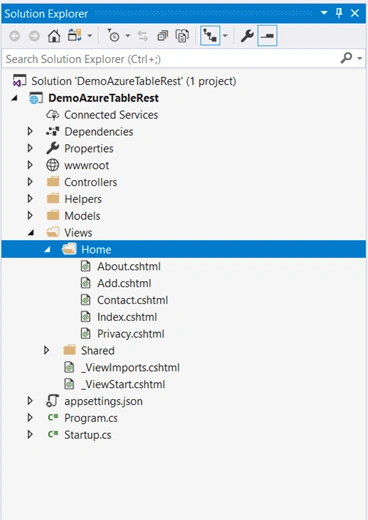
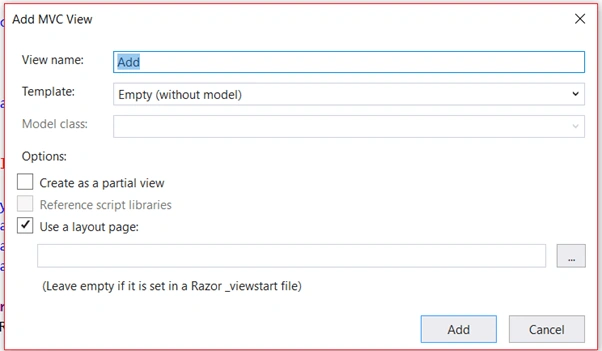
Open Views/Home and right click Home -> Add -> View.
Open the Add.cshtml file and replace the code given below. Here, we use strongly-typed synchronous forms because it is easy to maintain the forms in cshtml. HTML helpers like @Html.BeginForm(..) create the <form> tag when rendering the web page and @Html.Textbox(..) creates the <input> tag when rendering the webpage.
- @model DemoAzureTableRest.Models.MaterialUsageDetails
- <div class="container">
- <h2>Add New Device</h2>
- @using (Html.BeginForm("Add", "Home", FormMethod.Post))
- {
- <table>
- <tr>
- <th colspan="2" align="center"></th>
- </tr>
- <tr>
- <td>Device ID: </td>
- <td>
- @Html.TextBoxFor(m => m.deviceId)
- </td>
- </tr>
- <tr>
- <td>Furnace: </td>
- <td>
- @Html.TextBoxFor(m => m.furnace)
- </td>
- </tr>
- <tr>
- <td>Material: </td>
- <td>
- @Html.TextBoxFor(m => m.material)
- </td>
- </tr>
- <tr>
- <td>Weight: </td>
- <td>
- @Html.TextBoxFor(m => m.weight)
- </td>
- </tr>
- <tr>
- <td></td>
- <td><input type="submit" value="Submit" /></td>
- </tr>
- </table>
- }
- </div>
- @if (ViewBag.Message != null)
- {
- <script type="text/javascript">
- window.onload = function () {
- alert("@ViewBag.Message");
- };
- </script>
- }
- <style>
- table {
- border-spacing: 8px 2px;
- }
- td {
- padding: 6px;
- }
- </style>
Now, open the Controllers/HomeController.cs and replace the code with the one given below. Here, we will get materialUsageDetails model data and pass it to the AzureTable helper class. Azure Table InsertEntity Method requires a storage name, storage key, table name, and model data so we need to pass the following data while calling the InsertEntity method.
- public IActionResult Add(MaterialUsageDetails materialUsageDetails)
- {
- string response ="";
- if (materialUsageDetails.deviceId != null)
- {
- materialUsageDetails.PartitionKey = materialUsageDetails.deviceId;
- materialUsageDetails.RowKey = materialUsageDetails.furnace;
- response = AzureTables.InsertEntity(StorageName, StorageKey, TableName, JsonConvert.SerializeObject(materialUsageDetails));
- }
- if (response == null)
- {
- ViewBag.Message = "Saved Successfully";
- }
- return View(materialUsageDetails);
- }
- public static string InsertEntity(string storageAccount, string accessKey, string tableName, string jsonData)
- {
- string jsonResponse = "";
- string host = string.Format(@"https://{0}.table.core.windows.net/", storageAccount);
- string resource = string.Format(@"{0}", tableName);
- string uri = host + resource;
- // Web request
- HttpWebRequest request = (HttpWebRequest)HttpWebRequest.Create(uri);
- request = getRequestHeaders("POST", request, storageAccount, accessKey, resource, jsonData.Length);
- // Write Entity's JSON data into the request body
- using (var streamWriter = new StreamWriter(request.GetRequestStream()))
- {
- streamWriter.Write(jsonData);
- streamWriter.Flush();
- streamWriter.Close();
- }
- // Execute the request
- try
- {
- using (HttpWebResponse response = (HttpWebResponse)request.GetResponse())
- {
- using (System.IO.StreamReader r = new System.IO.StreamReader(response.GetResponseStream()))
- {
- jsonResponse = r.ReadToEnd();
- // return (int)response.StatusCode;
- }
- }
- }
- catch (WebException ex)
- {
- // get the message from the exception response
- using (System.IO.StreamReader sr = new System.IO.StreamReader(ex.Response.GetResponseStream()))
- {
- jsonResponse = sr.ReadToEnd();
- // Log res if required
- }
- // return (int)ex.Status;
- }
- return jsonResponse;
- }
- public static HttpWebRequest getRequestHeaders(string requestType, HttpWebRequest Newrequest, string storageAccount, string accessKey, string resource, int Length = 0)
- {
- HttpWebRequest request = Newrequest;
- switch (requestType.ToUpper())
- {
- case "GET":
- request.Method = "GET";
- request.ContentType = "application/json";
- request.ContentLength = Length;
- request.Accept = "application/json;odata=nometadata";
- request.Headers.Add("x-ms-date", DateTime.UtcNow.ToString("R", System.Globalization.CultureInfo.InvariantCulture));
- request.Headers.Add("x-ms-version", "2015-12-11");
- request.Headers.Add("Accept-Charset", "UTF-8");
- request.Headers.Add("MaxDataServiceVersion", "3.0;NetFx");
- request.Headers.Add("DataServiceVersion", "1.0;NetFx");
- break;
- case "POST":
- request.Method = "POST";
- request.ContentType = "application/json";
- request.ContentLength = Length;
- request.Accept = "application/json;odata=nometadata";
- request.Headers.Add("x-ms-date", DateTime.UtcNow.ToString("R", System.Globalization.CultureInfo.InvariantCulture));
- request.Headers.Add("x-ms-version", "2015-04-05");
- request.Headers.Add("Accept-Charset", "UTF-8");
- request.Headers.Add("MaxDataServiceVersion", "3.0;NetFx");
- request.Headers.Add("DataServiceVersion", "1.0;NetFx");
- break;
- case "PUT":
- request.Method = "PUT";
- request.ContentLength = Length;
- request.ContentType = "application/json";
- request.Accept = "application/json;odata=nometadata";
- request.Headers.Add("x-ms-date", DateTime.UtcNow.ToString("R", System.Globalization.CultureInfo.InvariantCulture));
- request.Headers.Add("x-ms-version", "2015-04-05");
- request.Headers.Add("If-Match", "*");
- request.Headers.Add("Accept-Charset", "UTF-8");
- request.Headers.Add("MaxDataServiceVersion", "3.0;NetFx");
- request.Headers.Add("DataServiceVersion", "1.0;NetFx");
- break;
- case "DELETE":
- request.Method = "DELETE";
- request.ContentType = "application/json";
- request.Accept = "application/json;odata=nometadata";
- request.Headers.Add("x-ms-date", DateTime.UtcNow.ToString("R", System.Globalization.CultureInfo.InvariantCulture));
- request.Headers.Add("x-ms-version", "2015-04-05");
- request.Headers.Add("If-Match", "*");
- request.Headers.Add("Accept-Charset", "UTF-8");
- request.Headers.Add("MaxDataServiceVersion", "3.0;NetFx");
- request.Headers.Add("DataServiceVersion", "1.0;NetFx");
- break;
- }
- string sAuthorization = getAuthToken(request, storageAccount, accessKey, resource);
- request.Headers.Add("Authorization", sAuthorization);
- return request;
- }
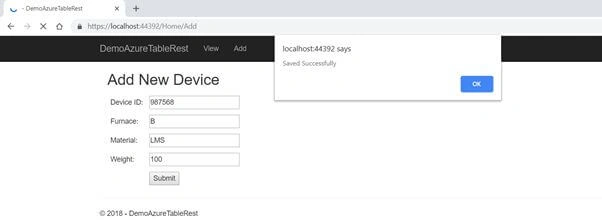
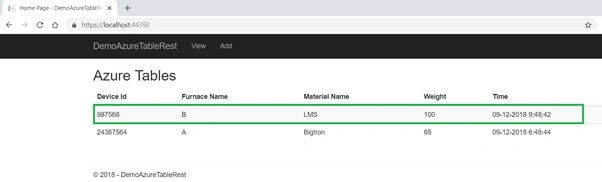
That's it. Now, run the web application, go to Debug menu, and click on "Start without Debugging" or press F5. To add a new form, change the URL to https://localhost:44392/Home/Add.

Muthu KumarPosted Jan 2, 2019, 8:34 AM
Nice Article Ravishankar. Thanks for sharing....