

Introduction
In this article, I will demonstrate how we can use Sum, Min, Max Count, Average, LongCount, and Aggregate operator of Language-Integrated Query (LINQ). Sum, Min, Max Count, Average, LongCount, Aggregate operators are part of the aggregation operation in LINQ. An aggregation operation computes a single value from a collection of values. An example of an aggregation operation is - calculating the average daily temperature from a month's worth of daily temperature values.
- Sum - Calculates the sum of the values in a collection.
- Min - Determines the minimum value in a collection.
- Max - Determines the maximum value in a collection.
- Count - Counts the elements in a collection, optionally only those elements that satisfy a predicate function.
- Average - Calculates the average value of a collection of values.
- LongCount - Counts the elements in a large collection, optionally only those elements that satisfy a predicate function.
- Aggregate - Performs a custom aggregation operation on the values of a collection.
Step 1
Open SQL Server 2014 and create a table named Products. Insert some records in it.
- CREATE TABLE [dbo].[Products](
- [Product_Id] [int] IDENTITY(1,1) NOT NULL,
- [Product_Name] [nvarchar](50) NULL,
- [Quantity] [int] NULL,
- [Price] [money] NULL,
- CONSTRAINT [PK_Products] PRIMARY KEY CLUSTERED
- (
- [Product_Id] ASC
- )WITH (PAD_INDEX = OFF, STATISTICS_NORECOMPUTE = OFF, IGNORE_DUP_KEY = OFF, ALLOW_ROW_LOCKS = ON, ALLOW_PAGE_LOCKS = ON) ON [PRIMARY]
- ) ON [PRIMARY]
- GO
Step 2
Open Visual Studio 2015 and create a new console application with a meaningful name.
Step 3
Add Entity Framework now. For that, right click on Models folder, select Add, then select New Item, then click on it.
Screenshot for adding Entity framework
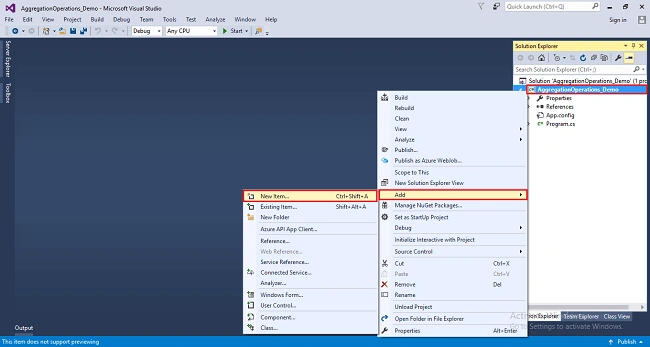
After clicking on the new item, you will get a window; from there, select Data from the left panel and choose ADO.NET Entity Data Model, give it the name DBModels (this name is not mandatory; you can give any name) and click on Add.
Screenshot for adding Entity framework 2
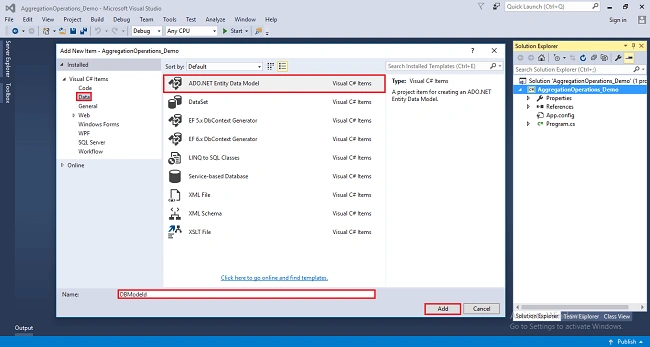
Screenshot for adding Entity framework 3
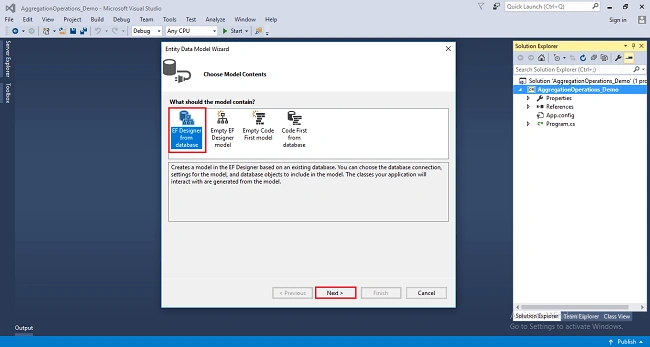
Screenshot for adding Entity framework 4
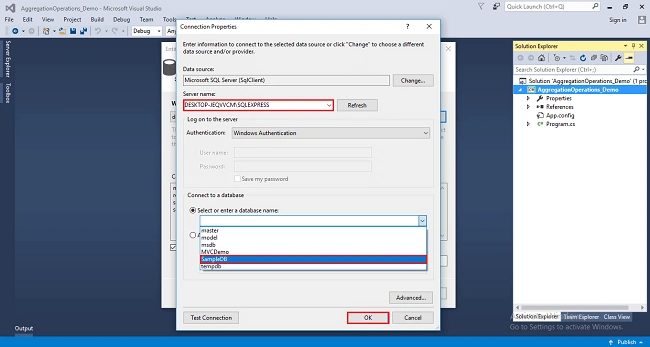
Screenshot for adding Entity framework 5
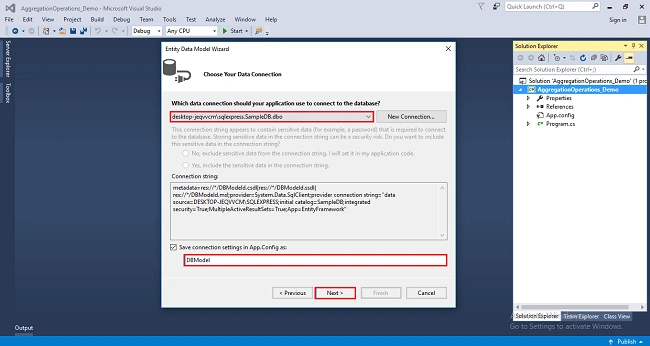
Screenshot for adding Entity framework 6
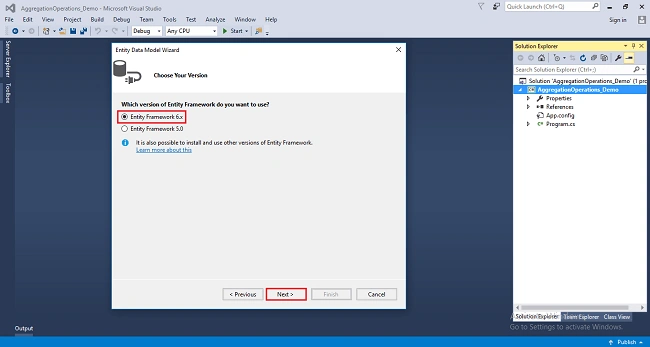
Screenshot for adding Entity framework 7
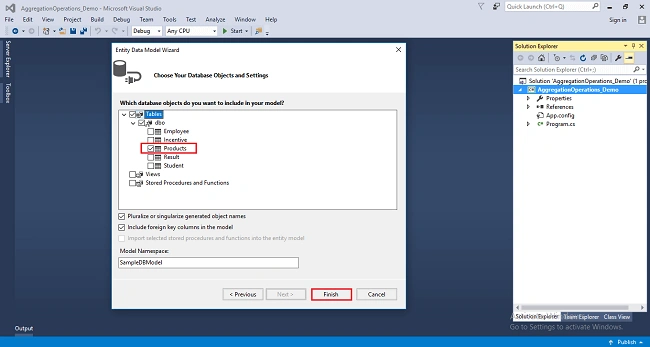
Screenshot for adding Entity framework 8
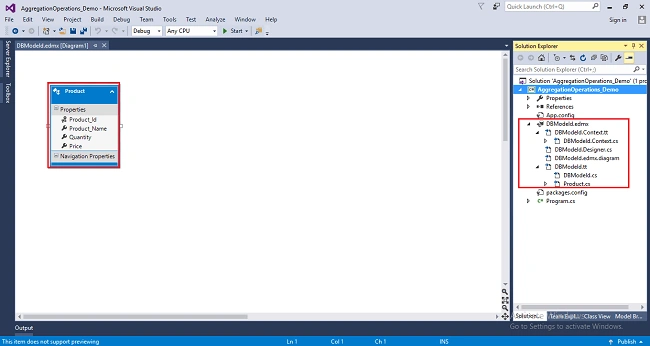
The following class will be added.
- namespace AggregationOperations_Demo
- {
- using System;
- using System.Collections.Generic;
- public partial class Product
- {
- public int Product_Id { get; set; }
- public string Product_Name { get; set; }
- public Nullable<int> Quantity { get; set; }
- public Nullable<decimal> Price { get; set; }
- }
- }
Step 4
Write a program to call the database class.
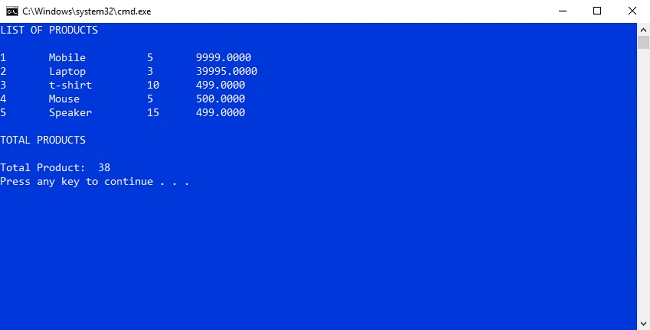
Example of Sum operator
- using System;
- using System.Collections.Generic;
- using System.Linq;
- namespace AggregationOperations_Demo
- {
- class Program
- {
- static void Main(string[] args)
- {
- using (DBModel db=new DBModel ())
- {
- List<Product>listProduct=db.Products.ToList<Product>();
- Console.WriteLine("LIST OF PRODUCTS \n");
- foreach (var product in listProduct)
- {
- Console.WriteLine(product.Product_Id+"\t"+product.Product_Name+ "\t\t" + product.Quantity+ "\t" + product.Price);
- }
- Console.WriteLine();
- Console.WriteLine("TOTAL PRODUCTS \n");
- int result = listProduct.Sum(q=>q.Quantity??0);
- Console.WriteLine("Total Product:\t"+ result);
- Console.ReadLine();
- }
- }
- }
- }
Example of Min Operator
- using System;
- using System.Collections.Generic;
- using System.Linq;
- namespace AggregationOperations_Demo
- {
- class Program
- {
- static void Main(string[] args)
- {
- using (DBModel db=new DBModel ())
- {
- List<Product>listProduct=db.Products.ToList<Product>();
- Console.WriteLine("LIST OF PRODUCTS \n");
- foreach (var product in listProduct)
- {
- Console.WriteLine(product.Product_Id+"\t"+product.Product_Name+ "\t\t" + product.Quantity+ "\t" + product.Price);
- }
- Console.WriteLine();
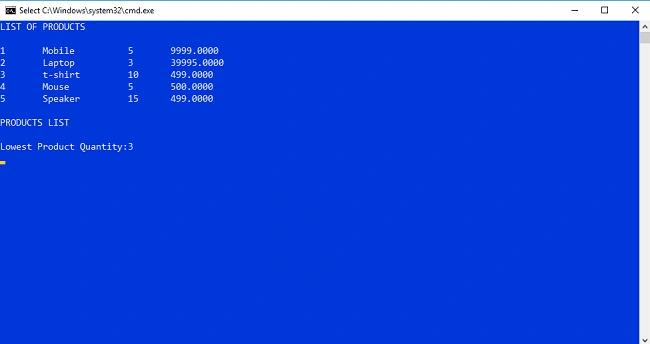
- Console.WriteLine("PRODUCTS LIST\n");
- int result = listProduct.Min(q=>q.Quantity??0);
- Console.WriteLine("Lowest Product Quantity:\t"+ result);
- Console.ReadLine();
- }
- }
- }
- }
Example of Max Operator
- using System;
- using System.Collections.Generic;
- using System.Linq;
- namespace AggregationOperations_Demo
- {
- class Program
- {
- static void Main(string[] args)
- {
- using (DBModel db=new DBModel ())
- {
- List<Product>listProduct=db.Products.ToList<Product>();
- Console.WriteLine("LIST OF PRODUCTS \n");
- foreach (var product in listProduct)
- {
- Console.WriteLine(product.Product_Id+"\t"+product.Product_Name+ "\t\t" + product.Quantity+ "\t" + product.Price);
- }
- Console.WriteLine();
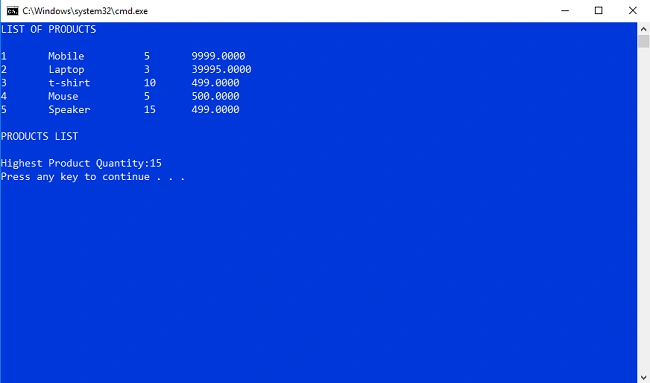
- Console.WriteLine("PRODUCTS LIST \n");
- int result = listProduct.Max(q=>q.Quantity??0);
- Console.WriteLine("Highest Product Quantity:\t" + result);
- Console.ReadLine();
- }
- }
- }
- }
Example of Average Operator
- using System;
- using System.Collections.Generic;
- using System.Linq;
- namespace AggregationOperations_Demo
- {
- class Program
- {
- static void Main(string[] args)
- {
- using (DBModel db=new DBModel ())
- {
- List<Product>listProduct=db.Products.ToList<Product>();
- Console.WriteLine("LIST OF PRODUCTS \n");
- foreach (var product in listProduct)
- {
- Console.WriteLine(product.Product_Id+"\t"+product.Product_Name+ "\t\t" + product.Quantity+ "\t" + product.Price);
- }
- Console.WriteLine();
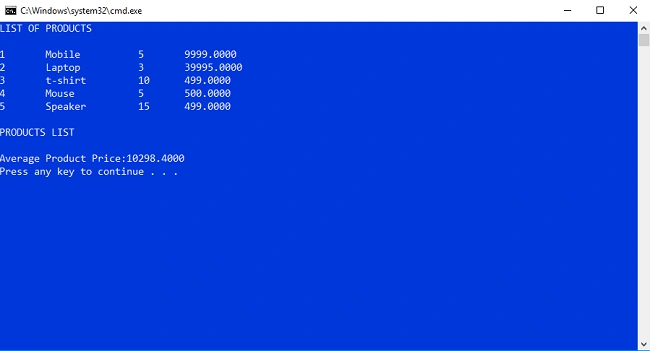
- Console.WriteLine("PRODUCTS LIST\n");
- decimal result = listProduct.Average(q => q.Price??0);
- Console.WriteLine("Average Product Price:\t"+ result);
- Console.ReadLine();
- }
- }
- }
- }
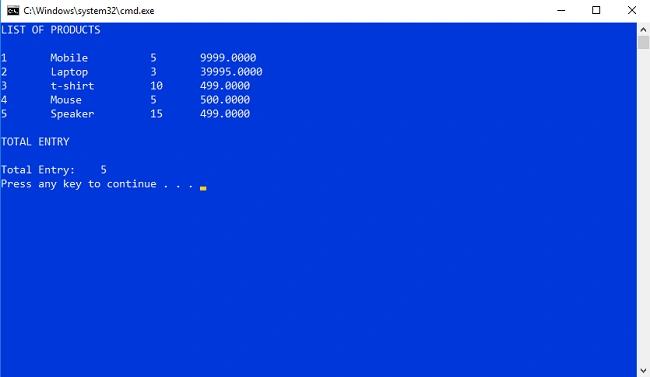
Example of Count Operator
- using System;
- using System.Collections.Generic;
- using System.Linq;
- using System.Text;
- using System.Threading.Tasks;
- namespace AggregationOperations_Demo
- {
- class Count
- {
- static void Main()
- {
- using (DBModel db = new DBModel())
- {
- List<Product> listProduct = db.Products.ToList<Product>();
- Console.WriteLine("LIST OF PRODUCTS \n");
- foreach (var product in listProduct)
- {
- Console.WriteLine(product.Product_Id + "\t" + product.Product_Name + "\t\t" + product.Quantity + "\t" + product.Price);
- }
- Console.WriteLine();
- Console.WriteLine("TOTAL ENTRY \n");
- int result = listProduct.Count();
- Console.WriteLine("Total Entry:\t" + result);
- }
- }
- }
- }
Example of Aggregate Operator
- using System;
- using System.Collections.Generic;
- using System.Linq;
- namespace AggregationOperations_Demo
- {
- class Aggregate
- {
- static void Main()
- {
- using (DBModel db = new DBModel())
- {
- List<Product> listProduct = db.Products.ToList<Product>();
- Console.WriteLine("LIST OF PRODUCTS \n");
- foreach (var product in listProduct)
- {
- Console.WriteLine(product.Product_Id + "\t" + product.Product_Name + "\t\t" + product.Quantity + "\t" + product.Price);
- }
- Console.WriteLine();
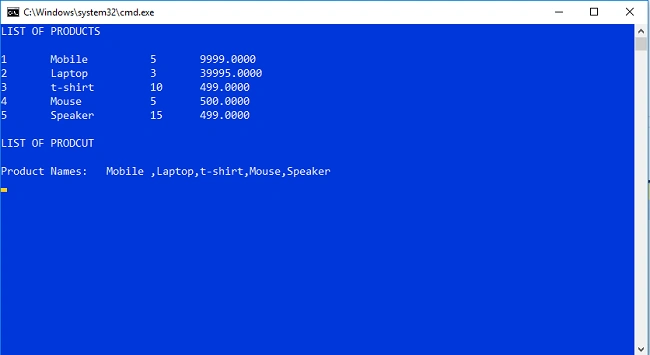
- Console.WriteLine("LIST OF PRODCUT \n");
- string result = listProduct.Aggregate<Product, string, string>("Product Names:\t "+
- String.Empty,// seed value
- (str, p) => str += p.Product_Name + ",",
- str => str.Substring(0, str.Length - 1));
- f; Console.WriteLine(result);
- Console.ReadLine();
- }
- }
- }
- }
Join the conversation! Your thoughts help the community grow.