

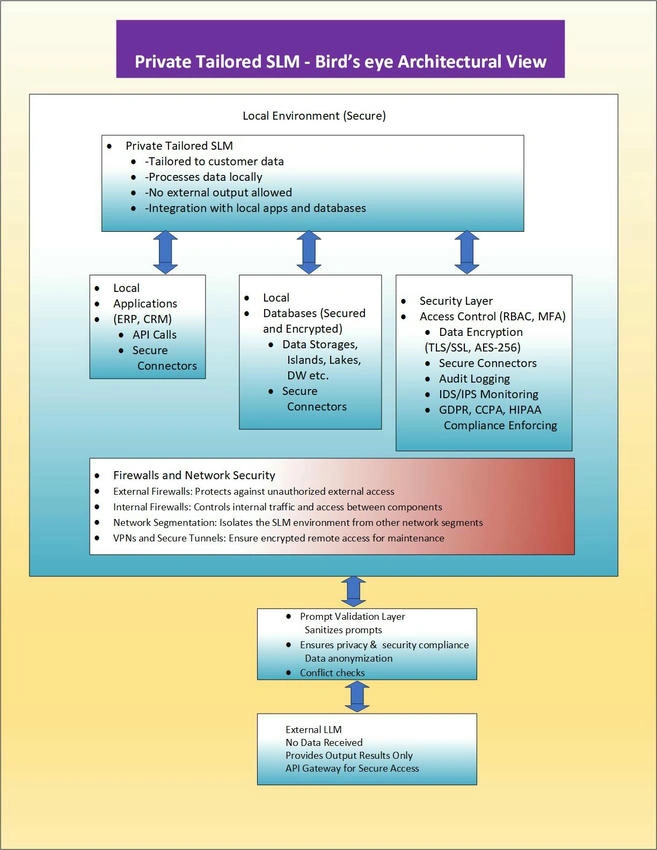
In the heart of every bank lies its core banking system — the central engine that manages deposits, withdrawals, payments, loans, and customer records. As digital demands increase, banks are seeking ways to make these core systems faster, smarter, and more secure without compromising sensitive financial data. Private Tailored Small Language Models (PT-SLMs) are uniquely positioned to enhance core banking by bringing advanced AI capabilities directly into the bank’s secure environment. Operating entirely on-premises, PT-SLMs integrate tightly with local applications, databases, and security frameworks to improve accuracy, automate tasks, and ensure compliance — all while preserving the confidentiality of core banking data. The architectural design (see Private Tailored SLM - Bird’s Eye Architectural View diagram) shows how PT-SLMs sit within a multi-layered security environment, ensuring that AI-driven improvements stay local and fully controlled.
What Makes PT-SLMs Valuable for Core Banking?
Core banking systems require precision, reliability, and security. PT-SLMs are tailored specifically for these needs, trained on internal datasets like transaction records, account histories, loan portfolios, and compliance logs. This specialization allows them to enhance core banking operations directly, providing contextual intelligence without the risks associated with external data processing. Their seamless integration with secured databases, ERP modules, and payment systems enables real-time enhancements to daily operations.
- Tailored to Core Processes: PT-SLMs are fine-tuned to understand the intricacies of account management, transaction handling, payment processing, and loan servicing.
- Local Data Processing: By working entirely within the bank’s secure perimeter, they ensure no sensitive customer or financial data is exposed to outside systems.
- Seamless Core Integration: These models connect to core banking modules through secure connectors, enriching existing workflows with AI-driven insights and automations.
- Multi-Layered Security Framework: With robust access control, encryption, and audit logging, PT-SLMs operate safely within the regulated landscape of core banking.
Enhancing Transaction Management and Account Services
Efficient transaction handling and account management are foundational to core banking. PT-SLMs improve these processes by adding intelligent automation and reducing manual workload. With deep access to account data and transaction patterns, they can deliver faster processing, error detection, and real-time account updates — all crucial for maintaining customer trust and operational speed.
- Automated Transaction Reviews: Flag suspicious or unusual activities automatically, assisting fraud detection teams.
- Real-Time Account Reconciliation: Improve the accuracy and speed of reconciling deposits, withdrawals, and transfers.
- Smart Notifications: Provide customers and staff with timely updates on account events, reducing inbound service requests.
Strengthening Loan and Credit Operations
Loan servicing and credit management are complex areas within core banking, requiring detailed analysis and precision. PT-SLMs can help banks automate loan evaluations, track repayments, and assess credit risk — all while ensuring data privacy and compliance with regulations.
- Automated Loan Processing: Streamline loan applications and approvals by extracting and validating critical information from submitted documents.
- Credit Risk Assessment: Analyze accounts and repayment histories to offer real-time insights into customer creditworthiness.
- Repayment Monitoring: Track loan repayment schedules and flag potential defaults early for proactive intervention.
Improving Payments and Settlements
Payments and settlements are time-sensitive operations where errors or delays can lead to significant customer dissatisfaction and financial loss. PT-SLMs strengthen these processes by providing intelligent oversight, reducing manual intervention, and ensuring compliance with settlement timelines.
- Payment Validation: Check payment instructions for errors or inconsistencies before processing.
- Settlement Optimization: Identify and resolve bottlenecks in the settlement pipeline, improving speed and efficiency.
- Regulatory Compliance: Ensure payment operations comply with local and international regulatory requirements through automated checks.
Architectural Strengths Tailored to Core Banking
The PT-SLM architecture is purpose-built to support the demands of core banking operations. Layered security — including firewalls, encryption, and role-based access controls — ensures that all AI-driven improvements stay confined within the bank’s network. Network segmentation isolates the SLM from external systems, and secure tunnels allow only controlled, encrypted maintenance access. The Bird’s Eye Architectural View diagram clearly shows how these components work together to create a fortified AI environment for core banking.
- Internal Firewalls and Segmentation: Keep core banking systems and PT-SLM functions securely isolated from other IT infrastructure.
- Prompt Validation and Anonymization: Before any optional interactions with external LLMs (if used), all data is sanitized and anonymized, preventing leakage of sensitive core banking information.
- Secure Database Access: PT-SLMs connect directly to core data repositories, ensuring real-time access while maintaining full encryption and access control.
Best Practices for Banks Deploying PT-SLMs in Core Banking
For PT-SLMs to deliver maximum value in core banking, banks must implement them carefully and strategically. This means focusing on the most critical operational areas, maintaining strict governance, and ensuring continuous performance monitoring.
- Prioritize Core Use Cases: Focus on transaction management, loan servicing, and payment processing, where AI enhancements will provide the most immediate benefits.
- Integrate Securely: Use robust connectors and adhere to internal security protocols when linking PT-SLMs to core systems.
- Govern Data Access: Apply strict governance over which data the model can access and ensure clear logging of all AI-driven decisions.
- Monitor and Update Regularly: Continuously evaluate model outputs, update training datasets, and perform audits to maintain accuracy, compliance, and performance.
Conclusion
Private, Tailored SLMs present a transformative opportunity to improve the precision, efficiency, and security of core banking systems. By embedding specialized AI models directly into the heart of banking operations, institutions can automate critical processes, enhance customer services, and strengthen compliance — all while ensuring their most sensitive data remains fully under control. With the right architecture, governance, and focus, PT-SLMs can become a central pillar in the next generation of core banking innovation.
Join the conversation! Your thoughts help the community grow.