

In enterprise software engineering, network failures, timeouts, and system glitches are inevitable realities. When a request fails mid-flight, standard distributed system resilience patterns trigger automatic retries. However, retrying an operation without safeguards can lead to critical data corruption, such as duplicate billing or corrupted system states. This is where idempotency becomes essential.
What is Idempotency?
Idempotency is a property of an operation where executing it multiple times with the same input yields the exact same outcome as executing it once. In an idempotent system, identical retry requests produce no side effects or state changes beyond the initial successful execution.
Non-Idempotent Operation:
Balance = Balance - $100(Running this 3 times deducts $300)Idempotent Operation:
Balance = SetBalance(500)(Running this 3 times leaves the balance at $500)
Why Idempotency Matters in Enterprise Applications
In distributed microservices architectures, services communicate over inherently unreliable networks using message brokers (such as Apache Kafka or RabbitMQ) or REST APIs. These communication channels typically guarantee at-least-once delivery, meaning a downstream consumer might receive the same message multiple times due to network blips or unacknowledged message retries.
Without idempotency, enterprise systems face severe operational risks:
Financial Discrepancies: Multiple charges triggered for a single order purchase.
Data Corruption: Duplicate creation of customer accounts, inventory reservations, or system records.
Inconsistent State: Desynchronization between upstream microservices and downstream databases.
Implementation Pattern: The Idempotent Consumer & Outbox Strategy
To guarantee that a transaction processes exactly once logically—even with multiple transport retries—downstream applications implement an Idempotent Table pattern alongside request tracking.
Processing Architecture Flow
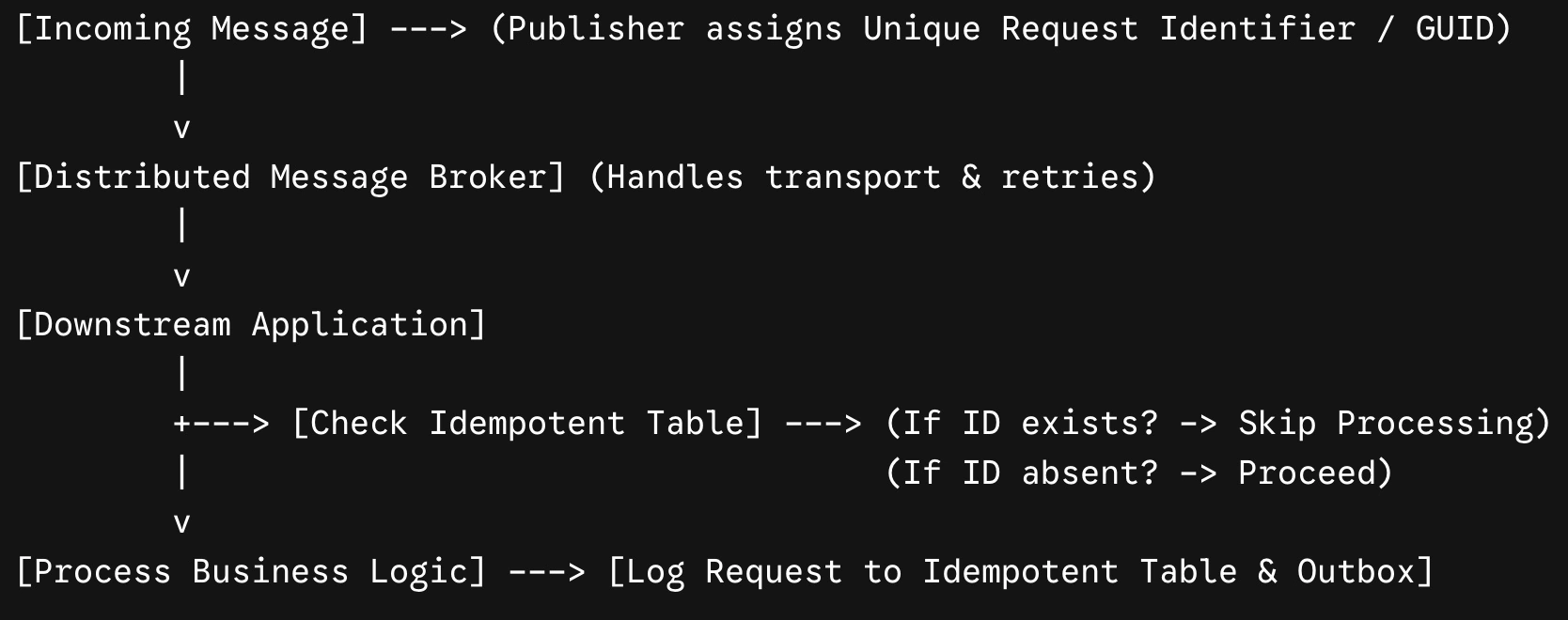
How the Flow Works
Identifier Assignment: The upstream publisher generates a unique correlation key (
Aid/ GUID) for the transaction header.Duplicate Check: Upon receiving the message, the downstream consumer checks a dedicated
Idempotent Tablefor the incomingAid.Execution or Short-Circuit:
First Attempt: The consumer logs the
Aidin the database within the same atomic database transaction as the business logic and Outbox entry. Processing succeeds.Subsequent Retries: If a duplicate request arrives with the same
Aid, the downstream service identifies the existing log, short-circuits execution, and skips the business operation safely.
Domain Model Example
A typical enterprise message payload includes structural headers specifically designed to pass idempotency metadata alongside the business payload.
public class MessageRequest
{
    public Header MessageHeader { get; set; }
    public string Message { get; set; }
    public DateTime RequestDate { get; set; }
}

public class Header
{
    // Unique Transaction Identifier used for idempotency tracking
    public Guid Aid { get; set; }
    public string UserId { get; set; }
}
Key Takeaways
Idempotency transforms unpredictable, fault-prone distributed networks into reliable, deterministic enterprise systems. By leveraging unique message identifiers alongside transactional idempotent storage, enterprise microservices safely process retries without risking duplicate business transactions.
Join the conversation! Your thoughts help the community grow.