

Introduction
In building software with .NET, it's super important to handle errors effectively. Think of it like catching mistakes before they turn into big problems! One Smart way to do this is using Global Exception Handling as a middleware. It basically helps keep track of errors all over your project. This article will show you how to set up and use middleware to handle errors in your .NET project, making your software more reliable and less likely to crash. and it'll save you from writing the same code over and over again.
What is Global Exception Handling?
Global Exception Handling is like having a special safety net in your software. When something unexpected goes wrong (like a mistake or a problem), instead of crashing your whole program, it catches the problem and deals with it calmly. It's a way to handle errors smoothly, making sure your software keeps running smoothly even when things don't go as planned.
Integrate the Middleware for Exception Handling
Let's integrate the Middleware for Exception Handling in the .NET Project.
First, you need to add a class in your project named GlobalExceptionHandler.cs and write this code inside this class.
 public class GlobalExceptionHandler:IExceptionFilter
 {
     private readonly IHostEnvironment _hostEnvironment;
     private readonly ILoggerRepo? _loggerRepo;

     public GlobalExceptionHandler(IHostEnvironment hostEnvironment, ILoggerRepo loggerRepo)
     {
         _hostEnvironment = hostEnvironment;
         _loggerRepo = loggerRepo;
     }

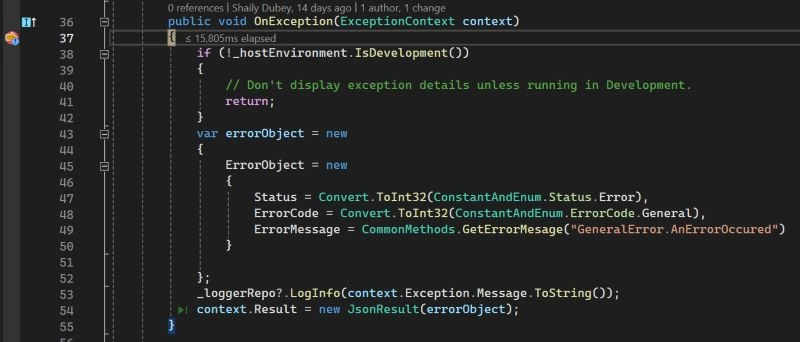
     public void OnException(ExceptionContext context)
     {
         if (!_hostEnvironment.IsDevelopment())
         {
             // Don't display exception details unless running in Development.
             return;
         }
         var errorObject = new
         {
             ErrorObject = new
             {
                 Status = Convert.ToInt32(ConstantAndEnum.Status.Error),
                 ErrorCode = Convert.ToInt32(ConstantAndEnum.ErrorCode.General),
                 ErrorMessage = CommonMethods.GetErrorMesage("GeneralError.AnErrorOccured")
             }

         };
         context.Result = new JsonResult(errorObject);
     }
}
Code Explanation
- GlobalExceptionHandler is a class name and this class implemented the IExceptionFilter interface indicating that it will handle exceptions thrown during the execution of the application.
- The GlobalExceptionHandler class has a constructor that takes two parameters: `IHostEnvironment` and `ILoggerRepo`.
- IHostEnvironment typically provides information about the hosting environment (like Development, Production, etc.).
- ILoggerRepo seems to be a logger repository, probably an abstraction over logging functionality.
- OnException method is part of the `IExceptionFilter` interface and is called whenever an exception occurs during the execution of a controller action and method begins by checking if the application is running in a development environment. If not, it skips handling the exception details. If the application is running in development mode, it proceeds to handle the exception.
Join the conversation! Your thoughts help the community grow.