

Introduction
Problems in traditional web Applications
- Many round trips to the server.
- Rendering of webpage is slower.
- Increases the consumption of server resources.
- Response time of application is very slower.
- Rendering of data is static.
- Data is updated of an application only when the user clicks on the browser refresh button.
So the preceding is some of the basic problems related to the traditional web application so to overcome these problems Ajax is the best alternative. So let us start with the basics.
What is Ajax ?
Ajax stands for Asynchronous JavaScript and XML; in other words Ajax is the combination of various technologies such as a JavaScript, CSS, XHTML, and DOM etc.
AJAX allows web pages to be updated asynchronously by exchanging small amounts of data with the server behind the scenes. This means that it is possible to update parts of a web page, without reloading the entire page.
We can also define Ajax is a combination of client side technologies that provides asynchronous communication between the user interface and the web server so that partial page rendering occurs instead of complete page post back.
Ajax is platform-independent; in other words AJAX is a cross-platform technology that can be used on any Operating System since it is based on XML & JavaScript. It also supports open source implementation of other technology. It partially renders the page to the server instead of complete page post back. We use AJAX for developing faster better and more interactive web applications. AJAX uses a HTTP request between web server & browser.
Using Ajax technologies we can observe in Google Maps, Gmail, YouTube, and Facebook tabs.
I hope you have understood the basic concepts of Ajax. Now let us see the following diagram showing how Ajax works:
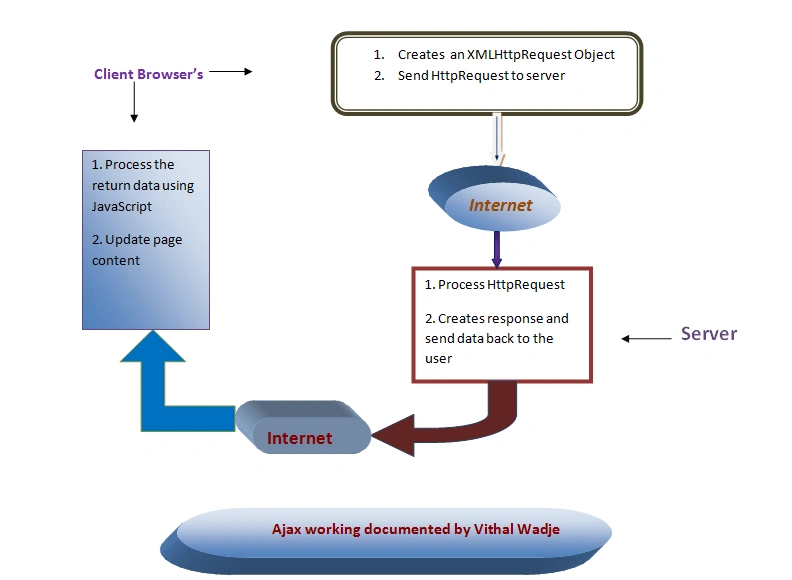
In the above diagram it's clear how Ajax works, that first depending on the client requests the browser creates the XMLHttpRequest and sends it to the server and there after that the server processes the HttpRequest given by the browser, processes it and then sends the response back to the user and at the end the browser processes the response given by the server using JavaScript and update the requested content of the particular page instead of the entire page contents.
AJAX is Based on Internet Standards
AJAX is based on internet standards, and uses a combination of a XMLHttpRequest object to exchange data asynchronously with a server, JavaScript and DOM to interact with the information and CSS is used to style the data and XML is often used as the format for transferring data.
Let us know about the basic information each technology uses in Ajax.
1. XHTML and CSS
XHTML (or HTML) is used for providing the markup tags, as used in any typical web site. In addition, we utilize CSS for extra styling functionality in relation to presentation and layout. XHTML is a stricter and more standardized form of HTML, which follows the rules of XML such as the requirement for well-formatted and valid against a schema or DTD.
2. Document Object Model (DOM)
The Document Object Model is a platform and language independent standard object model for representing HTML or XML.
3. XML
XML is typically used as the format for transferring data between the server and the client. Using XML we can represent any applicable data object structure we might wish to represent.
4. XMLHttpRequest (XHR) and JavaScript
The XMLHttpRequest is the core of the Ajax model; without it the model would not exist. The XMLHttpRequest JavaScript object is the enabling technology which is used to exchange data asynchronously with the web server. In short, XMLHttpRequest lets us use JavaScript to make a request to the server and process the response without blocking the user. Naturally, as we are using this JavaScript object, the providing technology is JavaScript and hence some knowledge of JavaScript is required to get Ajax applications to function.Note:
Sneha SinghPosted Jun 5, 2018, 12:50 PM
How to download ajax control example with coding
Vithal WadjePosted Oct 9, 2015, 4:23 AM
thanks
Mohamed Gani MnPosted Oct 9, 2015, 3:18 AM
I have tried this article and It's very useful for my trobule pages
Durgaprasad PatnaikPosted Feb 18, 2015, 1:04 PM
how to check username availability using asp.net ajax server control
Vithal WadjePosted Dec 8, 2014, 5:44 AM
Thanks Venkat Kumar sir
Venkat KumarPosted Dec 8, 2014, 5:14 AM
nice article sir...
Vithal WadjePosted Oct 27, 2014, 10:44 PM
thanks
Vaka SivaramireddyPosted Oct 24, 2014, 1:46 AM
nice
Vithal WadjePosted Oct 15, 2014, 3:04 PM
sure sir,thanks
Vithal WadjePosted Oct 15, 2014, 5:48 AM
thanks a lot sir ur words ,it will helps me to write more articles in future
Vidya Vrat AgarwalPosted Oct 14, 2014, 2:56 PM
Very well written and greatly structured.
Vithal WadjePosted Oct 14, 2014, 1:35 PM
refer my next article
Chandradev PrasadPosted Oct 14, 2014, 2:45 AM
http://encosia.com/why-aspnet-ajax-updatepanels-are-dangerous/
Chandradev PrasadPosted Oct 14, 2014, 2:42 AM
It is nice article, But i want to add one point I had seen in so many project, Developer used to keep update panel as default in master page, even though they used to use UpdatePanel in static page. So that will obviously decrease the performance page. But in gridview with insert/update/Delete function, we can use updatepanel. In this scenario it will increase the performance as compare full post back.
Vithal WadjePosted Jan 3, 2013, 7:07 AM
thanks Rishikesh sir
Rishikesh Kumar SinghPosted Jan 3, 2013, 5:17 AM
really very nice article...
Vithal WadjePosted Dec 27, 2012, 12:59 AM
thank you suresh sir
sureshPosted Dec 26, 2012, 7:26 AM
it's very good articale
Vithal WadjePosted Dec 19, 2012, 12:45 AM
thank you anand sir,i will publish it soon ,i have some work load thats why i am not gettig time ,when i will publish it i will personally inform you ok
Anand NPosted Dec 18, 2012, 1:33 AM
Thanks a lot... When will you post part-2 article?
Vithal WadjePosted Nov 28, 2012, 3:12 AM
thanks a lot Grabsi sir,it my pleasure
Grabsi AminePosted Nov 28, 2012, 3:11 AM
thanks
Vithal WadjePosted Nov 7, 2012, 3:25 AM
thank you sumit Sir
Sumit MehraPosted Nov 7, 2012, 2:43 AM
Nice Start. This will helps a lot....
Vithal WadjePosted Nov 7, 2012, 2:20 AM
its my pleasure swati madam
Swati AgarwalPosted Nov 7, 2012, 1:10 AM
very nice articles for beginners...Thanx for posting....