

If you’ve built AI applications in the last few years, you’ve likely experienced the "Agent Hangover." In the early days of Generative AI, we threw autonomous LangChain Agents at every problem. We let them loop, reason, and call tools until they reached a conclusion.
But when we tried to deploy these autonomous agents into production environments—like our AI-driven Credit Scoring Engine at AuraCredit—we hit a wall. Financial services require determinism, auditability, and strict guardrails. A purely autonomous agent deciding on its own whether to approve a $50,000 mortgage is a compliance nightmare.
This is where the paradigm shifted from LangChain Agents to LangGraph Nodes.
If you are building complex, stateful AI systems like credit scoring, understanding the difference between an Agent and a Node is no longer optional—it is the difference between a cool demo and a production-ready fintech product. Let’s break down the differences using our real-world gig-economy credit scoring pipeline as a case study.
The Core Concepts: Brain vs. Building Blocks
To understand the difference, we need to separate the reasoning from the orchestration.
1. The LangChain Agent (The "Brain")
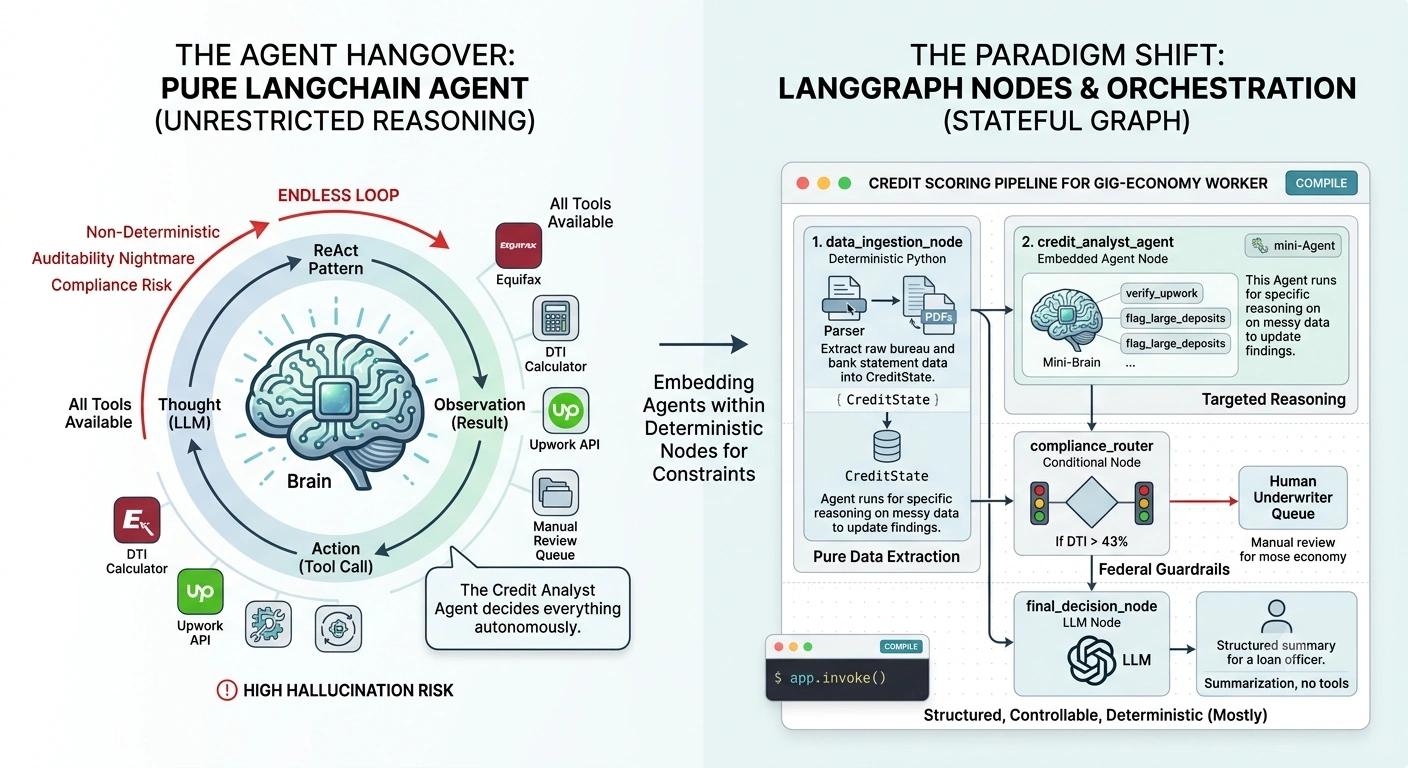
A LangChain Agent is a reasoning loop. It is an LLM wrapped in a ReAct (Reason + Act) pattern.
What it does: It looks at a user query or a state, thinks about what to do next, selects a tool (e.g., a database query or an API call), observes the result, and repeats until it has a final answer.
The Vibe: Autonomous, dynamic, non-deterministic.
In Credit Scoring: The Agent is the "Credit Analyst." It looks at an applicant's profile and decides, "The FICO score is thin, I need to use the
analyze_bank_statementstool to look for consistent freelance deposits."
2. The LangGraph Node (The "Muscle & Skeleton")
LangGraph is a framework for building stateful, multi-actor applications with graph-based orchestration. A Node is a single, discrete step within that graph.
What it does: A node takes the current
Stateas input, performs a specific operation, and returns an updatedState.The Vibe: Structured, controllable, deterministic (usually).
In Credit Scoring: A node could be the Agent mentioned above, but it could also be a simple Python function that calculates Debt-to-Income (DTI) ratio, or a router that checks if the applicant is over 18.
An Agent is often just a specific type of Node.
In LangGraph, you don't replace Agents with Nodes; you embed Agents inside Nodes to constrain them. You use deterministic Nodes for math, compliance, and routing, and you reserve the "Agent Node" strictly for unstructured reasoning and tool selection.
Real-World Use Case: Scoring the Gig-Economy Worker
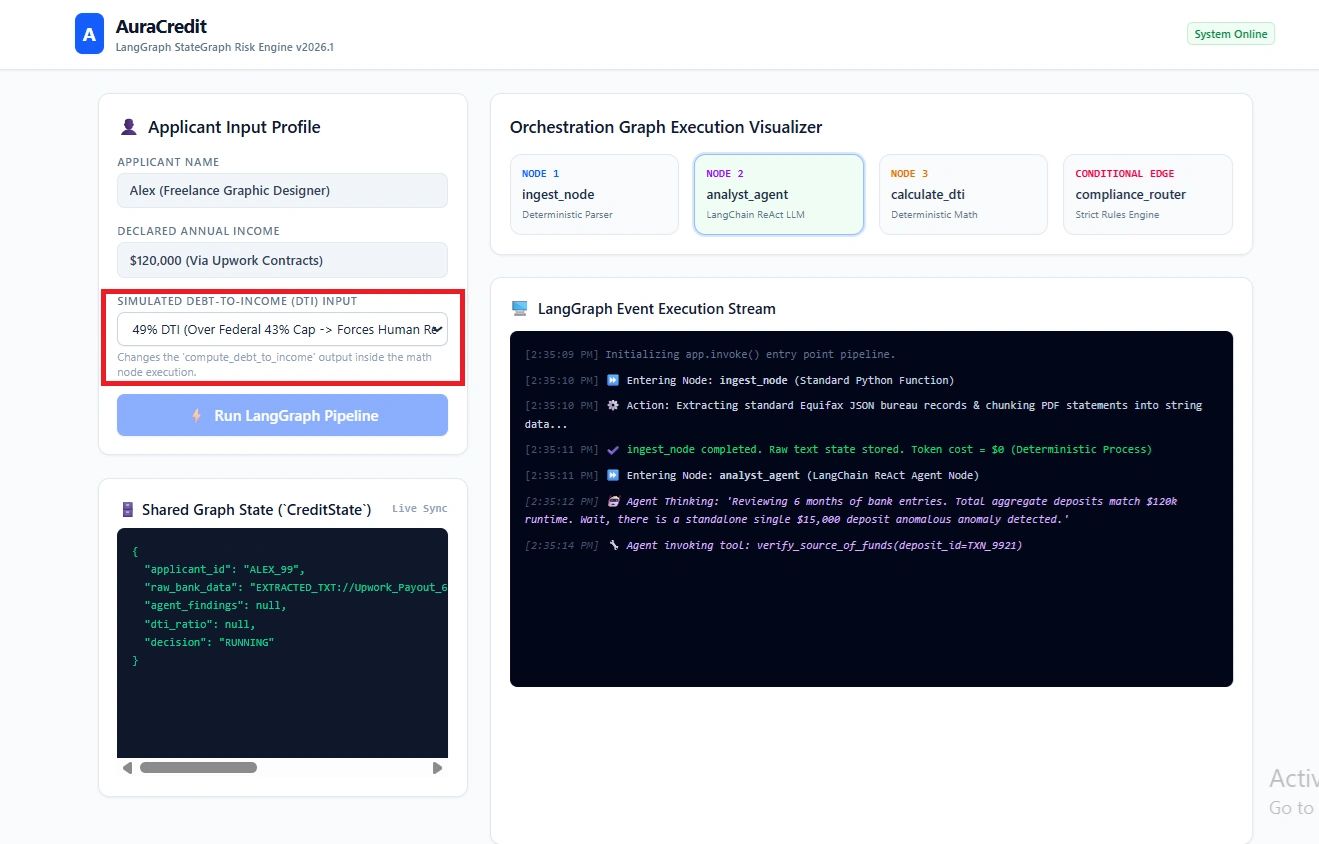
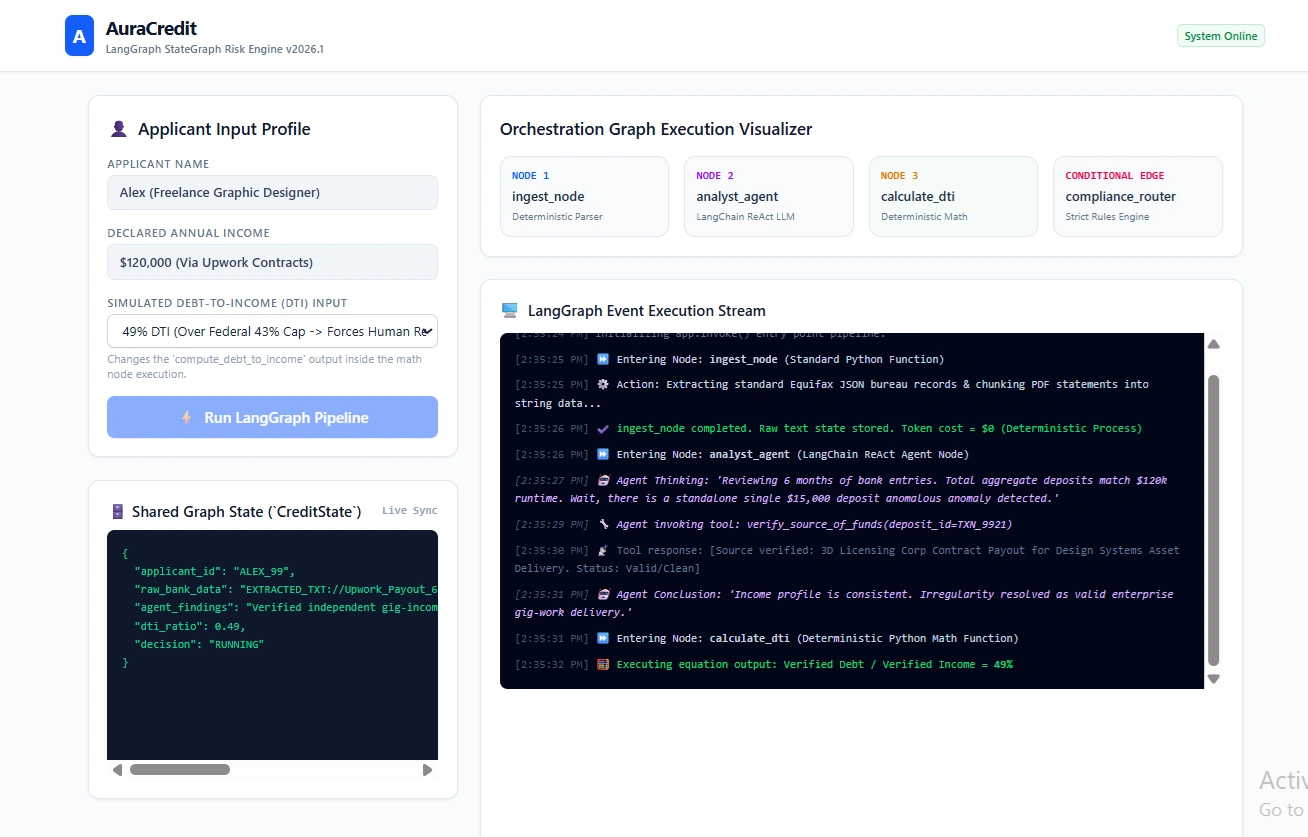
Let’s look at how we use this architecture at AuraCredit to score "Alex," a freelance graphic designer who applies for a personal loan.
Traditional credit models fail on Alex. He has a thin credit file, but he makes $120,000 a year via Upwork and has massive cash reserves. We need an AI system that can ingest his unstructured bank statements, verify his gig income, and calculate a risk score.
The Architecture: The AuraCredit Graph
Instead of one giant Agent trying to do everything, we build a LangGraph StateGraph. Here is the step-by-step workflow:
Node 1: data_ingestion_node (Deterministic Node)
Type: Standard Python Function.
Action: Fetches Alex’s raw credit bureau JSON and parses his uploaded 6-month PDF bank statements into text.
Why not an Agent? This is pure data extraction. We don't need an LLM burning tokens to figure out how to call the Equifax API. We just write a standard function.
Node 2: credit_analyst_agent (The LangChain Agent)
Type: LangChain ReAct Agent (embedded as a Node).
Action: This is where the Agent lives. It receives the parsed data. It has access to tools like
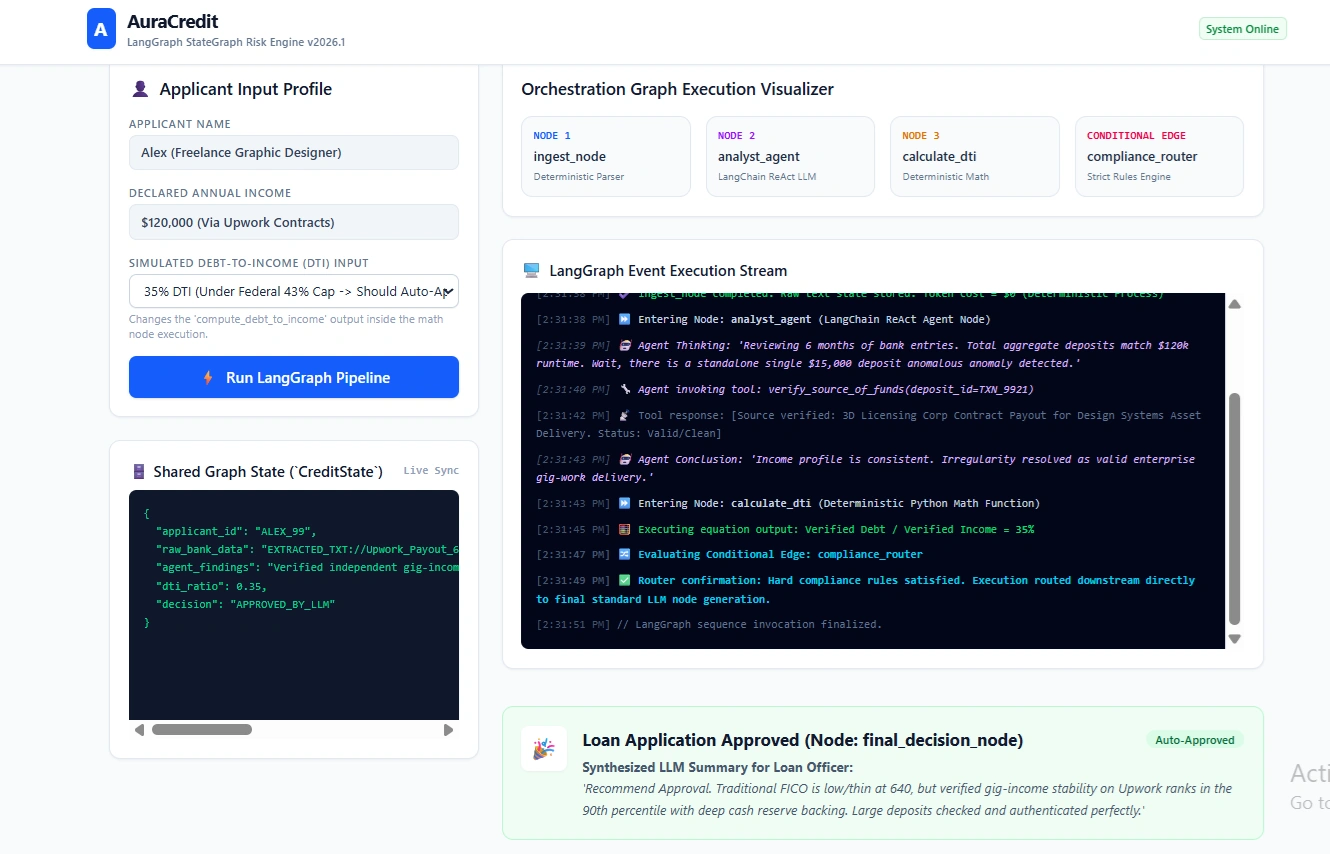
search_upwork_earnings,calculate_income_volatility, andflag_large_deposits.The Reasoning: The Agent notices a $15,000 deposit. It reasons: "This is unusually large. I will use the
verify_source_of_fundstool." It discovers it's a legitimate software licensing payout.Why an Agent? The data is messy. We need the LLM to dynamically decide which verification tools to call based on the anomalies it sees in Alex's bank statements.
Node 3: compliance_router (Conditional Node)
Type: Conditional Edge / Router.
Action: A strict, rule-based Python function. It checks the Agent's output. Did the Agent hallucinate a tool call? Did it access PII it shouldn't have? Does the final DTI ratio meet the federal baseline?
Why not an Agent? Compliance cannot be autonomous. If Alex's DTI is > 43%, the graph immediately routes to a
human_review_node. We do not let the LLM "reason" its way out of federal lending laws.
Node 4: final_decision_node (LLM Node)
Type: Standard LLM Call (No tools).
Action: Takes the verified data and the Agent's notes, and generates a human-readable summary for the loan officer. "Recommend Approval. Traditional FICO is 640, but verified gig-income stability is in the 90th percentile..."
Code in Action: How they connect in LangGraph
Here is a simplified look at how we wire this up in Python using LangGraph (as of our current 2026 production stack). Notice how the Agent is just one piece of the puzzle.
from langgraph.graph import StateGraph, END
from langchain.agents import create_react_agent, AgentExecutor
from typing import TypedDict, Annotated

# 1. Define the State (The shared memory of the graph)
class CreditState(TypedDict):
    applicant_id: str
    raw_bank_data: str
    agent_findings: str
    dti_ratio: float
    decision: str

# 2. Define the Nodes
def ingestion_node(state: CreditState):
    # Deterministic data parsing
    parsed_data = parse_bank_pdf(state['raw_bank_data'])
    return {"raw_bank_data": parsed_data}

def analyst_agent_node(state: CreditState):
    # THE AGENT: Given tools to analyze income and verify deposits
    agent = create_react_agent(llm, tools=[verify_upwork, check_deposit_source])
    result = agent.invoke({"input": f"Analyze this applicant: {state['raw_bank_data']}"})
    return {"agent_findings": result['output']}

def calculate_dti_node(state: CreditState):
    # Deterministic Math
    dti = compute_debt_to_income(state['agent_findings'])
    return {"dti_ratio": dti}

def compliance_router(state: CreditState):
    # Guardrails
    if state['dti_ratio'] > 0.43:
        return "manual_review"
    return "approve"

# 3. Build the Graph
workflow = StateGraph(CreditState)

# Add Nodes (Notice the Agent is just a node!)
workflow.add_node("ingest", ingestion_node)
workflow.add_node("analyst", analyst_agent_node)
workflow.add_node("math", calculate_dti_node)

# Add Edges (The Orchestration)
workflow.set_entry_point("ingest")
workflow.add_edge("ingest", "analyst")
workflow.add_edge("analyst", "math")
workflow.add_conditional_edges("math", compliance_router, {
    "manual_review": "human_queue",
    "approve": END
})

# Compile and Run
app = workflow.compile()
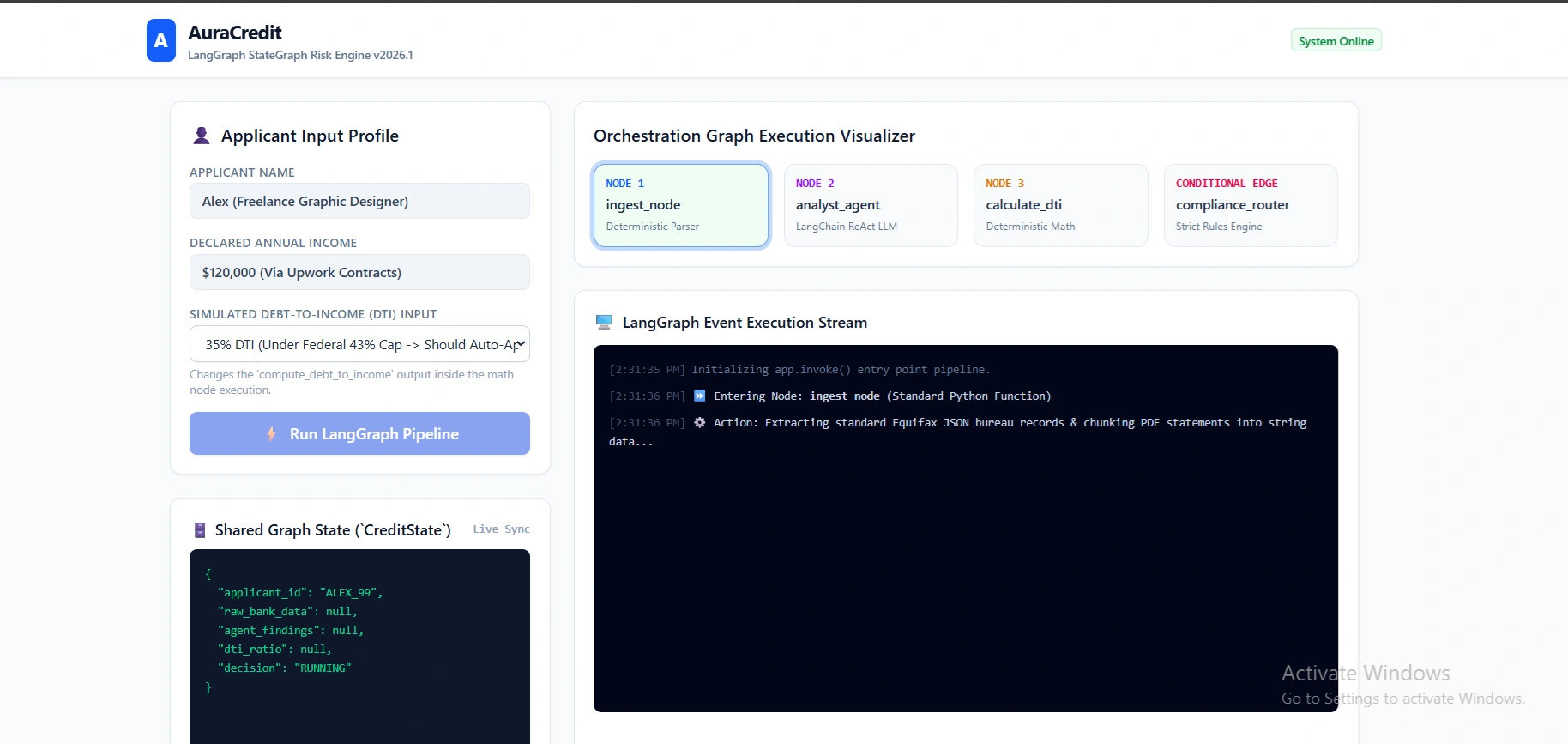
app.invoke({"applicant_id": "ALEX_99", "raw_bank_data": "..."})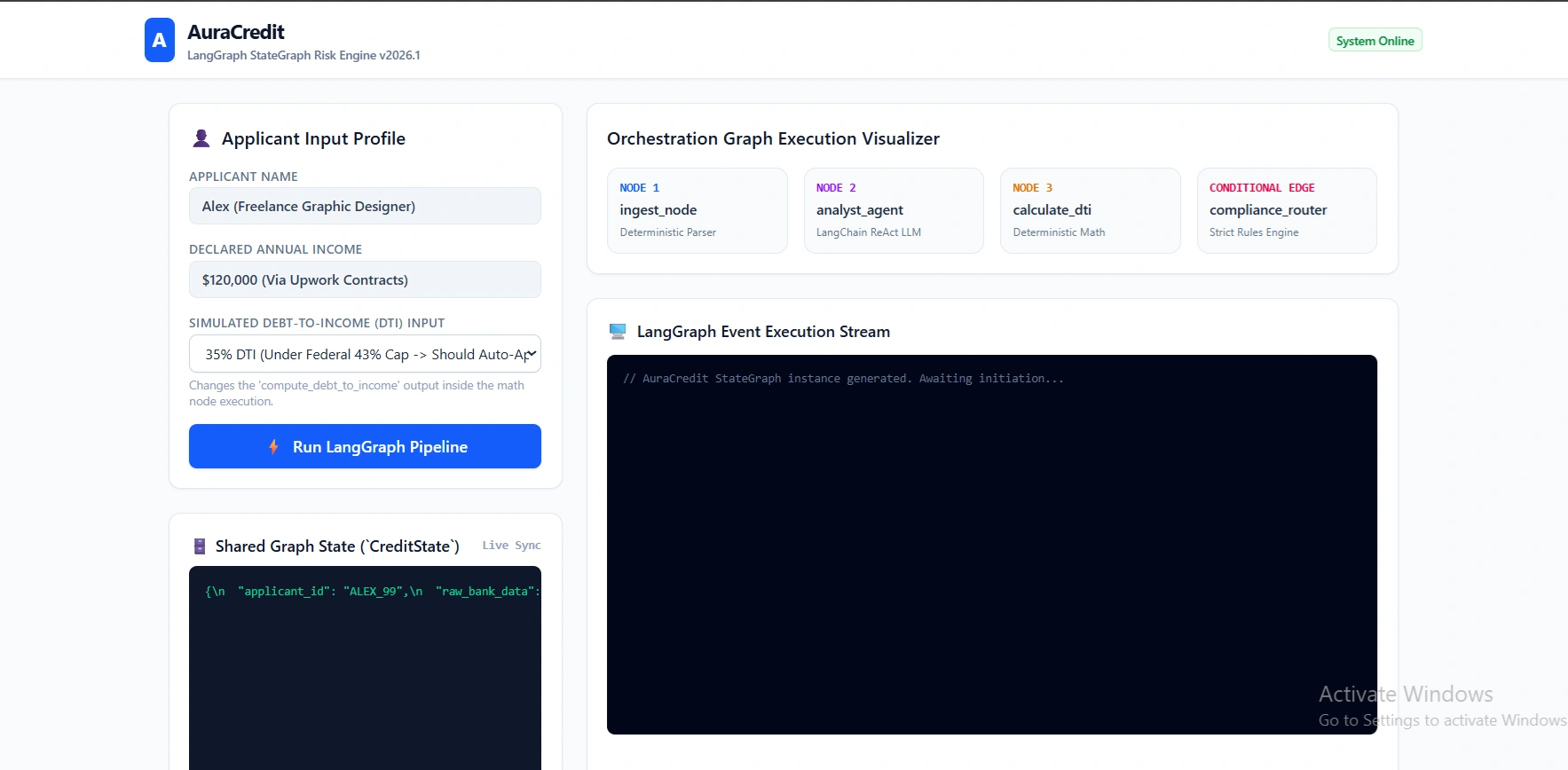
Why This Distinction Matters for Fintech
If we had just used a standalone LangChain Agent for the entire credit scoring process, Alex’s application would have been a disaster.
| Feature | Pure LangChain Agent | LangGraph (Nodes + Agent) |
|---|---|---|
| Control Flow | LLM decides the next step blindly. | Graph dictates the flow; LLM only decides within its designated node. |
| Math & Logic | LLM attempts math (high hallucination risk). | Handled by deterministic Python nodes (100% accurate). |
| Cost & Latency | Agent loops endlessly, racking up API costs. | Strict boundaries limit LLM calls to only where unstructured reasoning is needed. |
| Auditability | "The Agent decided to approve." (Black box) | "Node 1 ingested, Node 2 analyzed, Node 3 passed compliance." (White box) |
| Human-in-the-Loop | Very difficult to pause and resume. | Native support for interrupt nodes (e.g., pausing for manual underwriter review). |
The Takeaway
In the modern AI engineering landscape, LangChain Agents provide the intelligence, but LangGraph Nodes provide the reliability.
When building our credit scoring application, we stopped asking "How can we make the Agent smarter?" and started asking "Where in the workflow do we actually need an Agent, and where do we just need a deterministic Node?"
By treating the Agent as a specialized tool within a broader, node-based graph, we can harness the power of LLMs to understand the messy, unstructured reality of gig-economy finances, while maintaining the ironclad determinism required by financial regulators.
Join the conversation! Your thoughts help the community grow.