

Abstract / Overview
The “Stock Research Agent v3” (an initiative posted by LangChain on LinkedIn) is an advanced AI system built around multi-agent architectures using LangChain’s agent frameworks (including LangGraph and LangSmith). The system is designed for comprehensive stock research: retrieving data, analysing fundamentals, sentiment, and technicals, and producing actionable insights. This article outlines its conceptual background, architecture, step-by-step how such an agent works, use cases for AI trainers and project managers (like you), limitations, fixes, FAQs, and a publishing checklist for documenting or presenting it.
Conceptual Background
What are LangChain, LangGraph & LangSmith?
LangChain: an open-source framework for building LLM-powered applications and agents. (LangChain)
LangGraph: a framework (by LangChain Inc) for orchestrating multi-agent workflows, stateful agents, and graph-based task flows. (LangChain)
LangSmith: a platform for observability, evaluation, and deployment of agentic workflows. (LangChain)
“Deep Agents”: A term used by LangChain to describe agents capable of planning long tasks, using sub-agents, and executing deeper reasoning. (LangChain Blog)
Why multi-agent systems for stock research?
Stock research involves multiple dimensions: market data, fundamentals, sentiment, technicals, risk, and strategy. A single monolithic model struggles to reason across all. Multi-agent architecture allows specialization, modularity, clearer reasoning, and scalability. LangGraph docs highlight that multi-agent systems allow splitting work into specialized agents (e.g., “planner”, “researcher”, “math expert”) instead of one agent doing everything. (LangChain Docs)
What does “Stock Research Agent v3” imply?
Based on the LinkedIn post by LangChain (via their company page) about "Stock Research Agent V3 (made by the LangChain community) – an AI platform transforming financial research, leveraging LangGraph and LangSmith for agent ...” (LinkedIn)
We infer that:
It is version 3 of a stock research agent (so earlier versions existed)
Built by the community (open or community-sourced components)
Uses LangChain frameworks (LangGraph, LangSmith)
Designed to transform financial research (stock analysis)
Step-by-Step Walkthrough
Here’s a generalised workflow of how such an agent would work. (Note: you’ll have to adapt to your market/region, e.g., India/NSE, given your location.)
1. Define the workflow and architecture
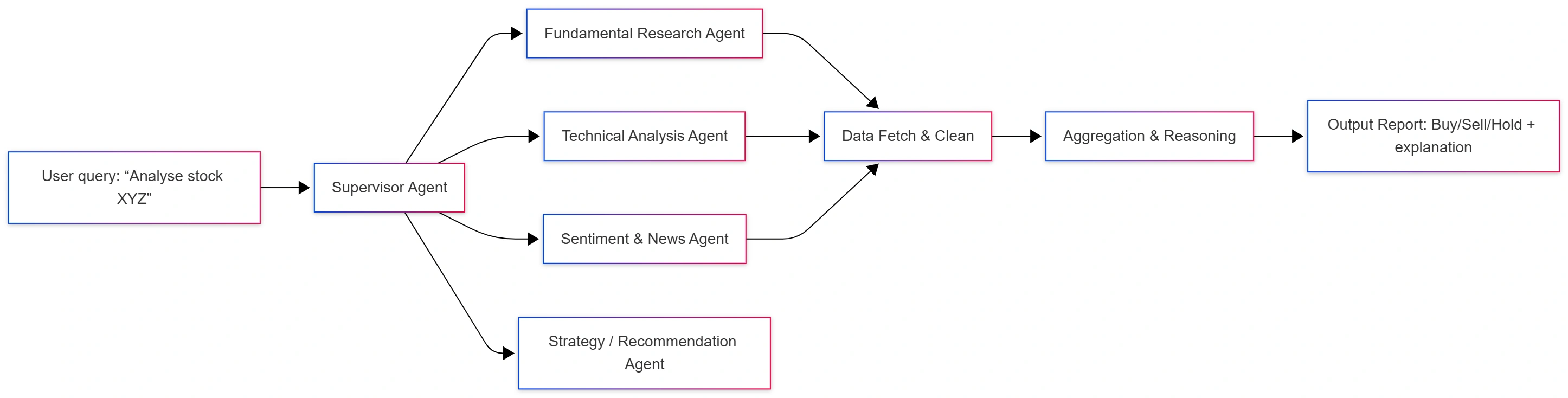
2. Agent roles and tasks
Supervisor Agent: Coordinates the sub-agents, routes tasks, ensures consistency, and handles human-in-the-loop if needed.
Fundamental Research Agent: Fetches balance sheet, income statement, cash flows, and computes ratios (P/E, ROE, debt/equity).
Technical Analysis Agent: Pulls price series, computes moving averages, RSI, MACD, support/resistance, etc.
Sentiment & News Agent: Scrapes recent news, social media chatter, sentiment classification (positive/negative/neutral), and identifies catalysts.
Strategy / Recommendation Agent: Ingests results of previous agents and produces an actionable recommendation (e.g., Buy / Hold / Sell), with target price, stop-loss, risk/reward.
3. Tool integrations & data sources
Connect to stock market APIs (YahooFinance, AlphaVantage, local exchanges) for data.
Connect to news APIs / RSS / social media for sentiment.
Use vector search, embeddings for news summarization.
Use the LangChain tool-calling and memory patterns for data persistence.
Use LangSmith for observability: trace what each agent did, how many tokens were used, and performance. (LangChain Blog)
4. Implementation snippet (Python pseudo-code)
from langchain import Agent, Tool
from langgraph import GraphWorkflow, Node

# Define tools
fetch_financials = Tool(name="fetch_financials", func=...)
fetch_price_series = Tool(name="fetch_price_series", func=...)
fetch_news = Tool(name="fetch_news", func=...)

# Define sub-agents
fund_agent = Agent(name="FundamentalAgent", tools=[fetch_financials], prompt="Analyze fundamentals of {symbol}")
tech_agent = Agent(name="TechnicalAgent", tools=[fetch_price_series], prompt="Analyze technicals of {symbol}")
sent_agent = Agent(name="SentimentAgent", tools=[fetch_news], prompt="Analyze sentiment for {symbol}")

# Define supervisor node
def supervisor(task):
    symbol = task["symbol"]
    fund_res = fund_agent.run(symbol=symbol)
    tech_res = tech_agent.run(symbol=symbol)
    sent_res = sent_agent.run(symbol=symbol)
    # pass results
    rec = recommendation_logic(fund_res, tech_res, sent_res)
    return rec

sup_agent = Agent(name="SupervisorAgent", tools=[fund_agent, tech_agent, sent_agent], prompt="Coordinate stock research for {symbol}")

workflow = GraphWorkflow(nodes=[fund_agent, tech_agent, sent_agent, sup_agent], edges=[...])
result = workflow.run(symbol="AAPL")
This is illustrative; you would embed memory, branching logic, tool calling, error-handling.
5. Output & User interface
Final report: stock symbol, date, summary: fundamentals strengths/weaknesses, technical trend, sentiment snapshot.
Recommendation: e.g., “Buy with target ₹X, stop-loss ₹Y, horizon 3-6 months”.
Explanation of reasoning.
Possibly an interactive dashboard (Streamlit/Gradio) showing charts, tables.
Use-Cases / Scenarios
For Web3 & AI training: You can use this architecture to teach how to build agentic workflows for finance.
For project managers: Use as blueprint for managing AI project that delivers automated equity research reports.
For Indian markets: Adapt the agent to Indian exchanges (BSE/NSE), local news, and local language sentiment.
For enterprise: Firms providing financial research services can deploy such agents to scale coverage and reduce manual work.
Limitations / Considerations
Data quality: Agent is only as good as the underlying data (financials, news). Incomplete or bad data leads to poor recommendations.
Market risk: AI-generated recommendation is not a guarantee of profit—markets are unpredictable. Consider disclaimers.
Over-reliance on LLMs: Agents use large language models, which may hallucinate or misinterpret. Need human oversight, especially for high-stakes finance.
Compliance/regulation: Financial advice is regulated in many jurisdictions; using AI to issue recommendations may raise legal issues.
Explainability: Even with a multi‐agent structure, reasoning may be opaque; it needs logging and a “why decision made” trace for trust.
Cost: Running many agents, calls to LLMs, and data APIs may become expensive. Observability (via LangSmith) is crucial to monitor cost.
Fixes (common pitfalls + solutions)
Pitfall: Agent uses stale data. Solution: Implement data freshness checks, versioning of fetched data.
Pitfall: Agents contradict each other (technical vs fundamental). Solution: Supervisor agent should have conflict resolution logic, a weighting scheme (e.g., fundamentals 60 %, technical 40 %).
Pitfall: Model hallucination in the sentiment agent. Solution: Add guardrails, human-in-loop verification, threshold for confidence before making a recommendation.
Pitfall: Token usage spirals and costs escalate. Solution: Use LangSmith observability to monitor token usage, set budget caps per run, and optimise prompts. (LangChain Blog)
Pitfall: Local market context ignored (e.g., Indian regulation). Solution: Tailor data sources and prompts for regional context; train domain-specific modules.
FAQs
Q1. Can I build this for the Indian stock market (NSE/BSE)?
Yes. Replace data sources (utilize Indian exchange APIs), adjust prompts for INR, and incorporate local news in Hindi/English, as well as adapt to multiple currencies and market specifics.
Q2. Do I need to fine-tune models?
Not necessarily. Many templates work with pre-trained LLMs via LangChain. But for high-accuracy domain work, you might fine-tune or add retrieval from domain-specific data.
Q3. What models are supported?
LangChain supports many LLMs (OpenAI, Anthropic, etc). The agent architecture is model-agnostic. (LangChain)
Q4. How do I evaluate performance?
Utilize LangSmith evaluation features to track metrics such as prediction accuracy versus actual outcomes, token usage, and run A/B tests of prompts—improving over time.
Q5. Is this turnkey?
No. “Stock Research Agent v3” is a framework/initiative—not a plug-and-play product. You still need to engineer data pipelines, agent logic, integrate models, and test.
References
LangChain documentation and product site. (LangChain)
Multi-agent patterns in LangChain docs. (LangChain Docs)
Deep Agents blog by LangChain. (LangChain Blog)
Building a multi-agent system for financial market analysis. (Analytics Vidhya)
Conclusion
The “Stock Research Agent v3” from LangChain represents a significant step in applying agent-based AI to financial analysis. For a trainer in Web3 & AI or project manager (like yourself), it offers a clear blueprint: define agent roles, orchestrate via LangGraph, monitor and optimise via LangSmith, and adapt to your regional context. It is not a silver bullet—data, compliance, cost, and domain-specific tuning matter. But it is a robust architecture to build on.
Join the conversation! Your thoughts help the community grow.