
Problem Statement
We have one enterprise healthcare application that is being used worldwide for teleconsultations. The main drawback of this application is that it is not that suitable for patients with limited English proficiency/ visual disabilities/ hearing disabilities. They are struggling to understand diagnoses, treatment options, and instructions. It would have been better if we had some language translation/voice-to-text conversion kind of capabilities so that the patients would be able to communicate with doctors and the doctors would be able to share the diagnosis and the instructions irrespective of the language barriers.
Solution
Integrate Azure Speech Service with speech recognition capabilities to provide real-time language interpretation/translation/recognition during healthcare consultations. This allows for seamless communication between patients and medical professionals, regardless of their native language.
Areas need speech service capabilities
For common patients
- Patients' voices should be converted to the language chosen by the doctors.
- Doctors' instructions should be converted back to the patient's language.
- Doctors' instructions should be documented.
Special requirements for patients with visual disabilities
- All the diagnoses, treatment options, and instructions should be documented and shared in audio format.
- Patients should get audio instructions on how to use the application.
Special requirements for patients with hearing disabilities
- All the diagnoses, treatment options, and instructions should be documented and shared in visual/text format.
- Patients should get visual / text instructions on how to use the application.
The benefit of using speech service capabilities
- Better communication between patients with limited English proficiency/ visual disabilities/ hearing disabilities and doctors: Medical information and instructions can be shared with more clarity and accuracy.
- Reduced anxiety: Eliminates stress and frustration associated with language barriers.
- Enhanced patient care: Doctors will be able to make better decisions and adherence to treatment plans.
- Increased accessibility: Expands healthcare access to all categories of patients.
Azure speech service, which can help us to achieve the above
Below are the details about Azure speech service, which can help us achieve the above.
Azure Speech Service
In today's fast-paced world, communication is more crucial than ever. We interact with devices, services, and each other.
Azure Speech Recognition, a cloud-based service from Microsoft, empowers us to seamlessly integrate speech recognition capabilities into their applications, enabling users to control devices, transcribe conversations, and access information with the power of their voice.
Speech Service Capabilities
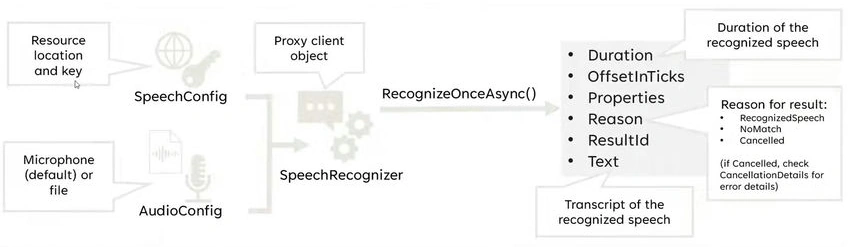
- Speech-to-text: Use speech-to-text to transcribe audio into text, either in real-time or asynchronously with batch transcription. Convert audio to text from a range of sources, including microphones, audio files, and storage.
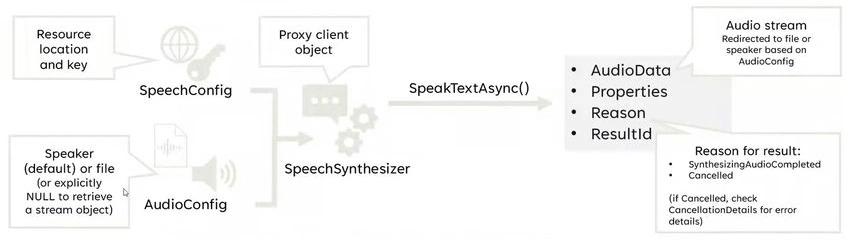
- Text-to-speech: With text-to-speech, you can convert input text into humanlike synthesized speech. Use neural voices, which are humanlike voices powered by deep neural networks. Use theSpeechSynthesis Markup Language (SSML)to fine-tune the pitch, pronunciation, speaking rate, volume, and more.
- Batch transcription: Batch transcription is used to transcribe a large amount of audio in storage. You can point to audio files with a shared access signature (SAS) URI and asynchronously receive transcription results. Use batch transcription for applications that need to transcribe audio in bulk, such as transcriptions, captions, or subtitles for pre-recorded audio.
- Speech translation: Speech translation enables real-time, multilingual translation of speech to your applications, tools, and devices. Use this feature for speech-to-speech and speech-to-text translation.
- Language identification: Language identification is used to identify languages spoken in audio when compared against a list of supported languages. Use language identification by itself, with speech-to-text recognition, or with speech translation.
- Speaker recognition: Speaker recognition provides algorithms that verify and identify speakers by their unique voice characteristics. Speaker recognition is used to answer the question, "Who is speaking?".
- Intent recognition: Use speech-to-text with conversational language understanding to derive user intents from transcribed speech and act on voice commands.
Speech service SDK
This will help us to implement Azure speech service with our application.
The Speech SDK exposes many of the Speech service capabilities so you can develop speech-enabled applications.
The Speech SDK is available in many programming languages and across platforms.
It supports 8 languages, including C#, Python & Java.
The Speech SDK is ideal for both real-time and non-real-time scenarios, by using local devices, files, Azure Blob Storage, and input and output streams.
Speech to Text – High-Level Diagram
Text to Speech – High-Level Diagram
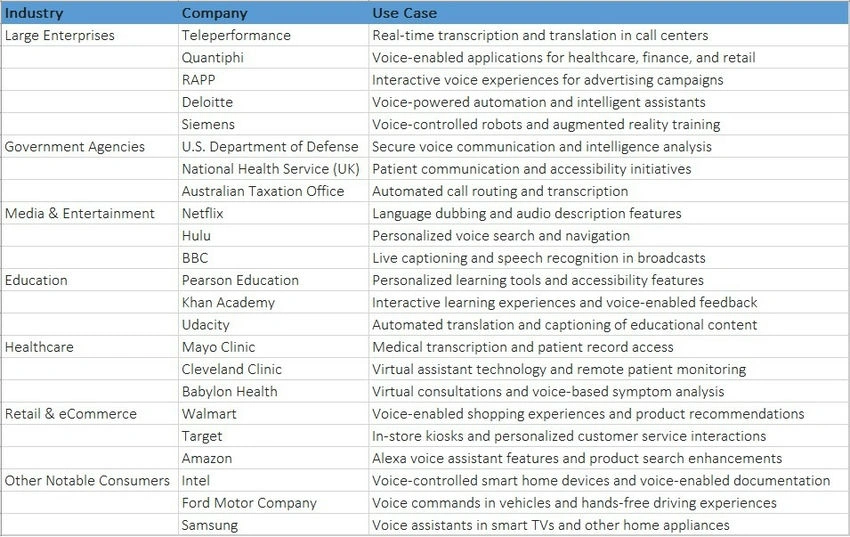
Consumers of Azure Speech service
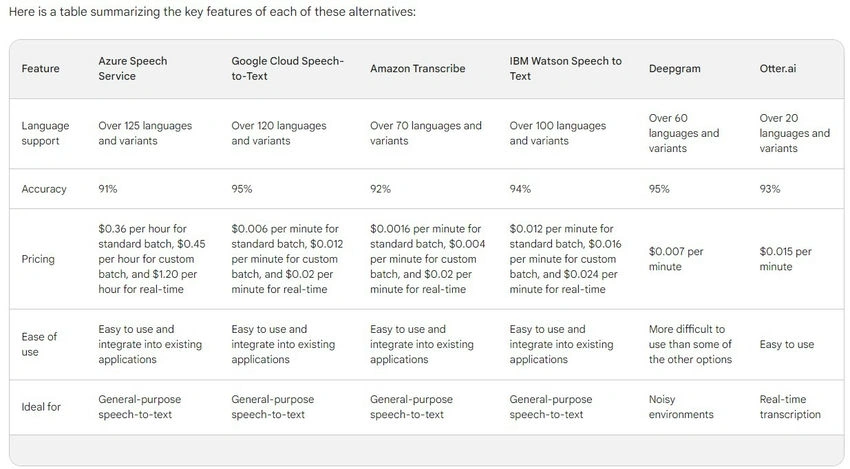
Azure speech service vs. other speech service
There are several alternatives to Azure Speech Service, each with its own strengths and weaknesses. Some of the most popular alternatives include.
Conclusion
By leveraging Azure Speech Service for real-time language interpretation and other speech recognition capabilities, healthcare providers can bridge communication gaps and deliver culturally competent care to a wider range of patients. This fosters a more inclusive healthcare system where everyone receives the best possible care, regardless of their language background.
References
- Speech Service Overview: https://learn.microsoft.com/en-us/azure/ai-services/speech-service/overview
- Code Samples: https://github.com/Azure-Samples/cognitive-services-speech-sdk
- Pricing: https://github.com/Azure-Samples/cognitive-services-speech-sdk
- Quotas and limits: https://learn.microsoft.com/en-us/azure/ai-services/speech-service/speech-services-quotas-and-limits
- Supported regions: https://learn.microsoft.com/en-us/azure/ai-services/speech-service/regions
- Language and voice support: https://learn.microsoft.com/en-us/azure/ai-services/speech-service/language-support?tabs=stt
Join the conversation! Your thoughts help the community grow.