

Today I came across a LINQ method, DefaultIfEmpty(), which is quite similar to the Left Join of SQL.
DefaultIfEmpty works like a left join and gives all the records from the left table including the matching records from the right table. Use DefaultIfEmpty<TSource>(IEnumerable<TSource>) to provide a default value in case the source sequence is empty.
For more information about DefaultIfEmpty(), please have a look into this link: http://msdn.microsoft.com/en-us/library/bb397895.aspx
Kindly look into the code given below:
using System;
using System.Collections.Generic;
using System.Linq;
using System.Text;
namespace LINQ_IfByDefault
{
//Class Employee having two properties
class Employee
{
public string Name { get; set; }
public string EmpID { get; set; }
}
//Class Worker having two properties
class Worker
{
public string WId { get; set; }
public string City { get; set; }
}
class Program
{
static void Main(string[] args)
{
//Object Initialization for Employee class
List<Employee> objEmployee = new List<Employee>{
new Employee{ Name="Sachin",EmpID="I001"},
new Employee{ Name="Vijay",EmpID="I002"},
new Employee{ Name="Ashish",EmpID="I003"},
new Employee{ Name="Syed",EmpID="I004"},
new Employee{ Name="Ravish",EmpID="I005"},
};
//Object Initialization for Worker class
List<Worker> objWorker = new List<Worker>{
new Worker{ WId="I001",City="Delhi"},
new Worker{ WId="I002",City="Haridwar"},
new Worker{ WId="I007",City="Roorkee"},
new Worker{ WId="I008",City="Amritsar"},
new Worker{ WId="I009",City=""},
};
//using of DefaultIfEmpty method provided by LINQ
var resultDefaultIfEmpty = from emp in objEmployee
join worker in objWorker on emp.EmpID equals worker.WId into ResultEmpWorker
from output in ResultEmpWorker.DefaultIfEmpty()
select new
{
EmployeeName = emp.Name,
City = output!= null ? output.City : null
};
Console.WriteLine(string.Join("n", resultDefaultIfEmpty.Select(emp => " Employee Name = " +
emp.EmployeeName + ", City Name = " + emp.City).ToArray<string>()));
Console.ReadLine();
}
}
}
I have also observed a few things which may be a bit beneficial for you; whilst working with defaultifempty, the line in the above code segment:

The output variable contains only records from the right side list of the Join Clause; in our case it is Worker List: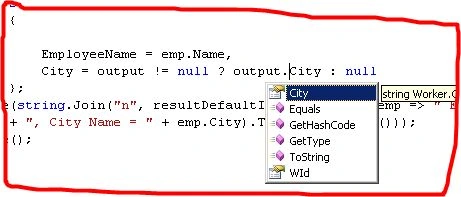
Please have a look into how DefaultIfEmpty() works.
Your thoughts are highly appreciated.
Keep Coding.
Join the conversation! Your thoughts help the community grow.