

Introduction
Artificial Intelligence has quickly become part of everyday digital life. Tools like ChatGPT, Gemini, and Claude have shown the world how powerful Large Language Models can be. But there is one assumption most people still make — that AI always needs the internet.
Until recently, that was true.
Today, a new shift is happening in AI architecture:
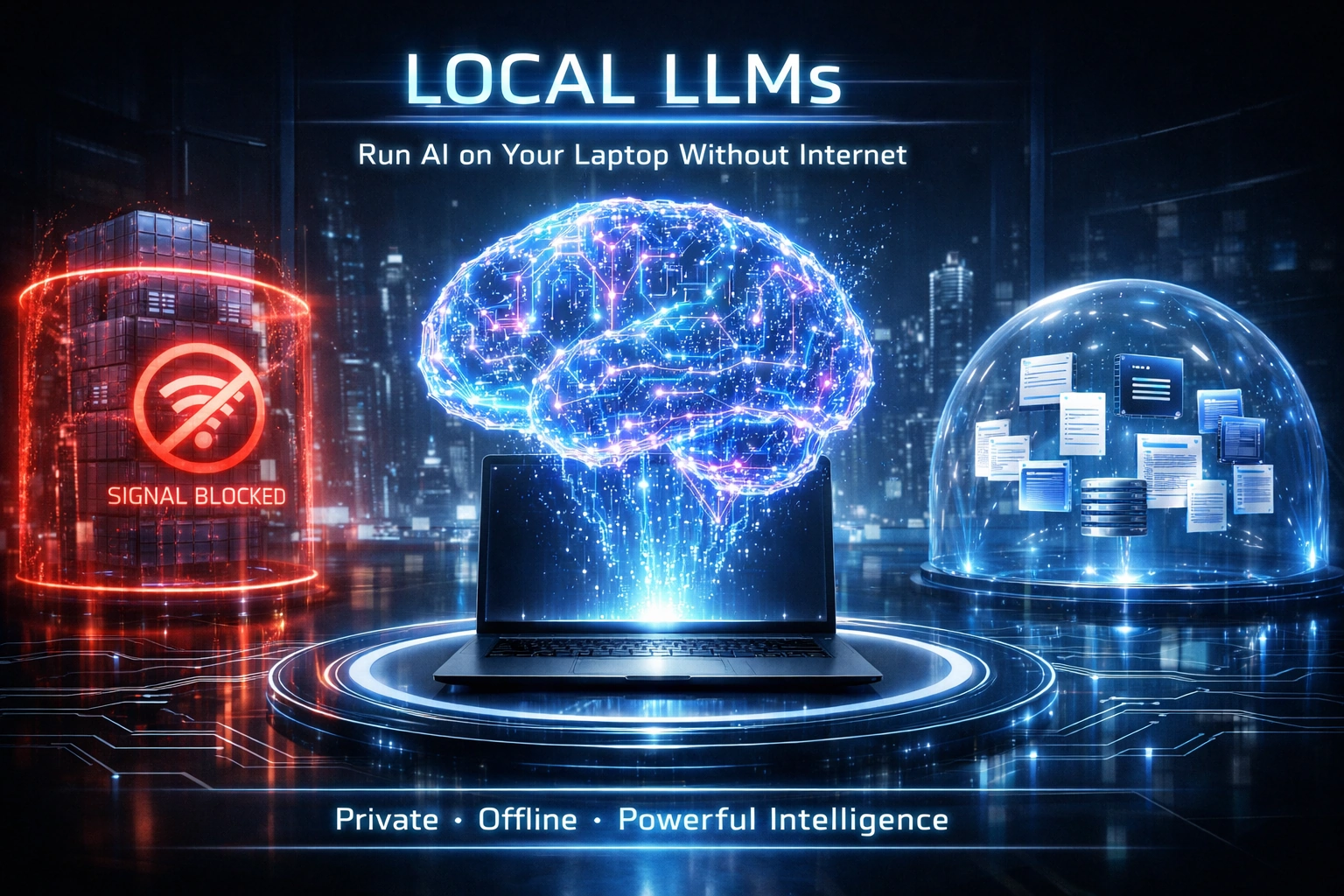
Local LLMs — Artificial Intelligence that runs directly on your own laptop, without cloud servers or internet connectivity.
This evolution is changing how developers, enterprises, and privacy-conscious users think about AI.
The Current Cloud-Based AI Model
Most popular AI tools today operate on cloud infrastructure. When you type a prompt into ChatGPT or any similar tool, your request travels to remote servers where the AI model processes your query and returns a response.
This approach offers high performance, but it comes with trade-offs:
• Continuous internet dependency
• User data sent to external servers
• Monthly subscription or API usage costs
• Potential privacy and compliance concerns
For casual use, this is acceptable.
But for businesses handling sensitive data, researchers working with confidential information, or developers building internal tools, this model introduces risk.
This is where Local LLMs enter the picture.
What Exactly is a Local LLM?
LLM stands for Large Language Model.
A Local LLM is simply an LLM that runs directly on your personal device — laptop or desktop — instead of a cloud server.
You download the model once.
You run it locally.
All processing happens on your machine.
No internet.
No external servers.
No data sharing.
Popular Local LLM models include:
• LLaMA
• Mistral
• Phi
• Gemma
• Falcon
With the rise of optimization techniques, these models can now run efficiently on consumer-grade hardware.
How Local LLMs Work in Practice
Running a Local LLM typically follows this flow:
You install a local LLM runtime tool such as Ollama, LM Studio, or GPT4All.
You download a chosen open-source model.
The model loads into your system memory.
All prompts and responses are processed locally.
From the user perspective, it feels just like using ChatGPT — except everything runs privately on your own device.
Why Local LLMs Matter
The impact of Local LLMs goes far beyond hobby experimentation. They solve three major limitations of cloud AI:
1. Data Privacy
Your prompts, documents, and internal company data never leave your device.
This is critical for:
• Enterprises handling confidential records
• Legal and medical applications
• Research environments
• Personal data protection
2. Cost Control
Cloud AI comes with recurring subscription or API costs.
Local LLMs require only one-time hardware investment.
No monthly billing. No usage fees.
3. Independence
No reliance on external servers.
No downtime issues.
No geo-restrictions.
AI works anywhere — even without internet access.
Real-World Use Cases
Local LLM adoption is growing rapidly in professional environments.
Enterprise Internal Assistants: Companies deploy Local LLMs to build internal knowledge bots that can read private documents without risking data leaks.
Coding Assistants: Developers run local AI coding helpers to generate code suggestions without exposing proprietary source files to external APIs.
Offline Research: Researchers use Local LLMs to analyze documents, notes, and datasets without internet dependency.
AI Agents: Personal AI agents running locally help manage tasks, summarize content, and automate workflows — fully private.
System Requirements
Running Local LLMs is now easier than ever.
Typical setup:
• Laptop or desktop computer
• Minimum 16GB RAM
• SSD storage for model files
• Optional GPU for faster performance
Modern tools like Ollama and LM Studio handle setup with minimal technical effort.
Why Developers Should Learn Local LLMs
For AI developers, Local LLMs represent an emerging industry standard.
Enterprises are increasingly asking for:
• Privacy-first AI architectures
• On-device inference pipelines
• Hybrid cloud + local AI deployments
• AI systems that meet data compliance regulations
Understanding Local LLM deployment is quickly becoming a must-have system design skill.
The Future of AI is On-Device
The next phase of AI evolution is clear:
• AI assistants embedded in laptops
• Offline corporate AI tools
• Personalized private AI companions
• Reduced dependency on cloud monopolies
AI will not disappear from the cloud —
but ownership of AI is moving back to the user.
Final Thoughts
Cloud AI introduced intelligence to the world.
Local LLMs introduce privacy, ownership, and independence.
Running AI on your own machine is no longer experimental.
It is the next foundational layer of modern AI systems.
AI that works for you — not for someone else's server.
Join the conversation! Your thoughts help the community grow.